Source: Beartracks 2026 Issue 1, Jared Yates
As we know, our airplanes don’t get “Annuals”, they get yearly Condition Inspections. The way it has always been, if we build an airplane with an Experimental/Amateur-Built (E/AB) airworthiness certificate, the builder could apply for a Repairman’s Certificate under 65.104. The holder of a certificate of that type could complete the condition inspection for that specific airplane, listed by registration number, even if the repairman no longer owned the airplane. In my case, the repairman certificate for our first Bearhawk isn’t good for much at all, since the plane was destroyed in a fire. When we had the good fortune to purchase a completed and flying Bearhawk from our friend Mark to replace the first one, I was not eligible for a 65.104 Repairman certificate, complicating my yearly Condition Inspection needs.
This year at Airventure when the new MOSAIC rules were announced, a very nice bonus regulatory change came along in the package. A person who owns an E/AB airplane could obtain a Light Sport Repairman’s Certificate with an Inspection rating under 65.107, and then that person could perform the Condition Inspection on any E/AB airplane that he owns. Notably, this isn’t just the newly-classified Light Sport airplanes, but any homebuilt, regardless of its performance capabilities. Also, while the Repairman must own the plane to do the inspection, any future planes that he purchases are also eligible for a Condition Inspection, without any additional classes. Before Oshkosh was over, I was in contact with Carol Carpenter at Rainbow Aviation to get myself into one of the 16-hour weekend classes so I could obtain the LSR-I certificate. I wasn’t alone, and Carol said her phone was ringing off the hook. In short order we secured the next open travelling slot and our local EAA Chapter 731 hosted the class in North Carolina in November 2025.
The class itself was still mostly oriented towards the type of airplanes that we used to call LSAs, with Rotax engines and sail cloth covering. I did learn some things though, and most importantly, I got the completion certificate for the course and forwarded it to my local FAA FSDO. Unfortunately, the “big” FAA had not yet issued guidance to the local FAA guys about how to issue these certificates, so we entered a brief holding pattern. In early 2026 the guidance finally came along and I was able to obtain the certificate, but I wasn’t quite done yet.
As we know, our E/AB airplanes have “Operating Limitations” that are issued along with the Airworthiness Certificate. Back a few years ago, the FAA combined these two papers into a single document, with the certificate on the first page, and the Operating Limitations language starting right below that. I had gone through the process of updating these documents right after we acquired our second Bearhawk, mainly to update the Phase 1 testing area to its new home in North Carolina, instead of Texas, and to enable transition training. Those operating limitations specifically listed that the Condition Inspection could only be completed by a 65.104 Repairman or by an A&P Mechanic. Most folks will have this language in theirs too, and to be able to complete the Condition Inspection as an LSR-I, we need to have a new Airworthiness Certificate issued again, along with the corresponding new Operating Limitations language.
As it was with the Repairman Certificate, when it came to the Airworthiness Certificate, the “big” FAA had not yet issued guidance to the local FSDO guys about how to execute the update, so I entered another brief holding pattern. Once the guidance was finally released, I had to log in to the FAA’s AWC portal and request a new Airworthiness Certificate, just as a builder of a new Bearhawk would today. This process is similarly tedious to applying for an Airman Certificate using IACRA. It requires some meticulous attention to detail to complete the fields and make sure everything is correct. Thankfully I was assigned a very accommodating and patient FSDO inspector, and together we made it through the process and got the new certificate with the new language.
If you find yourself in a similar situation of owning a homebuilt that you didn’t build, I would highly recommend this process. The weekend course makes you eligible for the LSR-I which allows you to inspect planes, but only while you own them. If time and money are less limited, you can also opt for a longer two-week course, which gets you the LSR-M Maintenance rating. This Maintenance rating allows you to complete the Condition Inspection on planes belonging to others, even on a commercial basis. This is a big rule change compared to the previous requirement to have a full A&P certificate for this kind of work. A two week class is still nowhere near as long as an A&P program. I’m glad to see this regulatory relaxation, and I hope all the folks who get the certificate are able to operate responsibly and within their personal limits, so that maybe we can convince the FAA to give us more freedom and responsibility in the homebuilt world.
Bob’s October 2025 Fly-in, Walkaround Details of N61XB
Source: 2025 Q4 Beartracks, Jared Yates
The weather was perfect for this year’s fly-in picnic at Bob’s airport in Fincastle, Virginia. We arrived by plane to find several other Bearhawkers already in position. John Bickham won the award for flying the farthest, by coming from New Mexico with 13.9 hours of flight time. This was my first opportunity to see his plane, N61XB, and it didn’t disappoint. He was up to around 760 hours total time since his first flight in 2020, but the airframe didn’t show the age. For this trip he left out the back seat, though he does have one he can put in for the grandkids. Around 74 hours prior, he installed a new set of Millenium cylinders, due to one cylinder having a cracked exhaust valve guide. His oil consumption has dropped from a quart in 4-5 hours to a quart every 14 hours. The wings and landing gear are from the kit factory, and the fuselage is scratch built. John devised an interesting lift mechanism that allows him to raise the tail of the airplane when he is camping. This makes sleeping in the plane more comfortable.
Bearhawk LSA builder Sam Scott was in town from the North Carolina Piedmont, along with his very experienced building buddy. Stephen and Monica Murphey, also LSA builders, drove up from South Carolina. Repeat-builder Roy Glenn drove in from central Tennessee, and Ray Gabriel from Wisconsin also drove in. Carlo Cilliers and Todd Stock flew in with Carlo’s Aircam. They were planning to transport some parts and materials home and the Aircam was well-suited to carry them. It wasn’t especially fast though, and they had to leave fairly soon after lunch to make it back to FDK before dark. Carlo’s Patrol is getting close to flying, and Todd is following behind with a second Patrol build. LSA builders Chuck Calvi and his buddy Mack drove in. Chuck’s plane has about 26 hours on it, so hopefully we’ll get to see it fly in next year.
It was also good to see Tim Weaver with his blue and white Bearhawk LSA, in from Pennsylvania.
Several of Bob’s local EAA friends were also there. Pilot and mobile A&P Hiram Leon of the New River EAA Chapter brought his young girls. He’s on track to be a Bearhawk builder though he might not know it yet. Bob’s grandson Erin Terry was there with his two very young children (Bob’s great grandchildren), the youngest being a practically-new 2025 year model baby. Our daughters had a great time playing with those two and with Hiram’s kids as well.
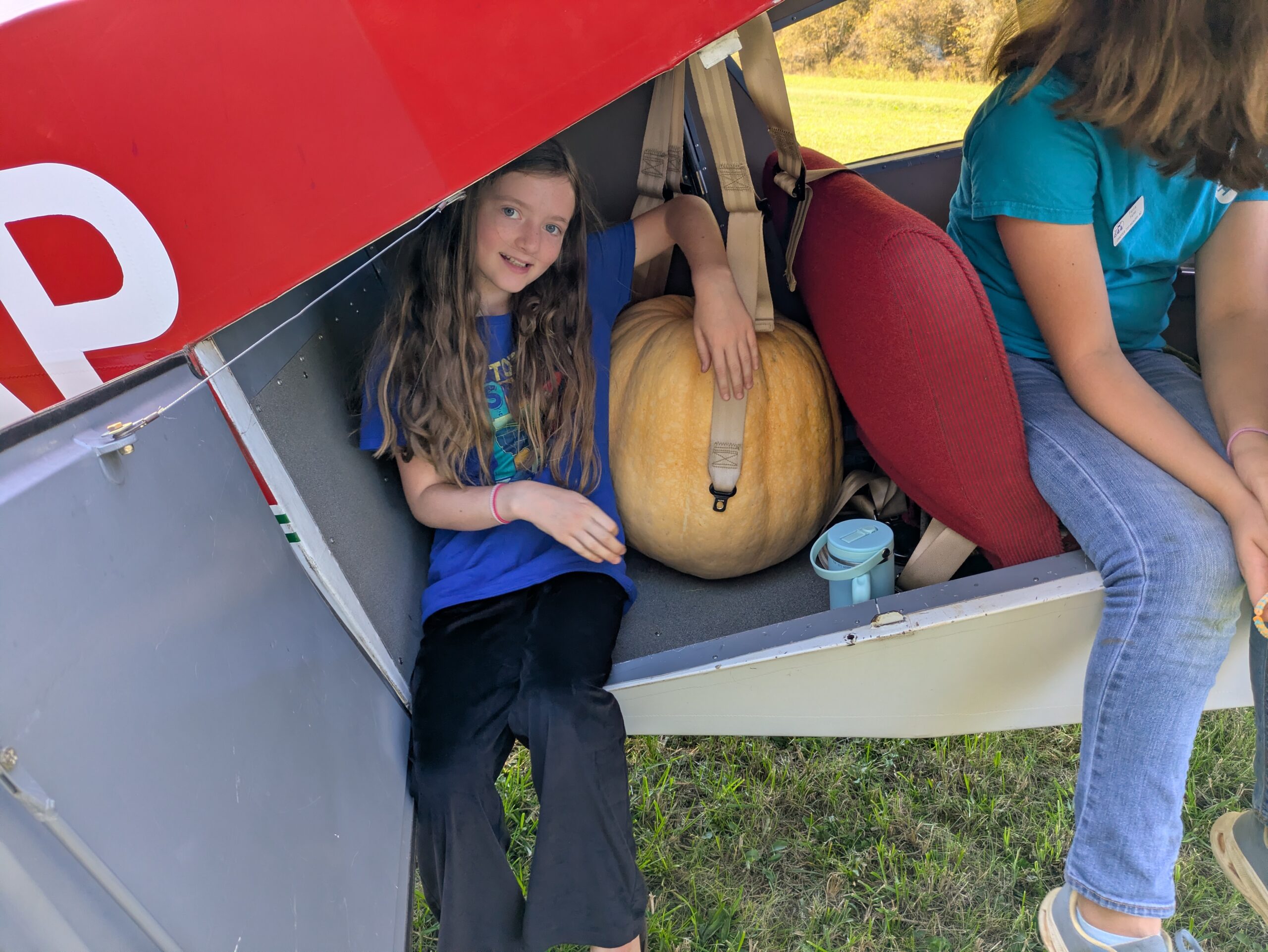
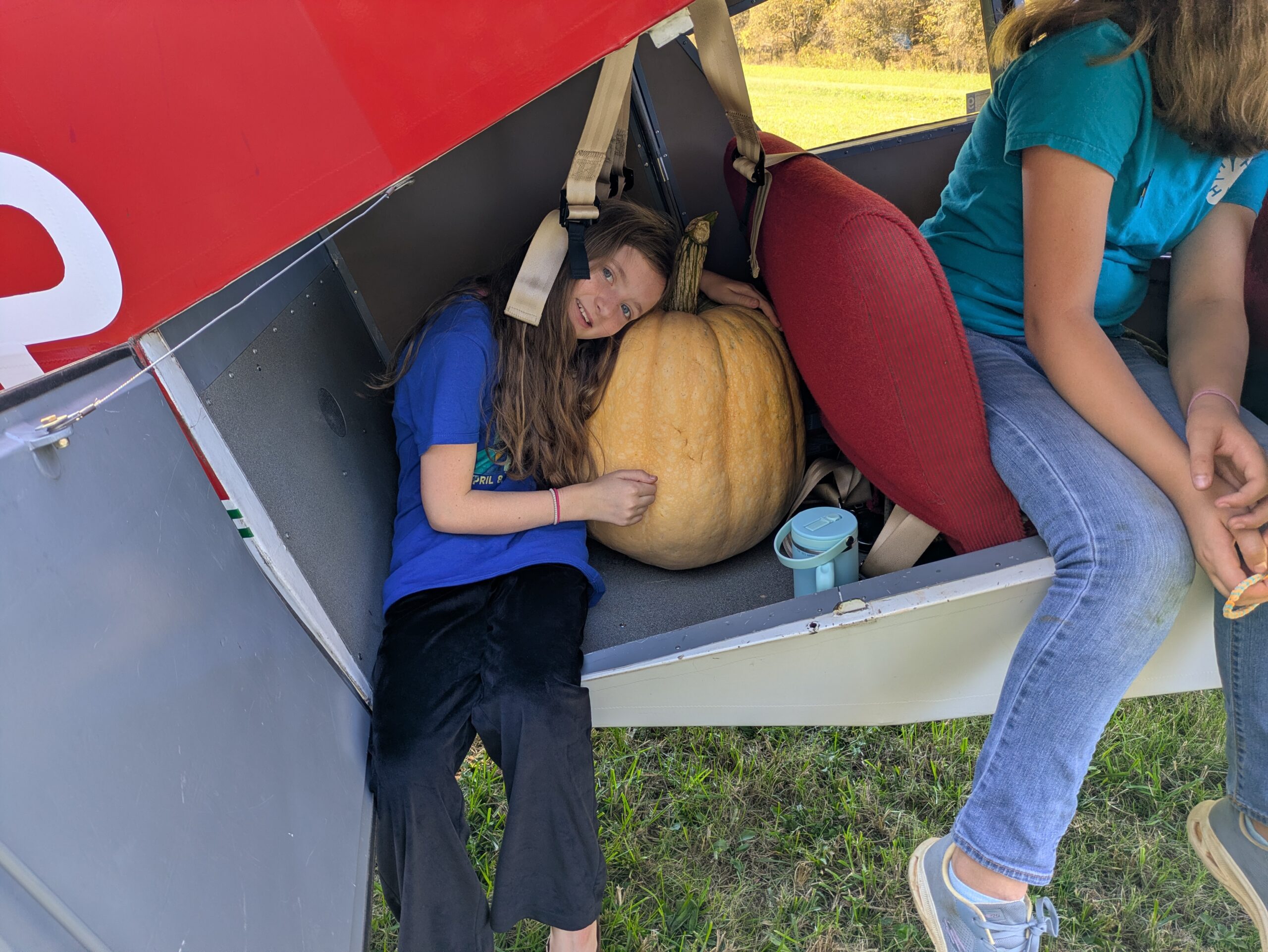
Bearhawk builder and owner Chuck Morris drove in from Michigan. Chuck usually brings some produce from his farm, and this year it was pumpkins. He offered that we should take one home, and our 11-year-old daughter Sarah thought that was an excellent plan. These were not small pumpkins. Knowing that our cargo capacity is large, but yet finite, I proposed that if Sarah could carry a pumpkin across the runway to our plane, then we could take it. A few minutes later, Sam was carrying a giant pumpkin across the runway, having undoubtedly been the victim of our young con artist. We didn’t have a scale, but I don’t think it was more than 80 pounds or so.
Overall it was a fantastic way to spend a day. We got to see Bob’s brown and white completed Companion all put together. We are thankful for Bob and Diana’s hospitality!