Bob’s Companion Project Update – Fall 2024
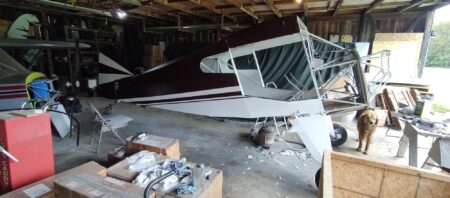
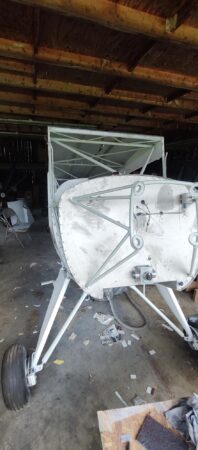
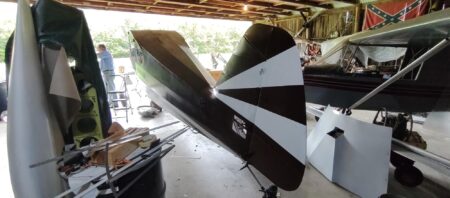
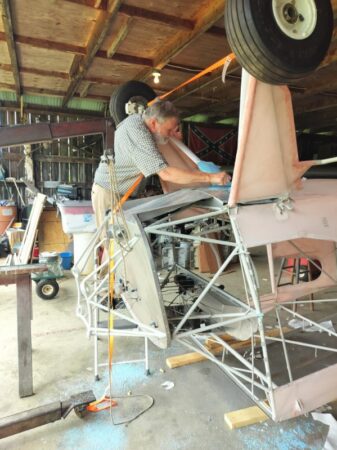
At press time the fuselage fabric is painted. A few pieces of front-end aluminum parts still need paint. The engine is finished, and is ready to be back on the airframe. Hopefully he’ll have an assembled airplane that looks like an airplane in time for the fly-in. The instrument panel, floorboards, and door sills are all in. He has taken a few antique car tours that have kept him away from the project but he’s still making steady progress.
There have been two completed Companions so far that we have weight and balance numbers for. In both cases, the empty CG was around 14-15 inches, as compared to a more typical 10-12 inches for a 4-Place. Bob says the CG on the companion is intentionally further aft, because it doesn’t need to be prepared to carry such a big load in the cabin. At a full-forward CG, the front seat occupants are aft of the CG, but approaching the aft limit, the front seat occupants become forward of the CG. Bob encountered this when carrying engines by himself. At the heaviest loads, the airplane can carry more if there is someone in the front seat than if the front seat is empty.
Bob says, if Companion builders want to carry a lot of cargo, use the constant speed prop and angle valve engine. For more reasonable/typical loads the parallel valve engine works very well. For both the 4-Place and the Companion, having the CG in the 14” range for day-to-day operations makes for an airplane that handles better, can land shorter, and feels lighter on the controls. It’s just with the 4-Place, we concede ideal solo-load handling by having the empty CG farther forward, to enable more cabin loading. Aircraft design is all about compromise!


First Flight of the new 3000-pound Bearhawk Five
Bob Marek’s Bearhawk N156RM
1999 Weight and Balance Calculations
Source: 1999 Beartracks, Bob Barrows

*Hold this dimension for all engine installations unless weight and balance calculation problems are encountered
Bearhawk N33RB
| Aft Sample | Weight | Arm | Moment | Forward Sample | Weight | Arm | Moment |
|---|---|---|---|---|---|---|---|
| *Main Gear R | 600 | -1.63 | -978 | *Main Gear R | 600 | -1.63 | -978 |
| *Main Gear L | 596 | -1.63 | -970 | *Main Gear L | 596 | -1.63 | -970 |
| *Tail Wheel | 75 | 199 | 14925 | *Tail Wheel | 75 | 199 | 14925 |
| Front Seats | 400 | 14 | 5600 | Front Seats | 200 | 14 | 2800 |
| Cargo Area | 530 | 57 | 30210 | Cargo Area | 0 | 57 | 0 |
| Fuel lbs. | 300 | 24 | 7200 | Fuel lbs. | 30 | 24 | 54 |
| Totals | 2500 | 55987 | Totals | 1500 | 15829 | ||
| Gross Weight | 2500 | Gross Weight | 2500 | ||||
| C.G. Range | 10.5″ – 22.5″ | C.G. Range | 10.5″ – 22.5″ | ||||
| C.G. Range | 16% – 34% | C.G. Range | 16% – 34% | ||||
| C.G. Aft | 22.4″ | C.G. Forward | 10.5″ | ||||
| C.G. (MAC) | 34% | C.G. (MAC) | 16% | ||||
| Empty Weight – 1270* Empty Weight C.G. – 10.2″* | |||||||
*As per weigh in of Proto II N33RB on 9-9-99
Note: Empty weight includes: 10 quarts oil, O-540 Lycoming Engine, no electrical system, no rear seats, utility door system and constant speed propeller (3-blade composite).
Forward C.G. = 15829/1501 = 10.5″ 10.5/66 chord = 16%
Rear C.G. = 55987/2500 = 22.4″ 22.4/66 chord = 34%
Do your first test flight with the c.g. between 13.5″ and 18.5″.