Source: 2024 Q3 Beartracks
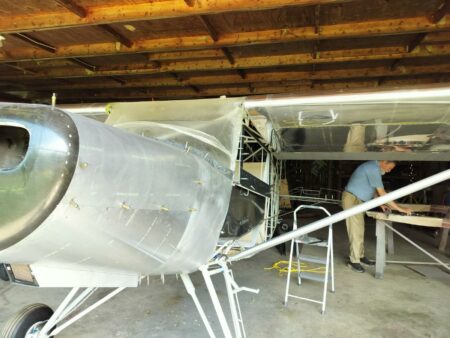
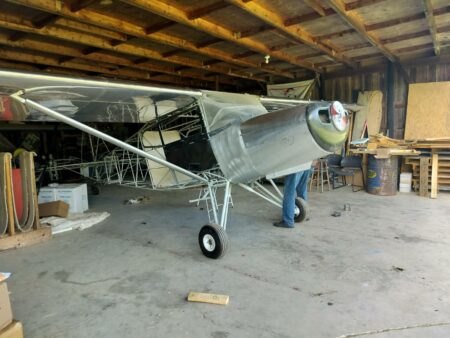
Following up from an update in our Q1 issue, Chuck has completed his first flight! His LSA was built from a Quick-Build Kit in Berryville, Virginia.
Movies:
IMG_2157
IMG_2162
Radek Szymański’s Bearhawk 4-Place in Poland – UL Engine and Skyview


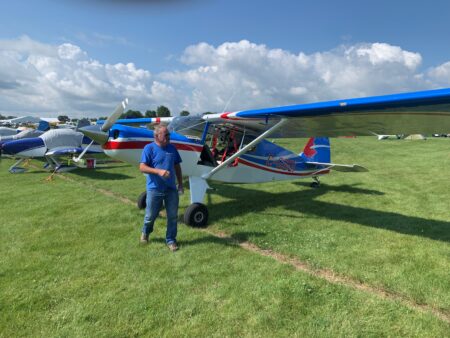
Bearhawk 4-Place C-GSOI Wins at Airventure 2024
Source: 2024 Q3 Beartracks, George Huntington
Back in 2006 I got the bug to build an airplane. Fully understanding it was a big project, but I put it on my bucket list anyway. Long story short, I persevered and 16 years later I was flying my hand crafted Bearhawk.
Building the airplane was a major undertaking that took countless hours in the shop with unrelenting commitment on my part and support and understanding from my wife, family and friends.
The pinnacle of it all being able to fly “my own” airplane to Oshkosh. That is where the aviation community meet to display their planes and see what other enthusiasts have as well.
The trip was planned out and I was flying with two other local pilots in their planes and I had a co-pilot, with me. The trio, a Cessna 170, a Cessna 180 and my Bearhawk set out on July 24, and headed from St Andrews, Manitoba for Duluth, Minnesota where we would clear customs.
In the air, we trued out at about 137 MPH burning 40 ltr/hr (10.5 Us gal/hr) at 55% hp. The AWOS in DLH transmitted that it was VFR but when we contacted the tower, they were not VFR. This weather change put us in a holding pattern and we circled for about ½ hr. Since there was no good news in the short-term weather, we decided to head back north to Fort Francis to re-submit customs paperwork and get fuel. The first leg was 3.8 hours, and we were only about 200 miles from home.
We gained customs and landing approval then flew across the river to International Falls and cleared US customs. A nice short hop of .2 hrs. We then flew from International Falls to Wautoma with airtime of 3.0 hours, fueled up and waited till OSH was open for the evening incoming traffic. With the heavy traffic of people arriving and the onset of the evening rush, there were unexpected delays, and we were put into the arrivals circuit and ended up circling with the invasion for1.1 hours, after which we decided to fly back to Wautoma where we camped overnight.
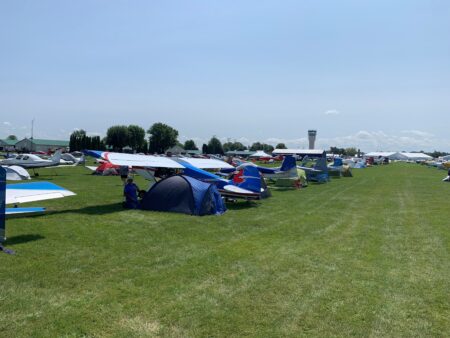
Thursday morning we packed up camp and headed to Fisk arrival, weather was below limits for arrival, so we were once again in the holding pattern for about 2.1 hours. We were pleased to see the weather lift, and we were allowed to land. We got through the maze of taxiways and parked in the homebuilt camping area where we got registered and I submitted to have my Bearhawk judged.
Later that day a team of judges stopped to inspect my Bearhawk. I was riddled with anticipation as I opened the cowl to let them look inside the engine compartment and stood back as they did a thorough inspection of my plane. After about ½ hour of checking their paperwork and making notes they left with a “thank you” for the opportunity to look at my aircraft. Now I had some free time so I went on tour through the other EAA aircraft and displays.
I was checking out the center square displays when I got a phone call asking if I was willing to do an air-to-air photo shoot of course I said yes. A briefing was set up for Saturday morning at 10 am. This piqued my curiosity so that got me wondering what was up.
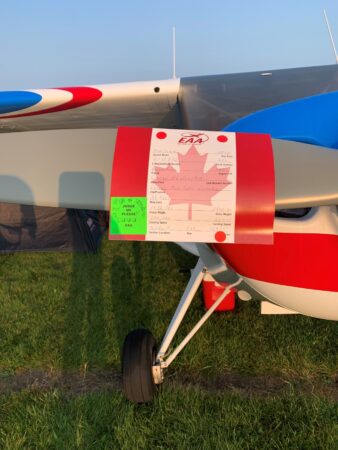
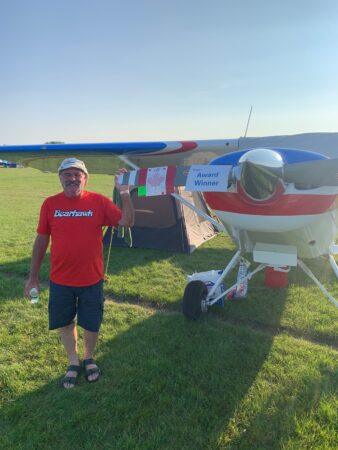
When we arrived at camp later that afternoon after the airshow, I see a white flag “AWARD WINNER” on my propeller. That was an amazing surprise. Along with the red flag was the qualification form that had 14 judge’s initials on it with 3 red dots, WOW! I had been been chosen for an award.
I called my buddy Bob Matarelli from Duluth who had helped me out along the way while I was building the airplane, and he had always given me encouragement and had forecast that “you’re going to get a Lindy”.
Saturday morning, I just got started checking out the warbirds and got another call to do an interview and static photo shoot at the airplane in 15 minutes. I scooted back to the Bearhawk and met the photographer who took a substantial number of detailed photos and the completed the interview. They were very interested in my plane but did not reveal any information about awards.
We completed the photo shoot and interview and then proceeded to the briefing for the air-to-air photo shoot. The action would take place on Sunday morning as we were departing OSH.
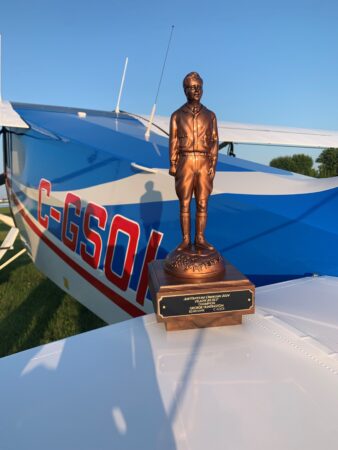
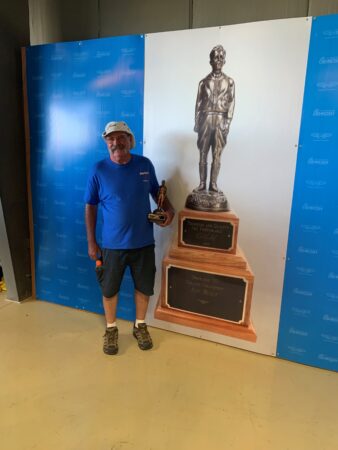
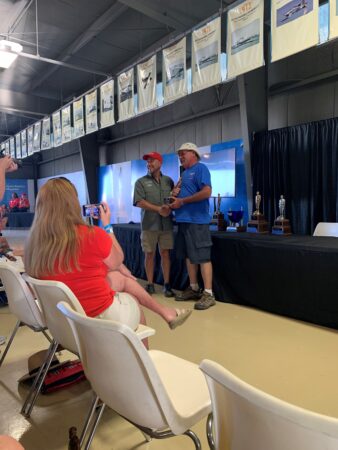
I attended the Award ceremonies with my travelling companions at the homebuilt building at 6:30 Saturday evening. They went through the Kit Outstanding Workmanship and Plans Outstanding Workmanship plagues then to the Kit Champions bronze Lindy then to Plans Built Champion Bronze Lindy, the second Name announced was George Huntington Bearhawk C-GSOI wow I won a Bronze Lindy Plans Built Champion.
In preparation for the Sunday morning departure and Air-to-air photo shoot, we packed up camp at 6:00 am and taxied to an open area just to the south of the button of Runway 27. There, still more photos were taken prior to the flight. We taxied to RNY 27 took off and went into a hold over the bridge at Winneconne, circled for about 15 minutes. Then the C-210 camera airplane flew up to us and took the lead. We circled to the left for a couple 360’s to get the sunshine in the right area, some straight and level, up and down and a banking roll away to the left then with a wave of our wings we continued on our way to Cloquet for our first stop on the way home with air time of 2.8 hrs.
The weather was not cooperating as a line of thunderstorms prevented us from leaving Cloquet on Sunday, so we spent a night at the terminal in Cloquet. Such a nice airport with fuel and bicycles to use to go into town if need be. With time on our hands, we were able to look at Tim Tollefson Rans homebuilt nearing completion. With the help of my friend Bob, we were able to organize hangarage with Mike Ray a fellow homebuilder to park the Bearhawk overnight.
The next morning, the weather was still below VFR so waited couple hours until it cleared enough to go North with flight time of 2.5 hours and clear Canadian customs at Piney/Pinecreek, an interesting little airport which is half on the US side and half on the Canadian side.
Next leg was 0.8 hours to Oak Hammock Airpark just north of Winnipeg. Total airtime 15.5 hrs.
In my opinion, Bob Barrows has designed an excellent aircraft. He supplied a great set of plans, and was willing to sit and talk with me about the aircraft build. The Bearhawk 4 place meets all my expectations and more.
Mark Goldberg provided a sounding board and shared his knowledge and support throughout our build.
Friends of mine, Cameron Lawrence and Ziggy Smolinski were my build partners, together we have built 4 Bearhawks, so far 2 flying next one to fly this fall.
Special thanks to Jim Gile for his experience and patience helping me fly to Oshkosh as he has done this trip about 10 times already and this is my first-time flying in.
Two of us went to Oshkosh and had a third passenger “Lindy” on the way home.
Bearhawk 4-Place C-FDDJ Fall 2024 Update
Source: 2024 Q3 Beartracks, Dan Dagasso
In 2017 or 2018 my wife commented that we needed a bigger travelling aircraft for the West coast and the Mountains of British Columbia. I had just finished two and a half years restoring my Pitts S1S, which involved many many late nights at the hangar during the work week and a lot of my weekends.
At the time I was flying my RV6A, which was a great speedy aircraft. My better half wanted to be able to haul both of us and two roadbikes, two mountainbikes and some camping gear for trips to the coast or down to Moab/Montana/Oregon/Alberta (Yes my wife is Awesome, No you cannot have her).
My choice was pretty simple once I read about the capabilities of the Bearhawk. The one problem was that my wife forbade me from taking on another project by myself right after finishing the Pitts. After doing some research I found out that Steve Busby of the Ottawa area had built a few Bearhawks and had worked closely with Mark Goldberg representing the Brand North of the Border. Steve was also involved in prototyping the model B wings on N303AP.
Steve Busby knew that Mark had the Kit that had been intended as the new Model B demo aircraft in Storage at Bob’s place in Virginia. Mark was and is an absolute gentleman and after he endorsed Steve’s skills and quality I contracted with Steve to construct the Kit that was stored at Bob’s. I was looking forward to being in the air with the Bearhawk by late 2020. Unfortunately in the summer of 2018 Steve had a terrible motorcycle accident and spent close to a year in the hospital. It truly was a miracle that he survived.
By this time I had sold my RV and was working with a local engine builder to source and rebuild an IO-540. Ken Vike of Vike Aeromotive built up another awesome engine for me, he built the 360 in my Pitts and it is a beast. Ken knew the intended mission for the plane and he talked me out of any electronic ignition or non-certified parts, as this plane will spend a lot of its life in remote parts of BC. We kept the compression ratio at 9.2 so that I could use mogas in a pinch if I was in a remote logging or fishing camp.
By 2020 Steve made the decision that he did not think that his recovery was going to allow him to finish the aircraft. He did recommend one of his good friends who had helped him on most of hos builds over the last 10 years. In June of 2020 the kit was moved into the shop of Dale Lamport in Perth Ontario. Dale is a retired AME/Flight Engineer/MDRA inspector. Over the next two and a half years Dale made steady progress and we spent a lot of time on the phone with quite a few trips back East to work out kinks that always crop up.
My local Avionics shop helped me design and draw out the electrical system and avionics. One of my local avionics techs flew out to Ontario and spent a week installing and testing the electrical system and installing the panel. Kaine and Rob at Inland Communication Services were amazing to deal with and continue to be so on a daily basis.
In the fall of 2023 I had the plane moved to St Thomas Ontario for paint with John Gordy. My daughter who helped me fly the plane back designed the scheme. John Gordy did an amazing job executing the paint. Final assembly was completed at Purple Hill Air at St Thomas Municipal Airport, by John Goris and his crew of Johnny and Ben who were so excited to work on the plane.
Paul Ragany an octogenarian was hired to do the flight testing. Paul has over 26,000 hours in everything from J3’s. TBM avengers, turbine Ag Cats, a bunch of Boeing products 737, 777, 747 etc. and he still flies crop dusters on a daily basis. He is a legend.
George Miller was the CFI who helped fly off the 25 hours and spent three days helping me transition into the aircraft. On the last day of my checkout George noted that the weather was turning really ugly with the winds at 25 knots gusting to 30 with variable wind directions and ceilings of 800 feet. I was expecting him to call it a day but he suggested we go work on the crosswind runway with the crosswind varying from 50 to 70 degrees off runway heading. That was some of the most challenging flying I have done. We had the main runway as a backup with the wind straight down the pipe. I was so grateful to George for doing his best to make sure I was ready for the trip home. He knew that my daughter had come out to copilot the plane back home 2000 miles through some potentially challenging weather.
My daughter Emily got her license when she was 18 in my RV, but she has little tailwheel time so we managed the trip home with her doing most of the cruise flight and radio management with myself taking care of flying takeoffs approaches and landings.
Now that we are home I have managed to take the rest of the family flying and the instigator of the project, my wife, is so very excited to travel as we intended with a lot of trips back and forth through the Rockies to see our daughters who are now living and going to school on the prairies. I am looking forward to becoming current with IFR flying again and travelling up and down the west coast.
This morning my wife woke up and said, “ so, when are we putting it on Floats?” She doesn’t know that I am going out this summer to look at another Pitts that was ground-looped 10 years ago, and needs to get back in the air. I have always wanted to build a set of Pitts wings.
I had hoped to bring the plane to Oshkosh this year but that will probably need to wait until next year. My thanks to the Bearhawk community and especially to Mark Goldberg. I know that Virgil will make something great even better.
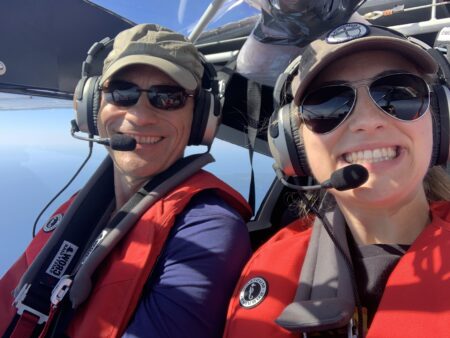
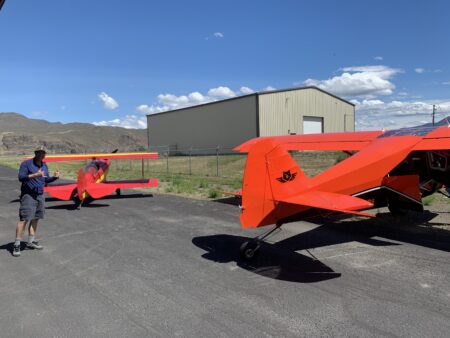
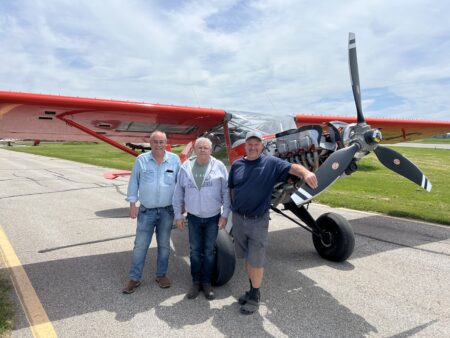
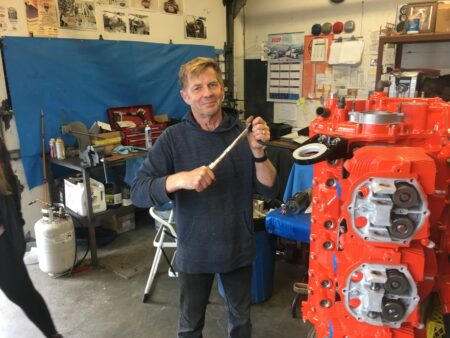
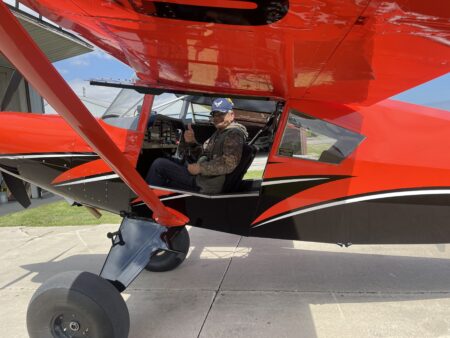

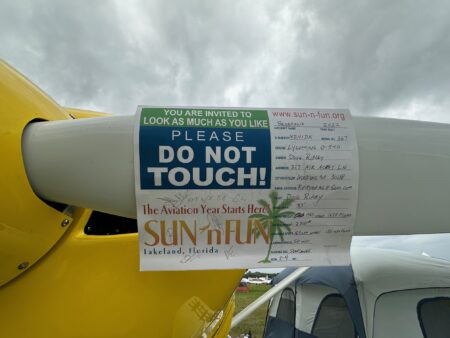
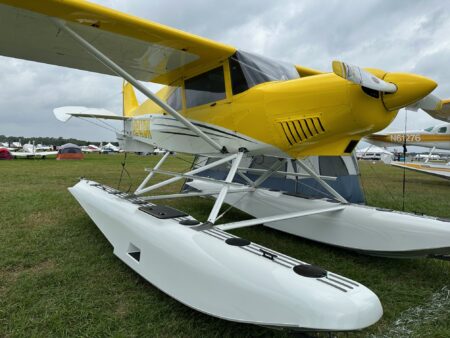
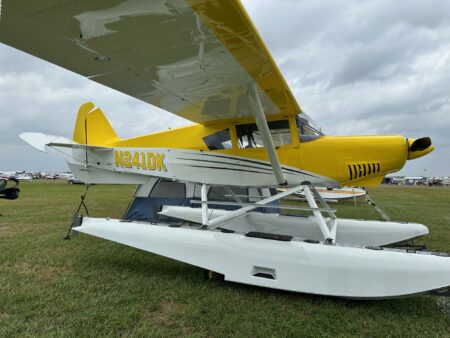
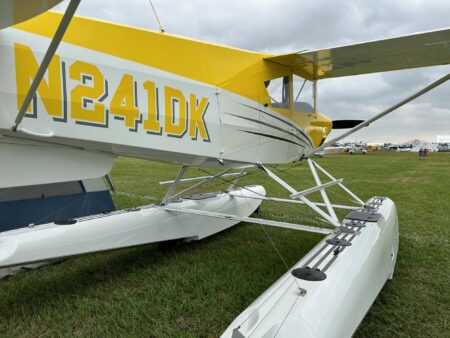
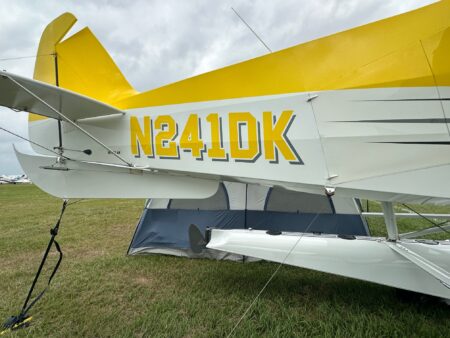
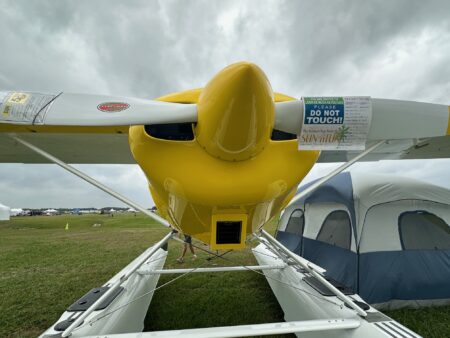
Bearhawk 4-Place Seaplane Grand Champion at SNF 2024
Doug Ripley with N241DK wins “Grand Champion – Seaplane” at Sun-N-Fun 2024! Thanks to Mike Swain for the photos.
Dan Dagasso’s First Flight – C-FDDJ – Bearhawk 4-Place
Source: 2024 Q2 Beartracks
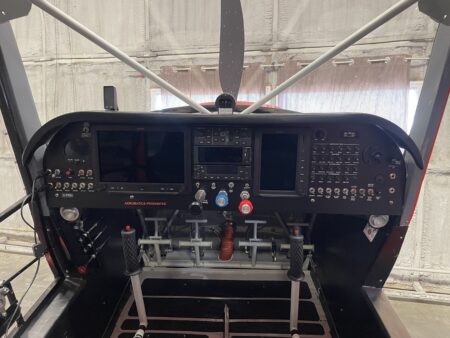
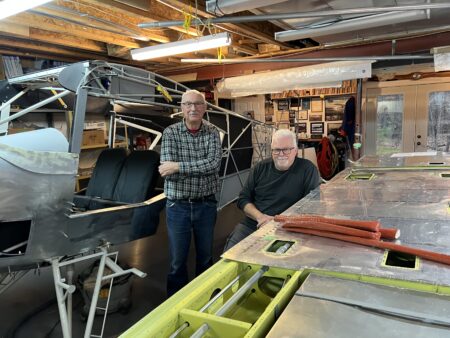
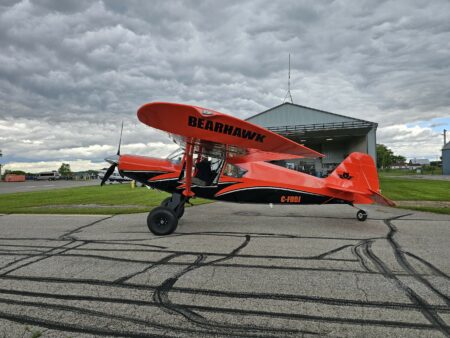
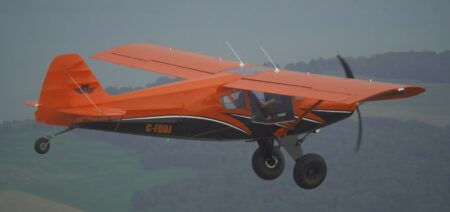
Based in Kamloops, British Columbia, Dan has completed his 8-year project and is out flying. We may have to wait until winter for him to be sitting still long enough to tell us more about his plane! He posted a few pictures on the forum and as you can see his paint job is stunning.
Stenton Maddox First Flight in Texas – Bearhawk 4-Place – N628SD
Source: 2024 Q2 Beartracks
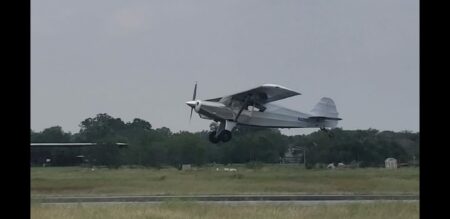
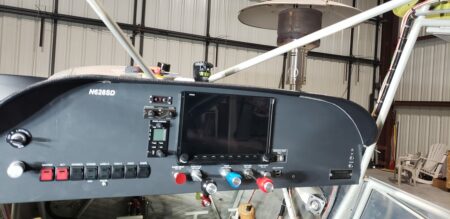
Stenton Maddox First Flight in Texas – Bearhawk 4-Place – N628SD
Stenton’s plane has a carbureted O-540, a Dynon panel, and is covered in Oratex.
Summer 2024 Updates from Bob Barrows
Source: 2024 Q2 Beartracks
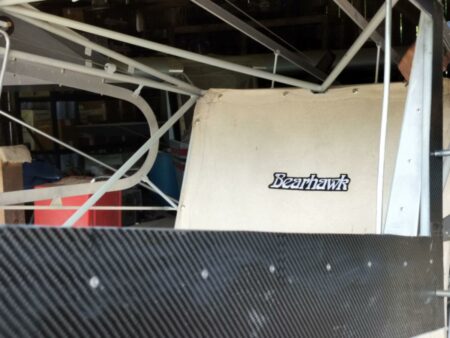
Work continues on Bob’s Companion project. As of press time he did a preliminary installation of the wings and has mostly completed the cowling. There is a mock-up engine that has no cylinders in place, and he has validated alignment and positioning of the engine, and is quite pleased with the kit’s conformation to the plans. The ailerons, flaps, rudder are covered, and the elevators and horizontal stabilizer are in progress. With the mock-up engine in place, the weight was 767 pounds. Bob feels like he is on track to meet the target empty weight of 1050 pounds. This build uses carbon fiber door panels instead of aluminum. Bob says it saves a little weight, and he’s pleased with how the carbon panels flex, drill, and otherwise behave much like aluminum would. To make them, he starts with a flat sheet of aluminum. He says you can also bend the aluminum if you want the part to also be bent. He applies lots of wax to the aluminum, draws out an outline of the rough shape of the panel, and paints resin onto the panel. Then he lays 2-3 layers of carbon onto the panel, and the next day, it’s ready for cutting to shape and installing. He made similar floor boards out of Kevlar, and figures those are 2/3 to 1/2 the weight of aluminum in the same application.
Bob and Diana recently flew the Patrol to Pence Springs, West Virginia for a get-together that included around 30 airplanes. They have a nice long grass strip there. Diana’s improved mobility and health are great news. She’s always eager to ride along whenever Bob flies. He says he alternates between flying his Patrol and LSA, just to keep both active, and enjoys both equally.
He has not been working much on his electric Ultralight project. It is still pending a new motor controller to up the motor output from 230 to 300 amps. Bob did design and build a new full-castering tailwheel for it, to improve taxi handling. The new tailwheel doesn’t attach to the rudder for steering but is easier to maneuver than the original skid. Bob says back when he flew his RV3 the tailwheel could either be swiveling or steerable, so he usually left the chains off and allowed it to swivel so that he could turn around more readily at the end of the runway.
Bob has been working on a solution for the Brake master cylinders that uses an EDM (electrical discharge machining) machine to make very precise fluid passageways inside of the bore. The EDM machine is well-suited for this kind of work and yields very smooth and precise shapes down inside the bore, based on the shape of a custom electrode.
Save the date for Bob’s Picnic on 10/19/2024 at VA04!
Cabin Organization with MOLLE
Source: 2024 Q2 Beartracks, Tyler Williams
I like clean organized spaces. Well, at least I do in my airplane and in my kitchen. My truck, on the other hand, is a complete mess…always. It looks like I live in it, which sometimes I do. But not a lot goes on inside the truck that forces me to be meticulous about it being clean and organized. I sit, hold the wheel, throw the snacks in the center console and turn on some good tunes. My kitchen is a different story. My chef’s knife is sharp, my spices are stocked and I am a stickler for “mis en place.” When everything is in its place, I can work efficiently and get into a flow to create, improvise and make great food.
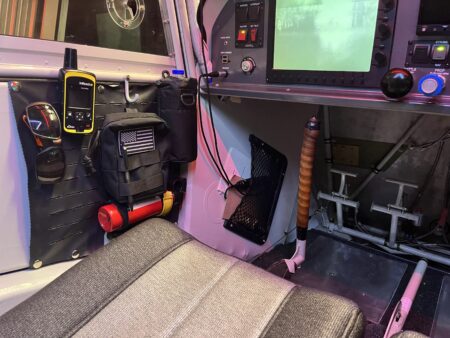
Operating the airplane is a similar experience for me. I like everything in its place, the plane prepped and my mind sharp for the task at hand. Flying a plane, at least the way I do it, involves much more than road tripping in the truck. I don’t just get in, hold the wheel and follow the line on the map. From the preflight, to the engine management, to flying the terrain and improvising the route around weather and airspace, to chatting with ATC and jotting down instructions, there’s always something to do. An organized cockpit helps keep the mind free for the important things, and I don’t like anything flopping around loose. When flying far, I need water, a bag of snacks, sometimes a pen and paper, sometimes I need my flashlight, I’ve got my InReach on and I like to plug in my phone for music. I keep a lot of stuff in the back of the airplane too and it all needs a secure place to rest. From the basic things like a screwdriver, fuel tester and a small flashlight that get used every preflight, to the just-in-case tool kit, spare fasteners, tubes and patches, to control locks, tie downs, travel chocks and a first aid kit, I like to have what I need, when I need it. You can usually find help anywhere in the lower 48, but it sure is nice to have what you need to handle things, in flight and on the ground.
When I finished the Bearhawk and started venturing across state lines, I kept all the tool kits and spares in a duffel bag in the baggage area. But, digging through a bag of stuff to find what you can be annoying at best. For the cockpit items, I initially used the side pockets installed by my feet and the seat back pockets to stow checklists, small items, snacks and water bottles. But we travel as a family often and I like to keep those seat back pockets clear for my kids to stow their drawing paper, books, cards and such. My side pocket is best kept minimal so I can get my checklist or writing pad without fumbling around down there while trying to fly and my wife likes to have her side available for her magazine or book.
I got some inspiration from some nice overland camper trucks that used the MOLLE (Modular Lightweight Load-carrying Equipment) system to organize gear and tools. I saw seat-back MOLLE panels with small pouches and also some nice tailgate MOLLE panels for easy access to tools, even when the truck is loaded with gear. That seemed like the perfect solution for my plane. Our doors are all recessed slightly from the interior so there’s a little space there that can be used to hang a MOLLE panel and install some organizers.
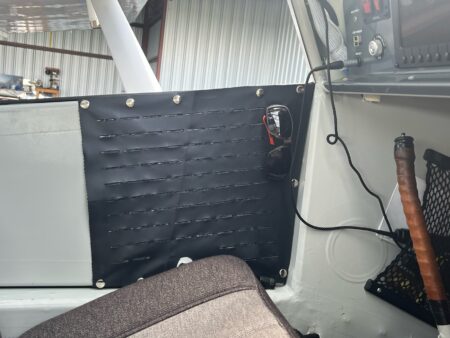
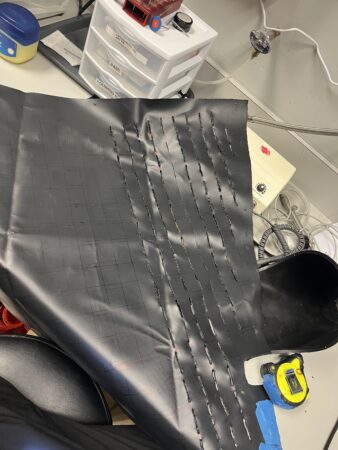
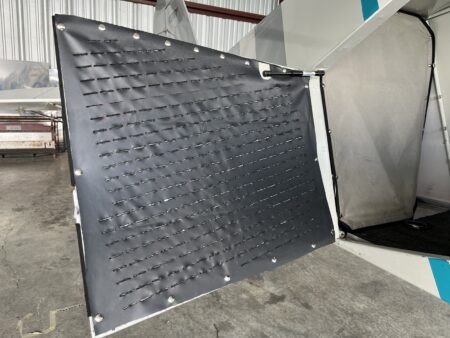
I made mine out of PVC coated Cordura nylon. I found some basic dimensions for the standard laser-cut Molle grid, drew it out on the fabric and simply melted the slits with a soldering iron. Mine are 1.12” wide slits, spaced ¼” apart horizontally and 1” apart vertically. I probably don’t have the exact military spec, but it was easy to lay out and fits all the attachments well. Someone more digital savvy could do the layout on a computer and have the fabric laser cut for a faster and more precise, factory looking result. I installed snaps in the door frames and fabric and snapped on the panels. They are lightweight and work great. Up front, I have my water bottle holder, sunglasses, pen, charge cord pouch, a place to keep my phone and snacks and my fire extinguisher secured on the door for easy access and still have all the elbow room I need. The passenger door has a panel as well with the same drink holder and stuff pouches and my wife loves it. The big panel on the aft baggage door stores my first aid kit, gust locks, travel chocks, extra quart of oil and funnel, preflight tools, hanging luggage scale, spare fuel cap, pitot cover, etc. etc. You can certainly stuff all these things under the back seat and that works just fine. But it sure is nice when the plane is fully loaded to be able to just pop the baggage door open and grab what you need.
Tribute to “Tinman” Kent White
Source: 2024 Q2 Beartracks, Mark Moyle
Sad News from California: “Tinman” Kent White Died on 5/19/2024
Kent was an early member of the Bearhawk community and was active in the Yahoo-based discussion groups that predate our present forum. Many of us purchased metal-shaping and welding tools, instructional videos, and supplies from Kent over the years. Bearhawk Builder Mark Moyle offers this tribute:
I hope I can even come close to relaying my reverence for Kent. From the second day I had met the man I started addressing him as Kent Master. Nearly 15 years ago I met Kent and 4 other Bearhawk builders at an aviation sheet metal class in Anchorage. Del Rawlins, Paul Minelga, Dan Schillings and Matthew Schumacher. There were other folks in this class, I don’t recall any of them. To me they were metal mashers, chimps I didn’t have any association with. I’m sure they were nice guys, but the Bearhawk guys. We were different. We obviously were not hammered mechanics like the other guys… my story relates to that.
Kent was there to teach us the basics. Taught us how to take a round disc of 5052H32 and turn it into a bowl by thickening the metal around the circumference of the circle. Now imagine 12 people all hammering on aluminum at the same time being taught by this huge man. Kent was like 7 foot if he was an inch! Here’s this huge guy using the same tool as the rest of us, but in his hands, that hammer, it looked tiny. That same hammer looked like a sledge hammer in the hands of a few of the small guys. Believe me when I say guys follow the example set for us by the teacher. Almost everyone was whaling on that sheet metal. Here’s this huge guy tapping on a thin piece of aluminum… he’s so damn big he must be putting allot of force into the metal. I’m like where are the ear plugs? I stood back and just watched for a bit before I started. Thing is I listened. Kent was one of these guys who gave you pearls of wisdom to make you think. He was an artist at it, and I think he enjoyed watching befuddlement. He enjoyed seeing the perplexing expressions on people’s faces. I could see it, it was like a twinkle in his eye. He wasn’t going to tell you how to do something one bean at a time. He’d tell a short story. Really short, maybe 5 words. You had to listen and think. I remember Paul catching on real quick. I think he was the first or second person to get the bowl done and done nicely. Turned out to make that bowl, this great big man was gentle on metal as he was as a person. I learned buckets from the guy. Even tooled up with the equipment he sold. English wheel, Planishing hammer and a bunch of his hand tools. Bought all of his videos. I have every one of his prototype planishing hammer dies.
Kent became a master European classic car restoration at Harrah’s auto museum. Kent was one of the few guys who could duplicate replacement parts with all the correct tool marks to make his part indistinguishable from OEM. He was considered royalty amongst the classic European classic car owners. It’s like Kent was many people: the teacher who didn’t lead you by the nose. The expert on European classic cars. The aviation expert on airframe repair and prototype work. To the guy who nobody really knew. Kent lived way off the beaten path. He moved to the Grass Valley, Nevada City area in the foothills of the Serria Nevada mountains in 1979. The year I moved away from Grass Valley. Kent lived in North San Juan. About as far out in the mountainous country and still be in Nevada county.
Kent was such a master craftsman. For years he build the prototype inlet nacelles for hawker beech jet engines. He was approved by Boeing to teach mechanics how to shape and replace skins on Boeing aircraft at facilities around the world. Kent was also the guy that Hollywood called upon when they wrecked damaging the tail on a Howard Hughes mono-wing replica aircraft in the movie Aviator. I have pictures he sent me of him repairing one of two aircraft in existence totaled by the insurance carrier, but had to be repaired because they performed a very specific task. A couple mechanics lifted this twin engine turbo prop with wing jacks and didn’t support the fuselage causing it to buckle badly in the middle.
About ten years ago, maybe longer. Kent began making a yearly trek to Platinum for a few weeks in late August for Silver salmon fishing. He liked that I took him on adventures and always brought him back alive. These adventures involved boats and four-wheelers to places and at speeds that would make a sissy cry out in fear. I didn’t put airplanes on that list. We did fly in some nasty conditions together, but always safely. Last summer Kent flew into Soldotna. We fished the Kenai and stayed with my daughter and her family waiting on a weather window to fly my airplane to Platinum. By the way, in Alaska, seaplane doors that are nothing but window, down low. Yeah.. do it.
We spoke on the phone often. Ask about each other lives, things real friends talk about. The emotional stuff. When it came to me tying to mine that brain of his for some nerdy odd ball thing, it was always on the phone. I avoided taking advantage of him on his vacation. Made me feel guilty. It’s like being a doctor and everyone around you is asking you things medical. Or a car mechanic whose friends want you to fix something for them. Maybe that’s why I have all of his prototype dies for the planishing hammer. We’d use them together in my shop.
Kent was a true independent thinker. He made his life his way and by his rules. I don’t think I ever heard him say or do anything that told me this guy was any thing but a genuinely nice caring person who was nice and respectful to absolutely everyone.
Kent was truly a great friend, loved that guy. We were going to a sandbar hopping fishing and camping adventure this summer. From Platinum, through the Dillingham area, up through lake Clark. I’m going to miss him. Now I’ll have to train up someone for my adventures. Didn’t have to train Kent. He was game for anything. Great great man!
Continue reading