Summer 2024 Updates from Bob Barrows

Source: 2024 Q2 Beartracks
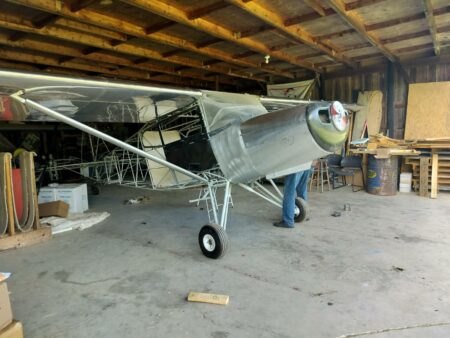
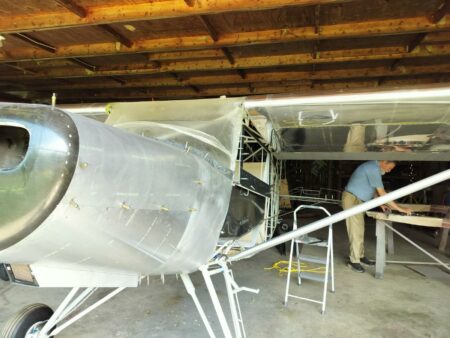
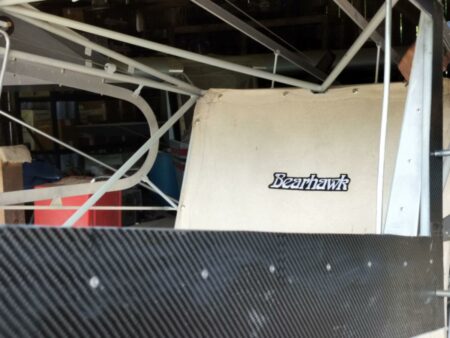
Work continues on Bob’s Companion project. As of press time he did a preliminary installation of the wings and has mostly completed the cowling. There is a mock-up engine that has no cylinders in place, and he has validated alignment and positioning of the engine, and is quite pleased with the kit’s conformation to the plans. The ailerons, flaps, rudder are covered, and the elevators and horizontal stabilizer are in progress. With the mock-up engine in place, the weight was 767 pounds. Bob feels like he is on track to meet the target empty weight of 1050 pounds. This build uses carbon fiber door panels instead of aluminum. Bob says it saves a little weight, and he’s pleased with how the carbon panels flex, drill, and otherwise behave much like aluminum would. To make them, he starts with a flat sheet of aluminum. He says you can also bend the aluminum if you want the part to also be bent. He applies lots of wax to the aluminum, draws out an outline of the rough shape of the panel, and paints resin onto the panel. Then he lays 2-3 layers of carbon onto the panel, and the next day, it’s ready for cutting to shape and installing. He made similar floor boards out of Kevlar, and figures those are 2/3 to 1/2 the weight of aluminum in the same application.
Bob and Diana recently flew the Patrol to Pence Springs, West Virginia for a get-together that included around 30 airplanes. They have a nice long grass strip there. Diana’s improved mobility and health are great news. She’s always eager to ride along whenever Bob flies. He says he alternates between flying his Patrol and LSA, just to keep both active, and enjoys both equally.
He has not been working much on his electric Ultralight project. It is still pending a new motor controller to up the motor output from 230 to 300 amps. Bob did design and build a new full-castering tailwheel for it, to improve taxi handling. The new tailwheel doesn’t attach to the rudder for steering but is easier to maneuver than the original skid. Bob says back when he flew his RV3 the tailwheel could either be swiveling or steerable, so he usually left the chains off and allowed it to swivel so that he could turn around more readily at the end of the runway.
Bob has been working on a solution for the Brake master cylinders that uses an EDM (electrical discharge machining) machine to make very precise fluid passageways inside of the bore. The EDM machine is well-suited for this kind of work and yields very smooth and precise shapes down inside the bore, based on the shape of a custom electrode.
Save the date for Bob’s Picnic on 10/19/2024 at VA04!
Bob’s Fall Fly-in at Fincastle 2023

Source: 2023Q4 Beartracks, Jared Yates
On October 21st Bob held his annual fly-in picnic at VA04. The sky was blue but the winds were strong. Bearhawk builder Chuck Morris flew his Bearhawk 4-Place down from Michigan earlier in the week, and Peter Brown brought Mark Goldberg’s Bearhawk Patrol down from Pennsylvania. There were several other Bearhawk folks on hand including Roy Glenn, Chuck Calvi with his friend Mac, Stephen and Monica Murphey, Paul Roy, Curtis and Beverly Penner, Mike Meador, and Isa Merkt.
Several of Bob’s local EAA friends were there also.
Bob’s Bearhawk Patrol and LSA were in their hangars, and his electric Ultralight is looking pretty close to complete. He is working with Cedric Jeanty to create a new dual-channel motor control system for redundancy and reliability. We mark the growth of our children relative to Bushwheels, which used to be taller than them!

Ultralight Prototype Update Fall 2022

Mike Meador sends this photo of the Ultralight project posing with a fresh Lycoming 360, which weighs more than the whole ultralight! The
engine was delivered in late September to a Bearhawk Patrol builder from Michigan. As of now, all of the ultralight parts are covered and
sealed with their first coat of the green Stewarts Ekobond glue. Bob brushes it onto the fabric and wipes off the excess with blue shop
towels. This fills the weave and prepares the fabric for the final top coat. The control surfaces are painted with the top coat, and the
fuselage and wings are next. Bob says, “I might get to that this week.” So far the weight is on schedule, though the propulsion system is still offering some challenges. During a high power ground run the system powered itself down after nearly a minute of running, perhaps
sensing a high temperature somewhere that isn’t apparent with an external inspection.

Summer 2022 Update about Bob’s Ultralight Prototype

Source: 2022 Q2 Beartracks
Bob and Mike Meador have been making steady progress on the electric Ultralight prototype. There was a minor setback involving the batteries when Bob mounted the speed controller in a way that led to an electric short. New batteries are in place along with an improved mounting scheme and fuses. Bob likes the configuration with one battery in front of the pilot and one behind.
The wing structures are complete, along with the new custom wingtips made from two layers of carbon. They add stiffness to the whole wing!

Bob’s 2021 Picnic, Taxi Tests for the Electric Ultralight

Source: 2021 Q4 Beartracks, Jared Yates
Bob’s usual October picnic was well-attended by Bearhawk folks, if not Bearhawks. With ours being recently liquidated (in both the financial and thermodynamic sense), we knew we would be driving in. But even if we’d had a flying plane, the weather close to home would have made it a no-go. A local Stinson was the only plane to fly in.

Bob’s friend Cedric Jeanty came in from California to help install and test a motor and speed control system for Bob’s Ultralight project. Cedric helped source a new and more powerful motor. With the new motor and system in place, the fuselage was to a point of being ready for some taxi tests. Cedric made a lap up and down the runway (photo below), and Bob offered that I could also (photo below Cedric).


This was quite a thrill, because there are no brakes or tailwheel steering. The only steering comes from the force of the air over the rudder. While it’s plenty adequate, this takes some pilot thinking, because if you want to slow down and simultaneously steer, reducing thrust also reduces steering. This would be familiar to someone used to driving most personal watercraft. The winds were erratic and occasionally gusty, which added to the challenge. I was impressed with how the motor reacted to “throttle” input. Similar to a direct-drive outrunner radio-controlled plane, it’s instant and not lacking any torque. Run time will be limited at very high power settings, but with as light and low-drag as this airframe promises to be, it won’t be running at high power settings for long. This is going to be a neat
machine to fly. In the next photo, Bob, Cedric, and Mike Meador prepare for a full-power run to test the temperature of the motor and speed controller. This was impressive to see. The powerplant is quieter than a C65, but not by much. The prop makes a large contribution to the noise in both cases.
Other Bearhawk folks on hand included Bearhawk 4 -Place builder and owner Chuck Morris from Michigan, Bearhawk Five builder Matt Layland from Florida, Bearhawk LSA builders Stephen and Monica Murphey from South Carolina, Bearhawk LSA builder Chuck Calvi and his buddy Mac, and Bearhawk Five builder Jay Thomas from Huntsville, Alabama.

Video Link to Taxi


Summer 2020 Progress on Bob’s Electric Ultralight

Bob’s latest project is moving right along. In the photo above, the front end is mocked up with a plug, which he built out of foam and filler. That allowed him to get the shape just right. He built a fiberglass mold around the plug, then removed it. From the mold, he made a carbon fiber cowl, shown to the right. As of late September, “The airframe is about done, just finishing off the hardware for the cowling on the front, up around the motor. The motor and controller are all in.
Bob has created all of the tail surfaces and their rigging, but has removed them for the next step, which is ground testing of the propulsion system.
Bob says, “I’m not absolutely sure I’m going to use that battery pack, not exactly sure of anything. It’s all new to me, and there’s new stuff coming out all the time.” To help with the logistics of testing, he mounted the two battery packs into a portable cart, which will make the packs easier to move around vs having them mounted into the fuselage. The two packs total 768 cells and 74 pounds. The current plan calls for one pack behind the pilot, and one pack on the firewall behind the controller. The packs run in series, at around 60 volts each for a total of 120 volts at full charge. He figures around 7 kilowatt-hours (kWh) of capacity. For comparison, a Tesla Model 3 has 54-75kWh, and a sporty electric motorcycle might have 10-20kWh batteries. Bob says “I may fly it with that setup or may not, depending on how the temperatures go.” The prop has turned tips and is a loaner/demo to test.
Once the propulsion testing is done, he’ll still need to sandblast the airframe and paint it, and of course he still needs to find a spinner. Folks coming to Bob’s fly-in on October 17th will have a chance to see the prototype up close.


Summer 2020 Q&A With Bob

Source: 2020 Q2 Beartracks
This month we’ve included Bob’s answers to two questions sent in by readers. First, Patrol builder Brooks Cone asks about making a computerized model of the plans.

Brooks says, “Do you plan to have them put into CAD, has anyone ever asked permission to put them into CAD? Is it being done by someone yet?”
Bob’s answer is a preference towards the hand-drawn plans. “I don’t have any time to do that kind of stuff, and it allows people to just put it on a disk and sell to everybody, which I don’t care too much for.”

The second batch of questions comes from builder Casey Hutson. We could call Casey an avid boater, since he is at sea for months at a time in the Navy. All of that time at sea has inspired a few follow-up questions about Bob’s ultralight. Casey asks: “I know it’s in the early stages, but compared to the LSA, what is the estimated build time from plans?”
Bob says the build time will be perhaps 10% less than a Bearhawk LSA. There are slightly fewer parts, but still about the same complexity as an LSA. In some ways, the extreme weight reduction makes the construction more challenging, with thinner materials. Fuselage finish welding has always been a demanding job that’s hard on a body. Bob says, “I was going to tack weld it and have David Spencer do the finish weld, thinking I’m getting to old for this. I was a little worried about being able to keep my hands steady enough to weld it at 77 years old. It’s turning out really good, I’m happier with my welding now than I was on the last one. Those thin wall 28 tubes came out nice.

Next question from Casey: “I know his goal is electric, but will the option be there to run a combustion engine if the builder chooses?” There are some exciting powerplant updates. Bearhawk builder Cedric Jeanty gave Bob a tip on a complete electric power package that light plane guru Chip Erwin was selling. The package may or may not be the final package that Bob flies with, but it is a starting point to get something going and help him learn about the needs of the system. The whole package was priced reasonably. Bob says “I’ll do a lot of ground tests with it, and it will get a pretty good workout on the ground before it ever goes up in the air.” Chip was having trouble with the BMS, but Cedrick has been helping Bob source a different BMS, in addition to lots of other help. Bob says “I’ve gotten a few calls from others in the Bearhawk world, and it has really been kind of fun figuring this out.”
This package has a 23-pound motor that is rated for 40 kilowatts in short bursts like for takeoff, and the battery is 7-8 kilowatt-hours and 90 pounds. The controller weighs 3 pounds and is rated at 1000 amps, oversized by a factor of two times what Bob thinks he’ll need. Getting around to Casey’s questions, a combustion powerplant would ideally be around 50hp, plus or minus 10. The weight of the engine would be crucial, and while Bob has not nailed down a final number, he suspects it would need to be under 100 pounds for the whole powerplant. As of today, Bob has built the motor mount, and is making the mold for the cowling by building up foam and plaster around the front end.

Casey has another question; like we said, he has a lot of time on his hands. “Similar to how the LSA can have a gross weight of 1500 pounds when not restricted by rules, will this be able to be classified as an LSA for those who are licensed? Basically, would I be able to build it above ultralight weights and will there be a gross weight for those that are licensed?” Bob is expecting utility-category strength at a gross weight of 550-600 pounds including the pilot. Part 103 empty weight is 254 pounds, so there is some extra margin there for someone who didn’t need to comply with part 103.

The photo below shows the parts deemed salvageable of his LSA loaded up on Mike Meador’s truck for a trip out to Collin Campbell’s house. Collin is going to rebuild the airplane with a new set of Quick-Build wings from Mark Goldberg.

Bob says his October 17th Bearhawk Fly-in is still on, so be sure to save the date! We’ll have more information in the next issue about the particulars, but everyone should visit Bob’s at least once!

More photos of the Ultralight prototype:

Bob’s Part 103 Ultralight as of Winter 2020

Source: 2020 Q1 Beartracks
Building light takes on a whole new meaning with Bob’s newest prototype. His latest design is an ultralight, intended to have electric propulsion. The fuselage is 4130 steel tube. The wings will be a fabric-covered aluminum structure. And compared to the rest of the Bearhawks, it is a whole different animal.
Part 103 in the United States allows very generous freedoms. There is no FAA requirement for pilot training, pilot certificates, or medical certificates. Anyone can make, work on, or design an ultralight. Airframes do not need to be amateur-built. There are no ADS-B requirements. In the legal sense, aircraft that operate under Part 103 are “ultralights” and not “aircraft” so they don’t need to comply with Part 91 (except for one specific point about TFRs). Part 103 is very short by regulation standards, but there is a specific list of limitations. Notably, there can only be one occupant, and the maximum empty weight is 254 pounds. The power off stall speed has to be less than 24 knots, and it can’t be capable of more than 55 knots at full power in level flight.
Airplane designers always make trade-offs depending on the mission at hand, and this is a very specific mission. Bob is looking for a local “around the patch” airplane. He has still not ironed out all of the propulsion details, since he hasn’t needed to yet, but he’s targeting a flight time of around 45 minutes. Based on what is currently available, he says that will require about 60 pounds of batteries. The target landing speed is 25 miles per hour, and with a 50 horsepower motor he’s concerned about exceeding the top end speed limits. “At 50 hp it will be capable of more speed than I want to have.”
Most ultralights on the market are high drag, so exceeding the top speed is not a concern. They have very short takeoff and landing capabilities, in part because their drag allows for steep approaches. Climb rates are usually great because of the excess thrust available at lower climbing speeds. Bob’s philosophy for this one is a little bit different. It will be very low-drag, with only a single wing strut as in his other designs. As he says, “Compared with most ultralights this thing should go through the air pretty easy. It should still land slow but will climb out fast.”
Those single wing struts are an airfoil-shaped aluminum extrusion, sourced from Carlson. They are half the weight of the struts on the Patrol, but still heavier than he’d like. While a wall thickness of .060” would make the struts strong enough, they are made to .080. He says, “You can only make extrusions so thin or they don’t extrude well. The depth and chord are good, but the wall thickness is thicker than ideal. They weigh about 4-5 pounds each. I hate to put that much weight in it, but some places you don’t have any choice. Another option would be a round tube with composite streamlining, but the extrusion is much easier and only slightly heavier.”
As of today, both wings are framed. They will be fabric covered to save weight, with a shop-laid carbon fiber skin leading edge under the fabric. Bob made a mold by bending a sheet of aluminum to the shape of the leading edge. Then he laid up two layers of carbon fiber inside the mold, so that what will become the outside of the skin will be as smooth as the aluminum mold. The skins are 4 feet long each, with three per wing. They will be bonded to the spar and ribs, with flush blind rivets. Most of the strength will come from the adhesive. Any single strut wing requires lots of torsional stiffness, and the bonding will help gain that. The weight of the spars and ribs is 17 pounds per wing. The fuselage is framed up with the primary tubes, along with the landing gear and shock struts. The bare frame was 33 pounds, which became 42 pounds with the main landing gear, and control system (stick, rudder pedals, etc). These numbers are just staggeringly low. The wings are hanging from the ceiling, with the fuselage rolling around on the wheels while it receives a few formers and stringers.
The electric powerplant is still in the works, in part because the technology is still advancing, and in part because Bob hasn’t found exactly what he wants yet. He’d like to try to find a motor and controller from an American manufacturer, but hasn’t located one yet. The motor and controller need to be closely correlated, as will the battery with a battery management system. Bob asks if anyone in the Bearhawk world can be of any assistance with narrowing down the choices, please reach out. He knows it would be no trouble to install a combustion engine in this size range, but wants to try and make the electric work. He envisions that the battery packs would be quick to swap out, through some sort of access panel. It may be one single pack, or two smaller packs, whichever is easier to handle.
As for covering, Bob says he’s been vacillating with using light weight Ceconite or Oratex. The Ceconite would be painted with a water based latex paint just to fill the weave, not the regular Polyfiber process. He’s willing to forego UV protection since it will spend all of its life hangared. He’s just wanting to fill the weave so that the air doesn’t blow through it. Oratex makes a lightweight fabric that is an appealing option, but is much more expensive.
Speaking of expense, he says, “It’s not going to be a cheap airplane. I’m not looking for the cheapest or simplest, but rather the best. It won’t be for the guy who is wanting to see how cheap he can get away with flying, but would be really nice for someone who wants real performance but doesn’t want to mess around with government regulations.”
Soon he’ll need to find or design a windshield. He’d rather find something formed with compound curves, rather than a simple bent-wrap of a flat sheet. He says the formed windscreen flows much better into the upper surface of the wing, and looks better. It would be hard to get that smooth transition out of a single sheet wrap, and not end up with a sharp corner. He called a few days ago to LP Aeroplastics but wasn’t able to get through. He’s hoping they can find something already in production, but have it made out of a thinner material. Next will come making the boot cowl.
On the topic of designing airplanes, Bob says, “It’s all interesting, constantly creating ways to get the result you want. That’s why I love designing airplanes, it’s just so much creativity involved. Not following any directions, just working it out in your brain.” He says that having an engineering education is important, especially for being able to model how structures will perform in advance. But when it comes to having fun and making great airplanes, education doesn’t help with the crucial mental 3D puzzle of how things will go together. He loves the challenge of setting out into uncharted territory, building without instructions for any road map to get to the final destination.
As for his recovery from the crash last year, he’s still wearing a special boot most of the time. He can walk around in the house without it, but still is not ready to fuel his airplanes or climb ladders. He’s comfortable flying but not yet with hand propping his airplanes. His friend Mike Meador will stop by on occasion to help get things going. He’s still getting around quite a bit in his old cars on nice days, touring the back roads of the countryside around the mountains of Virginia.
Here is Mike making airplane noises in the fuselage:

Other progress photos: