Source: 2013 Q4 Beartracks, Jared Yates
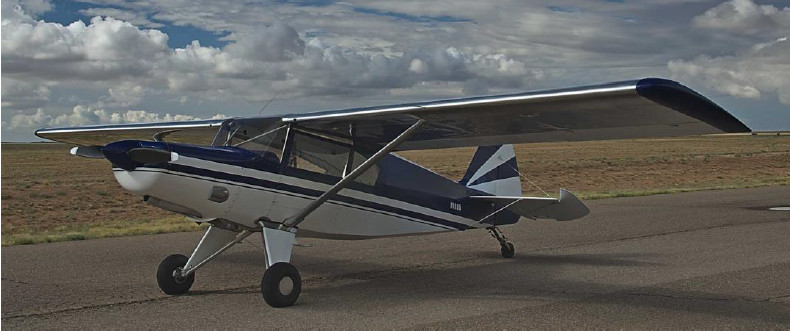
I’m happy to report that I successfully flew our 4-place Bearhawk, N805TB, for the first time on December 11th, 2013. The flight went very well, with about 30 minutes of circling high over the airport. N805TB started as a quick-build kit from Avipro (now known as Bearhawk Aircraft). We purchased our kit from another builder in 2009 and have somewhere around 1800 hours of build time since then. The engine is a normal-compression Lycoming O-360 that Bob built for us. He estimates that it produces 190HP. The Hartzell prop came off of a 2005 Husky, and has 7666A blades. These blades are a little bit shorter than the usual 80” prop, but the harmonics are such that a dampener is not required, which saves some weight and cost. The instrument panel includes a Dynon D180, D100, and HS34, which connects the Dynons to the Garmin 430 GPS. There’s also a Garmin GTX327 transponder in there.
With so many electric gadgets, I wanted to have a robust electrical system, so I used the architecture from Bob Nuckolls’s Z13/8. The skylight and windows are .060” polycarbonate, and as the in-flight GoPro image exaggerates a little, cockpit visibility is spectacular. The weight per square foot of the polycarbonate is slightly less than that of .032 aluminum. 805TB’s exterior finish is Polyfiber Aerothane, and it looks great from a distance. Let’s just say that by the time I finished with it, I had learned lots about how to make a nice paint job! We chose the scheme for its high contrast and high visibility, so that it will be easier for other planes to see us in the air.  The empty weight came to 1328. That doesn’t include a few parts that I’d like to add later, such as a floorboard covering, rudder cable guards, and wheel pants. Our home airport is a small grass strip with no good landing options in the event of an engine failure after takeoff. As such, we relocated the airplane a few miles north to the main municipal airport for the first few flights. The Hickory airport was very well suited for final assembly and flight testing, with a pair of nice long runways, a fuel pump, a fire station, and a tower. I thought that the most pressing threats for the first flight would be engine-related, such as high CHTs, or worse, a loss of engine power. Fortunately everything worked out well, with the CHTs very seldom above 400 degrees F. Since the engine is a new overhaul without any test stand time, I planned a first flight of circling the airport, as to facilitate a quick landing if necessary. I climbed to 3000 feet first, and did a few shallow turns to validate the most basic handling characteristics. Then I climbed to 5000 feet and made a few simulated traffic patterns and go-arounds. The elevator trim is very sensitive, such that having it in the wrong place for takeoff makes for a shock. Even with the newer small trim tabs, I’m still only seeing about 1/4 turn of travel throughout the flight envelope (as tested thus far). On subsequent flights I have had the speed up to 130 knots, and without any fairings I’m seeing a level cruise speed of around 100 knots.
 On the fourth flight I returned the airplane back to our home airport (left) and was glad to be finished with the relatively expensive second hangar in town. In all the final assembly process took about three weeks longer than it should have, due to delays with getting the polite but understaffed guys from the FSDO to come do the airworthiness inspection. If I had known that it would taken them that long, then obviously a DAR would have been a cheaper option. I’m looking forward to a productive Phase 1 full of data collection and plenty of family adventures in the coming years. My building log (complete with tales of many trial and error learning sessions) is available at http://bearhawkblue.com.
Heath Sneller’s Bearhawk
Source: 2013 Q4 Beartracks, Mark Phillips
 Just about all builders I talk to have every intention to keep their plane light. We all know what we have to do to
make that happen. It doesn’t seem like much, but an extra coat of primer here and leather seats here all adds up.
I would bet almost everybody looks at that final weight and thinks that it is a little more than I thought it would be. Heath Sneller has proven with his Bearhawk you can have everything you want in the aircraft and still keep it light.
In 2008 Heath decided he wanted more airplane than he had with his Cessna 172. His Skyhawk was a good airplane but wanted more performance. He knew he needed four seats because he liked to use the airplane to travel with his wife, Sarah and two sons, Cody and Bryce. The 172 was great to have while attending college at the University of North Dakota. After moving away from Grand Forks, ND and working as an airline pilot he knew it was time to trade up. He found a project in Montana, sold his Cessna and drove out west to get the Bearhawk from Don Lorenzen. Plans #143 was back in central Minnesota and work started in the summer of that same year. His property west of the Minneapolis was the shop for the first several years. Sarah obviously backed the project because when I say the project was home it was really home. Heath said that there were airplane parts everywhere. The bathroom even doubled as a storage area for wingtips. The back yard doubled as the paint shop for priming the fuselage. I think he said he even fitted the wings to the fuselage in the yard.
 When it came to the power plant, he thought, as many others do, that a Lycoming O-540 (pictured left) would be a good choice. Combing Barnstormers, he found one in Colorado. After another trip west he arrived back home with his engine and mounted it. Pairing this engine with a three bladed Catto prop was surely a huge weight savings measure. The Cattos are wood core, carbon props that are made for you specific to the aircraft/engine combo you are going to install it on. The props are painted to match your color scheme and have a nickel leading edge (pictured below). The project was well on its way when he bought it.
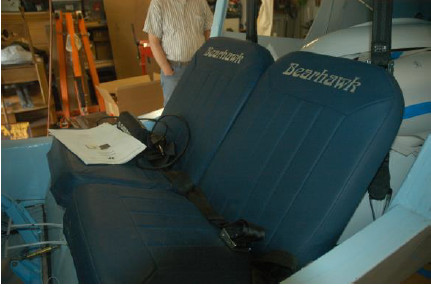
Being started by someone else it was built without the cargo door. The door is a great feature but Heath thinks he will be able to make it work by lining the cargo compartment with a .025 aluminum in a “bath tub” type configuration. He made tie down points on the floor for cargo. This will make it reasonable to throw bags and other items into the back with seats that fold forward. Bob Barrows estimates that eliminating the cargo door saves approximately 30 pounds. Further significant weight savings can be found in the construction of the front and rear seats. Heath used a light weight fabric and sewed the covering for the seats himself (pictured above). The seats are very functional and durable looking while utilizing a light weight fabric.
The panel is simple yet very functional including everything you need for VFR flying. The centerpiece is a Dynon Avionics Flightdek D-180 EFIS. It has all the primary flight instruments as well as up to 16 engine gauges. A docking station for a Garmin 196 GPS installed into the instrument panel makes navigating simple and accurate. A huge weight savings is realized by using a MGL V6 com radio. It is small; in fact it fits into a standard 2 ¼” hole in the panel. It has a built in 4 place intercom and a standby frequency. A Garmin GTX 327 transponder rounds out this smartly arraigned out panel.


Only the fabric covered parts of the exterior portions of the aircraft are painted. He chose Stewart Systems because of its ease of use and lack of harmful chemicals. It is hard to calculate how much of a weight savings this generates. I’m sure it’s substantial. The graphics were made locally and affixed to the aircraft in sections. The airplane was outgrowing its home so it was time to make the move out to the hanger at the Maple Lake, MN airport KMGG. With everything on the airplane the day to weigh in came. The empty weight came in at 1366 lbs. This seems a staggering number for an O-540 Bearhawk. I guess it gives some of us a number to shoot for.
Late in the summer everything was coming together and it was reasonable to expect a first flight before the end of 2013. Heath flew with CFI Dave Tannehill to brush up on flying with the little wheel in back. Heath has recently completed his first flight and will conduct all the flight testing himself. I’m sure the family will be able to enjoy some trips together next year.
Bearhawk N1685 Update from David Bice
Source: 2013 Q2 Beartracks, David Bice
I talked to Bob several years ago and saw his 0-360 Bearhawk at Oshkosh. For the flying I wanted to do, I decided to use Bob’s angle valve 0-360 with a McCauley constant speed prop, and to build my Bearhawk as light and simple as possible. I wanted it light to provide good performance with the 0-360 and simple for easy maintenance.
The level of simplicity I choose was a step up from Bob’s 0-360 Bearhawk. I wanted an electrical system to power a Becker Com and Transponder and a panel mount Garmin 496. It is day VFR only with no lights or strobes, and a small 8 amp alternator mounted to the vacuum pump drive provides enough amperage. Although my Bearhawk is not as light as Bob’s 0-360 with no electrical system, my empty weight was 1310 lbs.
I primarily use my Bearhawk for aerial photography. I have flown it for 168 hours and I am completely satisfied with the performance. It has been almost totally maintenance free. Double Eagle airport in Albuquerque is at 5,837 feet and I’m off shorter than anything else at Double Eagle and the climb rate is good with around 1,000 fpm when cool. Many of my photos are taken over mountains that are around 11,000 feet high. Today I was at 12,500 feet taking photos over Mount Taylor. When taking photos I use a couple of notches of flaps with low power settings of 15-17 inches mp and 1900 rpm, even when flying over 12,000 feet. However, even at this low power setting, if I my Bearhawk trimmed a little up, it still climbs. I was distracted taking photos over the mountains near Los Alamos, NM last January and ended up at 15,200 feet.
When flying to somewhere to take photos, I fly at 19 inches mp and 19 rpm which gives me 115-120 mph with a fuel burn around 5-6 gallons/hr. I’m fortunate I can buy ethanol-free auto fuel which is all I have used for the last couple of years. It is inconvenient to have to transport, test for water, and strain the fuel, but the plugs run clean and I have had no issues. Low power settings and auto fuel makes for inexpensive flying.
Bob told me he likes the angle valve cylinders because the added fin area cools well. Yesterday was close to 90 degrees when I departed Double Eagle. During the climb to 12,500 feet, the highest cylinder head temperature was 290 degrees and the highest oil temperature was 212 degrees. Although heavier than parallel valve cylinders, they do cool well.
I built my Bearhawk as designed with only one exception. I had trouble latching the window open or unlatching it in flight even at 60-70 mph. I came up with a simple method to hold the window up in flight or on the ground that works great. I mounted a super magnet on the bottom of the wing where the original clip was located. I push the window open in flight and the magnet grabs and holds it open. To close it, I simply pull it down. It works great, it is simple, and light.
My simple, light Bearhawk doesn’t seem to be what most builders prefer. However, it is exactly what I wanted. Because it is stable, flies great with just rudder, has very benign stall characteristics, has little wind in the cockpit when a window is open, I can’t imagine a better airplane for aerial photography. I can say without reservation it is the most enjoyable airplane I have flown.
Lynn Riggs Builder Update
Source: 2013 Q2 Beartracks. Article and Photos by Mark Phillips
Lynn Riggs is nearing completion of his 10 year project. Is tough to know how much of that last 90 percent is really left, but it looks as though plans #656 is almost there. Lynn plans on having his Bearhawk flying in August, which seems likely. 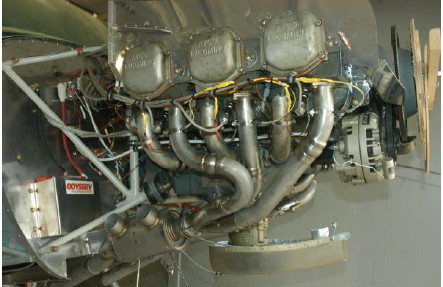
Kit #22 was received in 2003. Lynn saw it on display at Oshkosh and was able to get it after the show, it was delivered to him in the Minneapolis area so they didn’t have far to bring it. Now he had a fuselage so it was time to get some wings. Wing kits #3 and #4 were available. He bought them from Jim Clevenger in Florida. Lynn plans on flying his Bearhawk in a multitude of places and for many different uses.
 He spends time in Utah and is looking forward to exploring some of the backcountry in his aircraft. Because he plans on flying in and out of some high elevations it only made sense to pair his Bearhawk with a 230hp Lycoming O-540. He got it from a PA28-230 that suffered a minor incident. A Hartzell 2 bladed constant speed prop will round out the business end of the machine. This is the same pairing of prop and power-plant used by the Cherokee so it should prove to be a good choice. When the airplane is on the ground it will be sitting on 800-6 tires with brakes on both sets of rudder pedals. It looks like a real nice compromise for utilizing paved runways and some less than perfect strips away from the majority of people. Lynn is installing a big skylight to give a good view to the world outside.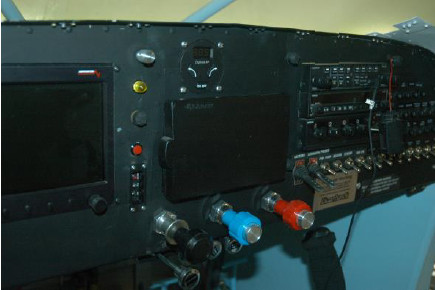
The interior will be a perfect balance of comfort, technology and sensibility. Lynn had his seats covered with a, soft, good looking blue leather. Very firm and comfortable yet did not seem much heavier than if they were made from another heavy cloth. A DigiTrak autopilot system will really be a nice feature for cross country flights. A Garmin radio stack will make communications simple and reliable. The EFIS by Advanced makes the whole panel look tidy. A few gauges round out the panel. The fabric and paint are from Stewart Systems. He chose to go with silver with sky blue accents. It really makes for a sharp looking combo.
Lynn made a couple of personal mods to the design which make his airplane unique. First he decided to hinge the front doors on the top to make for easier entries and exits of the aircraft. There are a few people who have done this with good results. The second change involves moving the control of the flaps from the floor to the ceiling. To do this Lynn used a crank with a sprocket to run the flaps.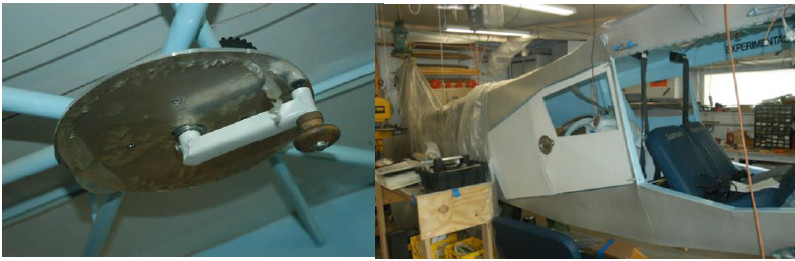
This is Lynn’s first aircraft project. Before retirement he was a pilot in the Army, flying both fixed wing and helicopters so in some building tasks he had to just learn as he went (like many of the rest of us I guess). He found the most challenging thing to do was closing up the skin on the wings. The closer you get to the trailing edge you start running out of room and small hands are needed to work in and around the rear spar holes.
UMBHBBQACE 2012
Source: 2012 Q4 Beartracks, Mark Phillips

Bob and Mark in deep conversation. Photo by Mark Phillips
Late October weather in Wisconsin can be a tricky thing. This particular weekend turned out to be as good as can be expected. Scattered clouds and temps in the low to mid 40’s were perfect to bring a group of Bearhawk builders to Medford, Wisconsin. Dwayne Parkinson, his wife Lori, and Chris Owens (we all know that Lori probably did most of the work) planned this annual event. The lure of some Wisconsin Cheese, brats and burgers was enough to bring people in from as far away as Northern Minnesota. As mentioned earlier the weather cooperated so most people were able to fly in. Mark J. flew an Arrow down, Brady and Caleb flew up in a RV6A, Chris made a short trip up in a Piper Dakota and I picked up Bob and Joyce T. in Rice Lake WI, the three of us loaded up in a Comanche and were the last to arrive.

Caleb, Dwayne and Mark Inspecting fine craftsmanship. Photo by Brady Lane
A quick scan of the ramp would yield no Bearhawks but one needs to take a closer look to see the three Bearhawks (or parts) that were there for everybody to view. It was great to meet people in person that up to that point were known only in correspondences. Everybody that wanted to was able to show off something about their project or impart knowledge to those of us that need it. All in all I’m sure everybody learned something. As advertised the food was great and plentiful. It wouldn’t have been a true Wisconsin gathering without the cheese and the event did not disappoint. I hope to see everybody and more next year.

Pictured from left to right: Mark Phillips, Lori Parkinson, Steven Parkinson, Dwayne Parkinson, Mark Johnston, Christopher Owens, Caleb Ihrig, Brady Lane, and Bob Triplett. Photo by Joyce Triplett
Curt Malecha’s Bearhawk
Source: 2012 Q3 Beartracks, Mark Phillips
Few things are better than a summer day in Minnesota when the temperature is about 80 and there are just a few clouds in the sky. You add a beautiful Bearhawk and you have a perfect day. As a scratch builder of Bearhawk plans #1228 you can imagine how excited I am to see other projects and see how other people are making these crafted pieces fit together. When you get the chance to look at a completed aircraft you jump at that opportunity and take a look. I’m sure everybody that is building an airplane has looked to see how many of that type are in the area where they live. I found out about a flying Bearhawk about 100 miles from my house so I started to do some research. It wasn’t really all that hard, I knew the owners name, Curt Malecha, and looked him up and left a message. The next day he called back and we started making plans on when we could meet to get some pictures taken.
We set up a date about a week in the future and hoped the weather would cooperate with our plans. The day before our planned day a quick look at the forecasts showed that things looked good. Scattered clouds and light wind all spelled good news. I shoot out of a C172K, only the left side window opens so I asked Chuck Schmidt to fly while I would be shooting. I called Curt and Chuck to tell them we were good to go the following morning. Mother Nature was not going to let me off that easy. I woke to fog outside and 1/4sm visibilities, but a quick check on the computer of forecasts and currents made me feel at ease as I was pretty sure this fog was going to lift early. I feel confident in my ability to read into the forecasts and in my knowledge of weather. On the way out to the airport a quick call to Laurie at the Princeton FSS confirmed what I suspected. A very nice, hour long flight and we were there.
As I taxied up to the ramp in Fergus Falls there it was sitting all alone on the ramp. The sun was shining on the airplane and with no one around; I couldn’t pull up and shut down quick enough. We agreed to meet in the FBO, but I could not resist, I had to go over and take a look at the first Bearhawk (that I know of) I have seen. Curt came out to greet us. He understood that I had to take a look. We went inside the FBO and started to go over a time line for what we wanted to get done. Curt told us that some of the local pilots got together on Fridays and made lunch. Today they were doing pork chops on the grill and baked potatoes, and we were welcome for lunch. This day just kept getting better and better.
Curt taxied the Bearhawk out onto the grass (where it is at home) so I could start to get some photos; he then went to tend to the chops. The Fergus Falls municipal airport has great facilities and the two runways were in great shape, and all the taxiways and ramps were in tip top condition as well. Over lunch I learned of two other homebuilts finished last year based at the field, a Kitfox owned by Lawrence Deal and a RV10 by Jay Wik.
Quick Build kit #19 arrived at Curt’s business, a rental store, in 2003 and there the project began. With Bearhawk plans #672 it should be easy right? Not so fast. As happens, life took over and Curt and his wife Lisa built a new house, sold his business, and started another business, the FBO. During this time they also adopted 11 children to bring the total to 13. The aircraft’s registration N132CL was chosen for that because God gave 13 kids to (2) Curt and Lisa.
Curt calls it a slow build kit. It was a total of 2500 hours building and another 2500 hours of research to get everything completed. After eight and a half years of anticipating and dreaming, on December 28, 2011 in the morning Curt had an airworthiness certificate in his hand. After a lunch, Curt could not wait any longer and conducted the first flight by 1:00.
The first flight went very well, 1.1 hours near the home airport FFM. The reason Curt chose the Bearhawk was because he wanted a capable float plane, after the first flight he knew he made a great decision. Each test flight was recorded in an aircraft test log book noting and recording EGT, CHT, RPM, MP, fuel flow, altitude and outside air temperature. The only issues were door leaks and a yaw. A rudder trim tab fixed the yaw. The other problem was fixed with different seals. All forty hours were flown with no other issues.
The plane was made to eventually be on floats and by the end of summer may never see wheels again. With this in mind, aux fuel tanks for long range fishing trips, and float attach fittings were installed. The custom sea plane doors were designed to be simple and easy to latch with lots of visibility. The doors are hinged at the top so a person could easily get out and walk forward on the float when approaching docks. The biggest obstacle in making the door was the strut. Shortening the door and raising the door jamb fixed that problem. After installing a gas lift strut the doors were perfect. EDO 2870 floats are getting redone as this is being written.
The aircraft is powered by a Lycoming O-540 producing 235 hp. A McCauley 8452 fixed pitch prop was installed and the verdict is still out if that was a good decision. It runs smoother than most 540s because of a LSE plasma II ignition and tuned SS exhaust. An ACS 2002 EMS was a good choice and they have been a great company to work with. A dual battery system works well for remote fishing.
Several years ago Curt was at Oshkosh looking at avionics. He found what he thought would be the perfect setup. He bought a Blue Mountain EFIS, who would have known we would see such advancement in avionics. He admits he may have bought a little prematurely. Custom leather rounds out the interior.
The exterior was done with Stewart Systems paint on the fabric and urethane on the metal parts. The paint and color scheme were picked by Curt’s daughter Genevieve. Because of her talent, everybody can appreciate how great it looks, and how well the colors look together. He said it was fantastic to have her help in the building process and lots of fun.
After lunch the plan was for a quick twenty-thirty minute flight to get about 300 air to air pictures. This was going to be simple, right? Everything worked great until Curt peeled off to do a 360 degree turn to get some banking shots. Who would think that a two toned brown and green C172 would be hard to see over forests and marshland. After 10 minutes of calling off landmarks to each other we got back in formation. We flew back towards the airport while I took more pictures. There was just enough time left in the day for one more quick flight. I was thrilled to get a chance to fly the plane, it flew as well as it looked.
The airplane would not look or perform as well as it does without the help of Kevin Cary. Kevin was instrumental in so many ways that without his help and knowledge there is no way that this Bearhawk would be flying let alone looking like a complete aircraft. Friends Craig Johnson and Lawrence Deal were always willing to help and provide wisdom and free advice. This was the first airplane project Curt built. It is said that it takes 10 houses before you build the perfect one. This may not apply to aircraft because there are few things Curt would do differently. Overall he is more than pleased with the almost perfect Bearhawk.
623MW heads to Maine
Source: 2012 Q2 Beartracks, Charlie Thiemann
To make good on a promise made to my wife during construction, we packed 623MW up on May 12 and headed north from central Pennsylvania. Accompanying me was my wife Jill and children, Miranda (5) and Will (3). My wife is a LL Bean fanatic and the flagship store is located in Freeport, Maine. The closest public airport was KBXM in Brunswick, Maine. Without winds the flight plans out at about 3.5hrs. Our intended route from home was to 1B1 (Columbia County, Hudson NY) then on to KBXM.
We cruised at 130mph TAS between 4000 and 6000 ft. Navigation was via the GPS map on the Dynon Skyview and I also had my iPad running Foreflight. Both worked great and are highly recommended. We departed around 0730 on May 12 into calm sky. The flight to 1B1 was uneventful and we stretched our legs and topped off with fuel as planned, and of course the winds aloft were blowing out of the North so ground speed was a bit reduced. We loaded the kids back in and headed out for the second leg. Somewhere in southern Vermont the calm air ended, we battled the last hour in to KBXM in increasing turbulence. We had originally planned to fly around Portland but with the increasing bumps, got a vector to go straight thru.
KBXM is the former Brunswick Naval Air Station, I assume sometime in the days of BRACC it was closed and recently was turned over to the local airport authority as a redevelopment project. The two parallel runways (1/19) at 200×8000 and ACRES of taxiway, ramp and tiedowns certainly speak to its past use. I understand from some folks formerly stationed there that a lot of transition training was done at this location. That large runway was a blessing with winds from the west at 20kts G25, both for us and the Cirrus was following us in. The Bearhawk handled the situation well, I am not sure how much, but we still had some rudder left. Lineman was great, got us tied down right away and the office had our rental car ready and opened the gate so we could drive out to unload the stuff we had into the car. They told us to call when we got to the old base check point on our way to the ramp in the morning and they would meet us at the gate.
By this time it was about 1300 and we dropped our stuff at the hotel and headed into Freeport for lunch. We ended up at the Jamestown Tavern and all thoroughly enjoyed our lunch, at least as much as you can in a coastal town with a family allergic to shellfish. The rest of the afternoon was spent at LL Bean and thankfully it was not a disappointment as Jill left thoroughly satisfied. We strolled around the shops in Freeport until evening set in and returned to the hotel. Based on the weather at home we decided to leave the following morning after a “healthy” breakfast at Dunkin Donuts. Again the lineman was great, got us fueled up and took care of the rental after we unloaded.
The flight home was a bit smoother, and we used the same fuel stop at 1B1. I kept telling folks that I did not feel the same sense of accomplishment after the first flight of the Bearhawk as I did after my first homebuilt. I am not sure if it was due to it being the second or that we built it with the expectation of going somewhere and hour around the patch was just not exciting. Well, the elation of building and flying this plane has finally set in.
Family Building
Source: 2012 Q2 Beartracks, Steven Chase
They say every good story begins with “There I was…” So- there I was, one dark and stormy day, finishing up the wings for my wooden Pietenpol, when my exuberant teenaged daughter barged in like the Great Santini!
Smiling, she loudly announced, “I’m here to build an airplane!” then added, “Where do I start”!? Now, most parents with a sense of humor would chuckle and reply with “you can start by making us something for lunch”. However, knowing my daughter, even when she is half-kidding, I do not take these proclamations lightly, as she normally makes good on her endeavors. Instead, I simply replied; you’ve helped me quite a bit with this one, but if you want, you can get started on my Bearhawk Patrol; showing her the recently arrived boxes filled with tubing, inventoried and sorted religiously in the back of my shop. I quickly offered her a reciprocal challenge; “but first you have to learn how to weld”! Her face lit up more from this than from any present received that Christmas. I stopped what I was doing and we spent the rest of the afternoon welding small sculptures, first with oxy/acetylene and then with TIG. By that evening she was laying strings of beads on practice plates, which made my jaw drop, and she loved it!
 During World War II women stepped in to play a significant role in military production. Women welders of course came to be known as “Rosie”, “Rosie the Riveter”, and in shipyards, “Wendy the Welder”. These women certainly earned their place in history, not just for filling in, but for their outstanding quality of work. Fast forward 70 years, and my daughter Caitlin “Cat” (as she is known to her friends), is holding up their proud tradition, and giving me insight into why these women, excellent welders all, were so appreciated, possibly as a function of their skillful, steady, patient hands. In addition to her normal freshman college classes Cat signed up for several welding classes. To say she excelled would be an understatement, in fact she certified in advanced TIG (3G and 4G) almost immediately, spending a majority of her time helping other students, or practicing with bargain boxes of 4130 tubing. She constantly reminded me, with enthusiasm, of her desire to start the Bearhawk as soon as possible. Now it was up to me to uphold my part of the bargain and in quick order. After all, how often do we get a chance to fan the flames of such dynamic youthful exuberance?
Instead of completing my Piet before starting my Bearhawk Patrol, I rearranged my shop to accommodate working on two aircraft at once (btw, there is no law against this). Over several days we built an 18’ long table; then cleaned, prepped, jigged, and aligned tubing, finally declaring the fuselage bottom ready to tack. We were going to start our first welding on our Bearhawk and I was a bit nervous, but she was as cool as a cucumber. Her confidence reminded me of how “Rosie” just stepped up to the plate, making it look easy, allowing talent and skill to carry the day. I looked over her shoulder for a time as she methodically stepped through joints making perfect tack after perfect tack. We had officially started our Bearhawk journey and she was doing the welding, with much better skill than I possessed, and she loved it. I realized the best help I could be at this point, was to go make us something for lunch!
Updates from Bob Barrows, LSA First Flight
Source: 2012 Q1 Beartracks
 The new Bearhawk LSA has flown! After 21 hours of preliminary flight testing, Bob has decided that his ninth airplane is a resounding success. The new design is similar to the Bearhawk Patrol, but features several weight-saving differences. For example, none of the flight controls are mass-balanced, and the tail surfaces are not aerodynamically balanced. These modifications save weight, but limit Vne to 140mph.
The LSA has no flaps, and smaller fuel tanks, with a total capacity of 30 gallons instead of 55. Bob built the prototype with .016 wing skins, but has since decided that it is worth the 10-pound penalty to use .020 instead. The prototype features a Continental A65/75 and basic mechanical VFR instrumentation.
Previous tests of very light weight electrical instrumentation showed the cost and weight to be wash when compared to quality mechanical instruments.
The maximum gross weight is 1320 pounds (per LSA rules) and the empty weight is 728 pounds. Bob has flown most flight tests with a gross weight of approximately 1000 pounds. At that weight, takeoff roll in grass is 200-300 feet, climb rate is 900 FPM, cruise speed is 110mph, and stall speed is 30-35mph. One flight test at 1220 pounds (simulated 200-pound passenger plus pilot and half fuel) showed a climb rate of 700 FPM. Bob says that the handling is very good, with good control harmony. Ailerons are the lightest, followed by the push-pull elevator, and finally the rudder. He says the control forces are very nice- lighter than something like a Cub, and of course heavier than something like an RV.
Bob intends to sell plans for the new design later this summer. The cost for plans sets will be $275, which will include some very basic building instructions. He says that the building techniques are very similar to the other airplanes and recommends the resources for those. When I asked if he plans to keep the prototype for the long term, he says that he plans to keep it and fly it. He enjoys all of his airplanes very much, but since this one is so light, it’s the easiest to get in and out of the hangar! It is also set up for skis, so Bob won’t be grounded when it snows. Bob is also rebuilding the damaged Patrol prototype, with the help of an apprentice and a set of Avipro wings. More next month!
Dream. Build. Fly.
Source: 2012 Q1 Beartracks, Brady Lane, BH #1190

On the left is Chad Jensen, EAA’s homebuilt community manager and also a technical counselor who joins us in the shop most Tuesday nights to monitor the chat room so Caleb (right) and I can keep working. In the photo we are celebrating the completion of our ribs.
Caleb wasn’t looking for a partner in the project but welcomed the idea after I convinced him our skill sets complimented each other and we could split all the costs 50/50. Most importantly, we could keep each other motivated throughout the project.
I was already a pilot but the furthest thing from a grease monkey. Changing the oil in my snow blower and F-150 was about the extent of my skills. However, I was longing for a meaningful project— something that would teach me new skills and provide a more meaningful way to spend my evenings than watching TV, surfing the Web or Facebook.
I also love taildraggers and grass strips, and have a family who enjoys camping and going to pancake breakfasts. The Bearhawk was the ideal plane. With aluminum wings and tube and fabric fuselage, I would also finally have an excuse to learn to weld and rivet.
Time for confession: building has always intimidated me–even as someone who works at EAA. While I dreamed of owning my own plane one day, I knew I couldn’t afford one that I really wanted and didn’t have the skills or experience to build one myself. Taking on a project like this with a partner, however, was a different story.
Caleb and I agreed to take the project at a pace we could afford and sustain. We’re not making any speed records, but we are making healthy forward progress. What makes our project most unique is that we decided to stream live video every week while we work on the plane. With a small camera strapped to the bill of baseball cap, we stream close-up video of exactly what we’re working on every week.
Since we’re both rookie aircraft builders, we wanted to stream video for two main reasons:
1 – We wanted to show that building your own airplane is surprisingly doable. It isn’t rocket science. In fact, when you break it down to individual parts, it is quite simple and achievable. We wanted to show firsthand through our discoveries as first-time builders how achievable a project like this is. For example, for weeks we made airplane ribs with only two simple hand tools–a pair of shears and a hammer. The thought of building an airplane can be intimidating to many people (myself included), but building a single airplane part is not.
2 – We also wanted to welcome tips and insight from other experienced builders. These tips would not only benefit us, but all the other builders and future builders watching the show. It’s sort of a live, uncensored,
organic Hints for Homebuilders series. Every night we work there are dozens of tips shared in the chat room. Just this week, while we were drilling holes in our spar cap strips, we learned different techniques for drilling straight holes, were introduced to Boelube, and a cool little drill bushing from Avery Tools.
For the last 18 months, we’ve thoroughly enjoyed getting to know many of you via the live video stream. You’ve saved us many headaches with your advice and tips and I can say with full confidence, this plane will fly one day because of your help and encouragement.
 The Bearhawk community itself was also one of the convincing reasons we decided to build a Bearhawk. The plane is not only a great design, it is also greatly supported. Bob Barrows and the folks at Avipro are always just a phone call away and welcome any question. We’ve also been impressed with the supportive and engaged group of builders on the yahoo group, ready to field any question you throw at them. We hope our Tuesday night live video broadcasts offer just one more way to showcase the great community that is available to builders.
Whether you’re still in the dreaming phase of a project, a rookie builder like us, or you’re an experienced builder, I invite you to log in periodically to check out our progress, learn from our experiences (both the good and bad), and interact with other builders in the chat room.
See you this Tuesday, 6:30-9 pm (Central) at www.DreamBuildFly.com