Daryl Rhodes Flies his New Bearhawk LSA N367G

Source: 2019 Q4 Beartracks
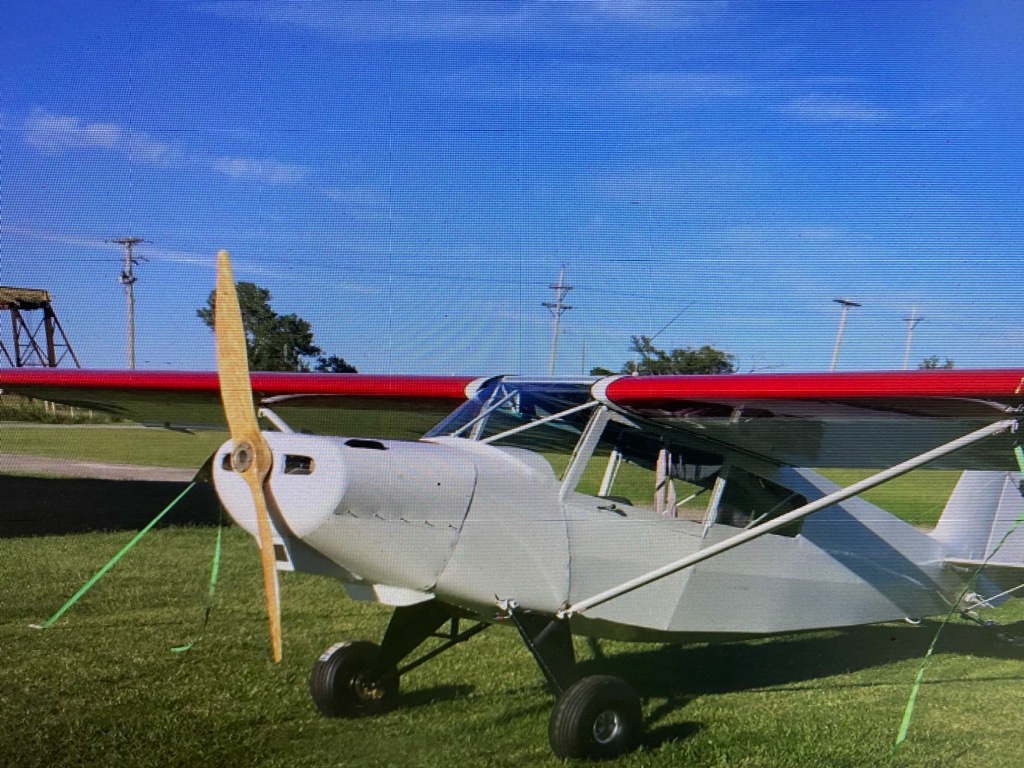
Building a homebuilt airplane is always a large achievement. Daryl built his new LSA in 2.5 years, without a kit! Well, it really took two years of construction, but it took a little while to get all of the paperwork and such done. He used the Stewart covering process, and a “little bit modified” Continental C-90. Empty weight came to Continue reading

Bob’s Carbon Fiber Prop and Carbon Fiber Wingtips

Source: 2016 Q4 Beartracks
Lots of exciting things are happening at Bob’s shop. Specifically, things are getting lighter, thanks to more use of carbon fiber.

He has expanded testing on the carbon fiber propellers that he has been making. Readers may remember reports in the last year of Bob testing lots of different props. He found the best performance from the aluminum McCauley prop, which weighs around 22 pounds. Knowing that he could do better with carbon fiber, he developed a process to lay up a carbon prop by hand. The process involves a mold for the front of the prop, and a mold for the back of the prop. He and his composite expert Lauren take turns laying up plies of carbon fiber cloth, around 8 layers at the tip, and perhaps as many as 90 at the hub. They alternate layers and each work on both sides of the prop to help ensure that minor variations in individual technique doesn’t impact the balance of the prop. Once those two layups are done but before they are cured, the two halves are joined for the final cure. The finished product is mostly hollow, except for the last few inches of the blade. As one might expect, the prop requires a fair amount of finish work once it comes out of the mold. Bob has developed a leading edge treatment that is a stainless steel powder mixed with resin, which yields an abrasion-resistant coating that is easily field repaired with a product like JB Weld.
The first prototype has over 200 hours of operation on his Bearhawk LSA, spanning almost two years. The second prop has around 30 hours, and he has a third that is ready to begin testing. He plans to offer the props for sale on a very limited basis, such as 3-4 props per year. The construction process is labor-intensive, and he plans to test/prove each prop with at least 10 hours of operation on his own airplane before shipping. The cost will be necessarily high (expected to be around $1800 per prop) but the total weight is a mere 8 pounds, and the performance is as good as the metal McCauley that he likes. Perfor-mance will be great on any airplane in the 100hp/100mph class, but the prop is specially designed for the Bearhawk LSA. He also plans to develop a similar prop for the 180hp Patrol and 4-Place in the com-ing years, which will weigh less than 15 pounds.
R&B has also expanded to offering carbon fiber wingtips. These wingtips cost a little more than the fiber-glass, but the weight savings is around 1 pound per wingtip. As Bob says, “Sometimes pounds are hard to find.” These tips are made in a female mold, laid up by hand by Lauren, who is also female. The virtue of these and other composite parts from R&B is that they are made with just the right amount of resin. Less experienced builders may have trouble by adding too much resin, increasing weight, or too little, reducing strength. The extra cost is $50 for the LSA and $55 for the Patrol/Model B.
Many builders are interested in the Model B plans for the 4-place. Bob has been working hard on the drawings and a “good share” of them are finished. He hasn’t set a firm deadline, but doesn’t plan to have them available to ship for at least four weeks.
Bob would like to plan a long trip to Idaho in mid-June 2017. He’d plan on spending 3-4 days to get out there, 3-4 days to get back, and 4-6 days of flying around the backcountry. If you’re interested in joining him, please get in touch by phone at 540-473-3661.

Patrol and LSA Takeoff and Landing Tests

Source: 2015 Q2 Beartracks, Bob Barrows
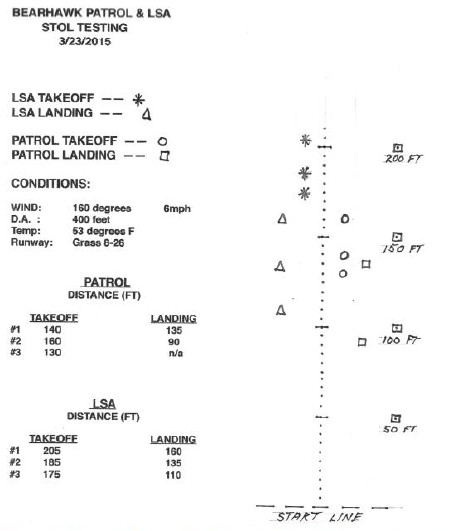
15q2nBob has been testing several different propellers on his Patrol and LSA prototypes. Here are the results of his favorites. For these tests the LSA was running a McCauley metal prop, and the Patrol was running a Hartzell Trailblazer prop. Mark Goldberg has just installed the same prop on his Bearhawk Patrol. Contact Mark to ask about special OEM pricing for orders through Bearhawk Aircraft.


15q2o
Continue reading

Bob Barrows Update on Carbon Fiber, Catto Prop

Source: 2015 Q1 Beartracks
It seems that Bob is seldom idle, and this winter is no exception. He has been testing a variety of props on all three designs, and recording results of static thrust tests and top speed. The snow image below shows the Catto prop in use. Bob says it “runs smooth, makes good speed, and the static thrust is a little bit better than all but the McCauley metal prop.” He’s been pondering the suitability of carbon fiber for prop construction, so he conducted a strength test of two identically-sized samples. One sample was 6061-T6 aluminum, and the second was a carbon fiber shredded material, in a hand layup bound with West Systems epoxy. The test pieces measure .9 inches wide and .19 inches thick. They were placed on supports 12 inches apart, and received a load in the middle. The aluminum piece weighed 108 grams and the carbon piece weighed 52 grams. The aluminum started to bend at 70 pounds, and the bend in the picture is from 80 pounds. At 110 pounds the carbon fiber part flexed, but remained undamaged when the load was removed.
Carbon fiber testing
Catto Prop on a Bearhawk LSA

Fixed Pitch Prop and a Lycoming 0-540

Source: 2014 Q4 Beartracks, Heath Sneller
Catto PropThere seems to be some interest in running a fixed pitch prop with a Lycoming 0-540 engine so I’ll just share my experiences. This set up isn’t for everyone and I won’t try to convince anyone that this is the best or only way to go, but it has met my build goals and so far has worked out pretty well. After I decided to go with a fixed pitch prop I contacted Craig at Catto Props and told him I wanted to go 120 mph and burn 8 g/hr. They will build it to go fast, slow, or anywhere in between. He did some number crunching and said that a 3 blade 80” diameter prop with a 55 degree pitch should work, and I believe he reached these numbers using a cruise altitude of around 8,000 ft. This sounded good to me so I told him to build it. Catto props use a wood core with a carbon fiber wrap and I elected to have the nickel leading edge put on.
In order to use this prop you have to change out the lugs on the end of the crankshaft that the prop bolts engage or use an aluminum spacer from Saber Mfg. I used a spacer from Saber and I believe it’s around 2 ¼ inches, this way if I ever decide to put a constant speed prop on down the road I won’t have to change my engine cowling. Another thing to consider when ordering a prop from Catto is that you can get a custom fit spinner. The spinners that they use are from Vans and they drill the holes for the screws and make the cut outs for the prop blades. I ordered one with my prop and had to do just a little sanding in the blade cut outs to make it fit (about 15 minutes of work), so to me it was worth ordering.
So how does it perform? That depends on your mission. If it’s just me in the airplane and a slight headwind I can be off the ground in less than 100 ft (temp makes big difference), with a 1,000lbs of people and fuel and a temp of 90 degrees it takes around 1,000ft. This works for the type of flying I do, I am not going to take my family into a one way bush strip but if I want to play around by myself or with a small load in the airplane I can get into and out of just about anywhere.
So how does it cruise? During my testing phase at 3,500ft msl and 2050rpm it gave me TAS of 100mph and burned 7.5 gph. On a recent hunting trip I flew at 5,500 and 6,500ft msl turning 2250rpm and burned 7.8gph with a TAS around 110-115mph. So far in the first year of flying it I have put on 90 hours and 70% of that has been just local flying at 1,000ft agl burning just over 7 gph at 2000 rpm. I really don’t care to go fast or high, the only time I get above 1,000agl is to get a smooth ride with passengers on board. If I flew at 8,500ft I could probably get close to a TAS of 120mph and a fuel burn of around 8 gph, but I like to stay close to the ground and look at stuff. The things on my airplane that probably rob it of speed are 8.50×6 tires, round tubing for shock struts, and that my gear legs are not streamlined.
Overall with this set up it is very close in speeds and fuel burns to the Cessna 172 I use to have, it just uses a lot less runway and can haul a lot more weight. If I want to go fast it will but it’ll just burn a lot more gas. With a constant speed prop I know I could go faster and get off shorter when fully loaded but for now it works and meets my mission.

New Hot-Rod Bearhawk Patrol in Virginia

Source: 2014 Beartracks, Jared Yates
14q2oHatcher Ferguson and Don Aldridge have just completed their second Bearhawk Patrol, and it is a showcase of experience and ingenuity. The two built N22HD with performance in mind, and spared almost no expense. The fuselage is welded from a VR3 tubing kit, and the quick-build wings are from Bearhawk Aircraft. The engine started out as an ECI IO360, and now it flies as a fire-breathing 210HP example of “the best they could make it.”
Sky Dynamics of Moneta, Virginia modified the engine with a light-weight cold-air sump and induction system, lightweight flywheel, and 4-into-1 exhaust system. After the modifications Sky Dynamics ran the engine on their dyno to validate the performance gains. Two P-mags drive the electronic ignition system, and the fuel injection servo is from Don Rivera at Airflow Performance. Hatcher and Don Aldridge initially purchased a used Silverhawk fuel injection system on eBay, but the engine ran terribly with it. They took the servo down to Airflow Performance and found that it had been contaminated with water. Airflow Performance swapped out their servo for another, and now it runs beautifully. All of that power is turning an 80- inch carbon fiber Whirlwind prop, and Hatcher reports takeoff rolls consistently under 100 feet. Why did they install such a high performance engine? When I asked, the answer was along the lines of “to see if they could.”
Hatcher and Don know that the best way to further boost performance in an airplane with this type of hot-rod engine is to reduce weight. They considered weight savings in nearly every construction decision that they made. For example, they eliminated the skylight, rear seat throttle control and brakes, and the baggage door. They installed light-weight single puck brakes, used micro nutplates throughout, substituted #6 screws for #8 screws whenever possible, and minimized the size of welded tabs. The lightweight tailwheel assembly is Bob’s design, built by Eric at BHTailwheels.com. They redesigned the seats to reduce the width of the rear and increase the width of the front, and had a hot-rod shop shape the foam and sew the leather upholstery. The miniature Becker radio and transponder save a few pounds, as does the vacuum-pad alternator. The lithium battery saves approximately 15 pounds over a comparable Odyssey, but it still turns the engine over with plenty of gusto.14q2p
In some cases they added a little bit of weight to make the airplane more safe and functional. The LED lights and strobes give better inflight visibility to other airplanes, and allow for flights later into the evening when the flying is good. Hatcher says “they’re all LEDs, which hardly weigh or draw anything.” When that engine is running at full power and burning 17-18 gallons per hour, cooling is a concern. A cowl flap adds a little bit of weight but keeps temperatures normal. In the end, this airplane’s empty weight is 1168 pounds, 30 pounds lighter than their last.
A local expert helped fabricate a two-piece all fiberglass cowling. This doesn’t save any weight, but the new cowl is much easier to install and remove, and it has a more complex shape that reduces drag. The installed cowl is the third one made from the female mold. The first was two heavy, and they reduced the thickness of each of the next two. Hatcher speculates that they could save a few pounds by using carbon fiber instead of fiberglass, and fortunately they can use the same mold with carbon fiber to test that theory in the future.
What’s not to love about such an advanced flying machine? The paint, according to Don and Hatcher. Everything was going well as they applied the Polyfiber covering system to the powder-coated airframe. After they started painting top coats with the same Imron paint that they used on their blue Patrol, DuPont discontinued the product and they had to switch to the new “XL Pro.” The new product didn’t match the old product to their satisfaction, so they had to repaint several parts, at an estimated expense of 10-15 pounds. Hatcher says that he’s not satisfied with the way the paint turned out, but I’ve yet to meet an amateur airplane painter who will tell you he is. If the two fly it to Oshkosh next month as planned, I suspect that they won’t receive any complaints about it, especially if it is parked anywhere near mine!
The big question is, how does it fly? The specifics are still pending as they refine the calibration of their instruments. Hatcher reports that it handles just like their last Patrol, but has a much shorter takeoff, steeper climb, and faster cruise. They have only taken it on a few short trips, so they don’t have good cruise performance data yet. Hatcher says for local flights he uses about 13” MAP, 2300 RPM, and gets 100-110 miles per hour at 5.9 gallons per hour. If he runs the engine hard in level flight, his cruise speed begins to approach the realm of VNE, which is the main reason that their Patrol is a little bit slower than their RV10. Bob Barrows has flown the airplane and says that he likes the way it performs. Like most experimental airplanes, this new Patrol still has a few tweaks in the works. The static RPM is only around 2600, and Hatcher would like to gradually adjust it up to 2700. He would also like to fit a set of his giant wheel pants (for 6-8.50 tires) and build some fairings for the shock struts. I asked if they had kept track of how much they had spent on the project, and Don said “Yes, but we don’t discuss that!” with a laugh. Both are quite pleased with the way the airplane turned out, and I’m looking forward to seeing it in person!

Heath Sneller’s Bearhawk

Source: 2013 Q4 Beartracks, Mark Phillips
13q4jJust about all builders I talk to have every intention to keep their plane light. We all know what we have to do to
make that happen. It doesn’t seem like much, but an extra coat of primer here and leather seats here all adds up.
I would bet almost everybody looks at that final weight and thinks that it is a little more than I thought it would be. Heath Sneller has proven with his Bearhawk you can have everything you want in the aircraft and still keep it light.
In 2008 Heath decided he wanted more airplane than he had with his Cessna 172. His Skyhawk was a good airplane but wanted more performance. He knew he needed four seats because he liked to use the airplane to travel with his wife, Sarah and two sons, Cody and Bryce. The 172 was great to have while attending college at the University of North Dakota. After moving away from Grand Forks, ND and working as an airline pilot he knew it was time to trade up. He found a project in Montana, sold his Cessna and drove out west to get the Bearhawk from Don Lorenzen. Plans #143 was back in central Minnesota and work started in the summer of that same year. His property west of the Minneapolis was the shop for the first several years. Sarah obviously backed the project because when I say the project was home it was really home. Heath said that there were airplane parts everywhere. The bathroom even doubled as a storage area for wingtips. The back yard doubled as the paint shop for priming the fuselage. I think he said he even fitted the wings to the fuselage in the yard.
13q4kWhen it came to the power plant, he thought, as many others do, that a Lycoming O-540 (pictured left) would be a good choice. Combing Barnstormers, he found one in Colorado. After another trip west he arrived back home with his engine and mounted it. Pairing this engine with a three bladed Catto prop was surely a huge weight savings measure. The Cattos are wood core, carbon props that are made for you specific to the aircraft/engine combo you are going to install it on. The props are painted to match your color scheme and have a nickel leading edge (pictured below). The project was well on its way when he bought it.
Being started by someone else it was built without the cargo door. The door is a great feature but Heath thinks he will be able to make it work by lining the cargo compartment with a .025 aluminum in a “bath tub” type configuration. He made tie down points on the floor for cargo. This will make it reasonable to throw bags and other items into the back with seats that fold forward. Bob Barrows estimates that eliminating the cargo door saves approximately 30 pounds. Further significant weight savings can be found in the construction of the front and rear seats. Heath used a light weight fabric and sewed the covering for the seats himself (pictured above). The seats are very functional and durable looking while utilizing a light weight fabric.13q4l
The panel is simple yet very functional including everything you need for VFR flying. The centerpiece is a Dynon Avionics Flightdek D-180 EFIS. It has all the primary flight instruments as well as up to 16 engine gauges. A docking station for a Garmin 196 GPS installed into the instrument panel makes navigating simple and accurate. A huge weight savings is realized by using a MGL V6 com radio. It is small; in fact it fits into a standard 2 ¼” hole in the panel. It has a built in 4 place intercom and a standby frequency. A Garmin GTX 327 transponder rounds out this smartly arraigned out panel.


13q4n

13q4m
Only the fabric covered parts of the exterior portions of the aircraft are painted. He chose Stewart Systems because of its ease of use and lack of harmful chemicals. It is hard to calculate how much of a weight savings this generates. I’m sure it’s substantial. The graphics were made locally and affixed to the aircraft in sections. The airplane was outgrowing its home so it was time to make the move out to the hanger at the Maple Lake, MN airport KMGG. With everything on the airplane the day to weigh in came. The empty weight came in at 1366 lbs. This seems a staggering number for an O-540 Bearhawk. I guess it gives some of us a number to shoot for.
Late in the summer everything was coming together and it was reasonable to expect a first flight before the end of 2013. Heath flew with CFI Dave Tannehill to brush up on flying with the little wheel in back. Heath has recently completed his first flight and will conduct all the flight testing himself. I’m sure the family will be able to enjoy some trips together next year.

Corvette LS1 Engine Updates from Ed Schweitzer, Late 2006

Source: 2006 Q4 Beartracks, Ed Schweitzer
LS1 Engine for a Bearhawk
Hello:
READER BEWARE. THIS GOT TOO LONG AND DULL. The transmission weighs 64 pounds complete for bolting on to an engine. I designed it so it can be used on any engine. The engine is a Corvette LS1. Aluminum block and heads. Its weight is 370 pounds. The prop will be in the same position as the prop of a Lyc O540. It has 350 hp at 5600 rpm. It has 350# of torque at 4200 rpm. (approx numbers).
The transmission swings the prop at 2700 when it is in low and the engine is running at 5600. The prop also turns at 2700 when the transmission is in high and the engine is at 4200 rpm. The concept I followed was to load the engine with the pitch to avoid over revving in high gear. The concept worked as predicted on my Q-200 and a Subaru engine before I learned that the fuselage was destroyed by invading gas. I did several taxi tests WITH A FIXED PITCH PROP.
The concept I followed is to allow an auto engine to work like it is intended and to avoid any modification. Auto engines have advanced so much while the A/C engine has the basic 1940’s design with a few “changes of an unsubstantial nature”. This must be so to avoid developing a new engine and keeping the old Certificates from FAA. If I am wrong about this correct me. They still use nitrite Hardening and magnetos as well as updraft carbs. I cannot see any difference between my fathers 1935 Case tractor carb and the carb on my previous O-200 Continential. I took both apart and reassembled them. The Marbel Schebler trade make label is even the same.
The reason I choose to use an auto engine without any mods is my belief that the auto makers want the greatest reliability in there engines. Too many dead cars on the shoulder will cause a question in the minds of new car buyers. The aircraft engine has some of the same features of a diesel, like low rpm for peak torque. This is necessary when swinging a direct drive big prop and not having mach tip excesses. With the 84 inch prop my Bearhawk prop will be at mach .94 when the plane is traveling at 170 mph and 2700 rpm. RED LINE rpms. I have worked on this transmission for 15 years , the last 4 years full time. Now I must finish the Bearhawk and test it in flight. I have a lot riding on this. I invite luck and constructive remarks. You are the unfortunate ones to see the first public pictures.
Ed Schweitzer
LS1 Engine on a Bearhawk