Source: 2010 Q1 Beartracks, Ray Gabriel
I ordered my plans number 334 from Bob in 1998. It took me one year to go over all the plans and order the material and get started on my project. I also purchased the wing and fuselage photo shoots. I fabricated the ribs first, then the spars, then I framed the wings and skinned the left wing on the top and nose. Was tired of working on wings so I started the fuselage. I had already built two sturdy steel work tables 4′ x 10′ with six leveling legs on each one before I started the project. I erected 2×4 jigs on the tables to hold the fuselage pieces. That was about 2001.
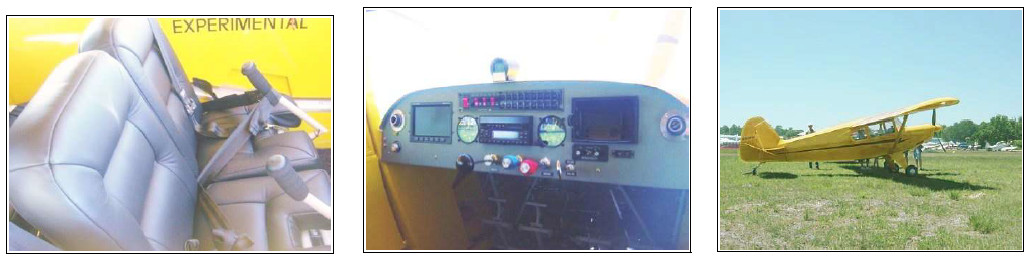
I have a small beef farm so I had many other projects while building my Bearhawk. I was remodeling my old farmhouse and I restored two cars and built a 48’x48′ hangar and runway. I February of 2004 I had to take time out for four heart bypasses. In 2007 I retired from fourty-three years of sheet metal fabrication and welding. I finished the fuselage complete with covering and painted in 2007. In October of 2008 I traveled to Bob’s Fly-In to pick up my O-360 Bob engine. Next I built the engine mount and cowling and finished the wings. Sounds done but much small stuff to do yet. 334’s welding was done with a TIG. I used Poly Fiber for my covering system. All exterior painting on metal is Imron Industrial. 334’s instrument panel is pretty basic. The radios are a transponder, one COM radio, and a Garmin 495. Tires are 8.00x6x6 on Cleveland wheels with double puck brakes. The tail wheel is a ten inch Bob wheel that I made.
334 was inspected in June of 2009 and became N786RG. My test area was centered at Appleton Wisconsin and had a thirty mile radius. I had very little tail wheel time, about twenty-four hours over a ten year period in a Citabria, so a friend Doug Osterberg who is a flight instructor accepted the offer to test fly 786RG.
The first flight 786RG encountered some pretty bad elevator flutter at a top speed of about 140 mph. After investigating we found the flutter started at the trim tabs. We found that the trim cables did not have enough tension or drag on them. It also had bent the trim control rods. After consulting with Bob and Mark I made a set of Delrin clamping blocks to put on the cables and increased the cable tension. We also eliminated the trim tab on the left side and made a heavier control rod. That fixed the problem. We also had a slightly heavy left wing which we corrected with tabs on the ailerons. Those were the only flight problems we have had. Doug flew the plane for the first ten hours. I myself now have about sixty hours in 786RG. I had 786RG at Air Venture 2009 for the whole week and plan to be back in 2010.
786RG has a 76”x56 pitch prop. It cruises at about 120mph at 2450rpm. It burns about 8 gallons per hour full rich. With three notches of flaps it stalls at 37mph and is very controllable. Empty weight is 1349 pounds. The takeoff roll with two 180 pound people and full of fuel is 300 to 400 feet and is very docile. The landing roll is about 500 feet. I have a 1300 foot runway so I am very happy with the performance.
I want to thank Bob for the tremendous support he has given me over these eleven years and for the great engine he built for 786RG. I also want to thank Mark for the help with information he has given me.
Ray Gabriel
Joe Lisanke Builder Update
Source: 2009 Q4 Beartracks, Joseph Lisanke
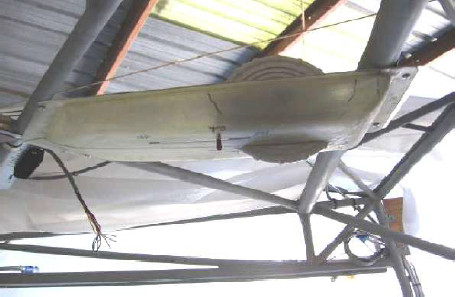
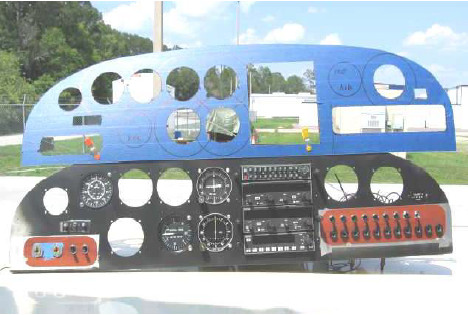
I haven’t sent in anything about my Bearhawk recently, so here goes: I’m getting close to the covering stage of my project. The airframe is done; scratch-built wings and other misc parts, and Avipro fuselage, controls, and seats, a great time saver. I’ve been working on the engine installation, panel, and interior touches the past few years and the majority of that work is done now. I want to do an auto pilot and EFIS installation at some point, but am thinking for the time being of just getting the plane flying with the basics and saving $10 grand in the process. Project was started in 2000 banging out ribs.
Hopefully 2010 will be the year that it flies!
Total time to date: 1850hours.


Glenn Patterson (Bearhawk 727) Builder Update
Source: 2009 Q4 Beartracks, Glenn Patterson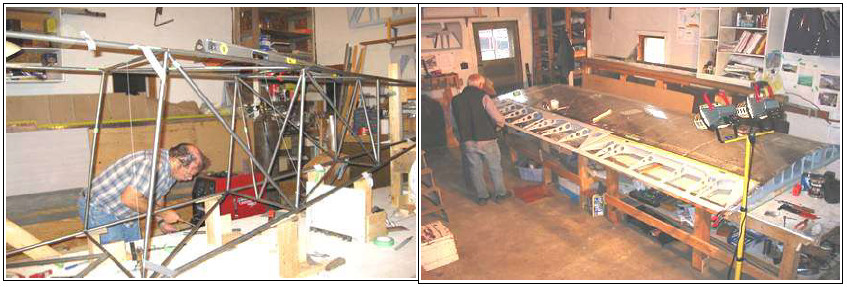
Wings, flaps& ailerons were inspected in January 2009 and passed without any issues. Inspector was very
impressed with the quality of work & said to keep it up. Wings were completed in June. Installed gap seals to tighten up the fit between wing & control surfaces top & bottom.
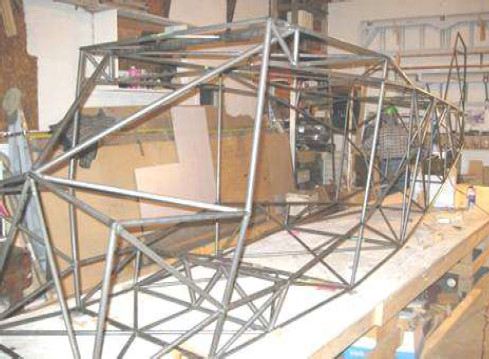
Tailfeathers built. Started fuselage in July, and main fuselage assembled and welded. The plumb bobs stayed on the center line for the full length of the fuselage. It is heavily tacked so we are keeping our fingers crossed that it remains straight after welding. Note Bob’s duct tape tube clamps that worked very well. The fuselage is being TIG welded with a good preheat and post heat for the welds plus the shop is kept close to 90 degrees. Busy making control sub assemblies and finishing fuselage.
210hp Continental IO-360 fuel injected 6-cylinder engine acquired. Would like to add electronic ignition and header exhaust to improve engine hp & fuel economy.
Estimated completion is summer 2011
Bob Smith, Jim Reid, & Glenn Patterson
Flying Update from Mike Araldi
Source: 2009 Q2 Beartracks, Mike Araldi writing to Mark Goldberg
Hey Mark……the Bearhawk has about 32 hrs on it now, and is performing flawlessly so far! It’s a very easy and honest airplane to fly. I’ve been able to induct 7 new BH pilots, and they all agree… it’s one of the best all around airplanes they’ve ever flown. I went with a Monty Barrett balanced IO 540X and a MT 3 bladed prop, extremely smooth combination.
All of your performance numbers are accurate, your kit is a pleasure to build, and working with you, Jim, Budd,and the rest of the BH tribe is great! Thank you for the great support. I’ve experienced the RV grin… and now the Bearhawk Rush!
I’m convinced now more than ever, the more BH’s that come on line and the more pilots fly them, your kit sales are going to grow exponentially… …brace yourself !! Lets try and put together a Bearhawk fly-in at my strip here in Lakeland!
Ernie Green Flying Update
Source: 2009 Q2 Beartracks, Ernie Green – N844EE
Ernie Green bought his Bearhawk plans in 1995 after reading about it. He pretty much sat on the plans and didn’t begin work until 1998. What finally prompted Ernie to get going was a call he received from Michael Harris, a fellow Florida resident who heard that Ernie was building a Bearhawk also. Michael contacted Ernie and came to see him. They made an agreement. If Michael made the commitment to show up and help Ernie work, together they would build the two Bearhawks. Ernie promised to weld up the frame of Michael’s plane in return.
Ernie has been a professional welder for over 20 years. His last years welding professionally were for the US Navy on aircraft carriers. Ernie is certified to weld titanium, magnesium, stainless, and all the other exotic metals that most welders never see.
Progress was slow but steady until Ernie retired in 2006. Then Ernie has been at it hot and heavy to get his BH finished. Ernie and his building partner Michael bought a Cessna 310 for the exorbitant price of $15,000. It was complete with engines and props but no radios. The engines (Continental 470’s) had 168 hours and 224 hours since chrome major overhauls. Ernie’s Hartzell 82” prop cost him $500 to comply with all AD’s by a certified prop shop in Florida. Then they sold the C310 airframe for $8000 on Ebay. Quite a nice deal for the Bearhawk builders.
When asked how many hours he has worked on this scratch built project, Ernie answers “a bunch”. The ‘N’ number Ernie has, N844EE, signifies Ernie’s birth date of August(8) 1944. The EE is for Ernie’s first and middle names. He hopes to fly before his birthday this August. Ernie fought a little with the Stewart covering system due to the extreme temperatures and humidity in Florida. But the results are beautiful and unique as you can see in the pictures. Ernie gives special thanks to Warren Simpson, a neighbor and experienced builder who has been a tremendous help.
Dan Shilling Builder Update
Source: 2008 Q4 Beartracks, Dan Shilling
 I am getting pretty close to the final inspection and first flight of my Bearhawk with 3.3 Boxer Subaru. It has a 1.97:1 Autoflight gear box & three blade Ivo Magnum Paddle Prop. I think I am within 6 months of flying if all goes well, and maybe less. I will keep you posted. I started work on plans #460 in October 2001. To date, I have almost 3,000 hours invested. I nicknamed my Bearhawk “Ursa” because of the Alaska flag “Big Dipper” paint scheme I designed. A few detours from the plans include a Cessna 180 tail wheel and stinger, Patrol style trim lever, skylight, cargo tube and rifle rack.
From the very beginning, I had planned to use an automotive power plant, considering rotary power first, but finally settling on a normally aspirated Subaru EG33, H-6, 230 HP from their SVX model car. Coming up with a motor mount design that would fit under the Bearhawk cowling was one of the biggest challenges, but with input from friends and the Bob, I finally got it sorted out. Figuring out an adequate cooling system is usually the hardest obstacle in any auto conversion.  I have a custom aluminum radiator that fits just in front of the firewall. A plenum isolates the air discharge from the front of the radiator, thus forcing all the air entering the cowling to flow through the radiator before exiting the bottom of the cowl. Time will tell if this design is sufficient.
My PSRU comes from Autoflight, in New Zealand, with a 1.9:1 reduction ratio. I am using an Ivoprop Magnum Paddle in-flight adjustable propeller, as well as a Simple Digital Systems ignition, both of which are proven in Ken Wardstrom’s Roverhawk. I hope to be flying by Spring 2009. The only things left on the “to do” list are some electrical changes and painting firewall forward. When I began this project seven years ago, I did not have the funds to complete it, or know where they might come from. Living in airplane Mecca and scrounging everything I could, having great friends and helpers, a supporting wife and above all, the Lord’s providence and generosity, I am at the cusp of completion. I haven’t added up all the receipts yet, but I think the total cost will be around $30,000.
Dan Shilling – Anchorage, AK
David Bice First Flight Report
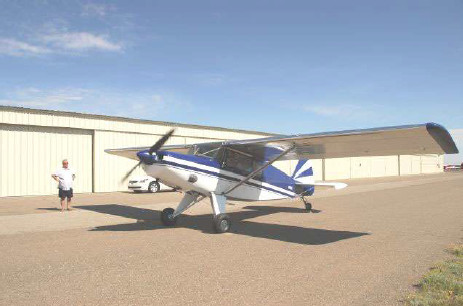 I flew another hour today, and I was even more impressed. I hope it will be the airplane I have always wanted so I won’t have to build-rebuild something else. It is really impressive. Today at 9000 it was indicating 105 mph and climbing 700 feet/min. At 10,000 feet 20 inches mp and 2400 rpm it had an average GPS speed from 4 headings of 140 mph. Not bad for a low compression 0-360. Below is the message I tried to send to the group after the first flight:
“I did the initial test flight today on my Bearhawk today. I have attached a couple of photos taxing out and back after the flight. Too bad the takeoff and climb photos were really out of focus (my wife was very disappointed in her camera work). All went well with only a couple of small problems. I have changed the breather line location because it was apparently in a negative pressure area and was sucking out a some oil. To measure empty weight, I had added 8 quarts of oil, and Lycomings I’ve flown always dump some oil when full, so this may have contributed. I also found a loose exhaust bracket that needed tightening. There was no wing heavy issue, but I may have to add a rudder tab. I need more tests flights to be sure. The airplane has Bob’s experimental 0-360 with angle valve cylinders, low compression pistons (I can burn 82 octane fuel), and a McCauley constant speed prop . The field elevation at Double Eagle Airport (Albuquerque) is 5800 feet (density altitude was 7200 feet), and the 0-360 Bearhawk did just fine. I had close to 50 gal of fuel. The engine has channel chrome cylinders, so at this altitude I’m running it open throttle (I believe I had 22 inches) with 2700 rpm to break in the cylinders. At 8300 feet, GPS speeds ranged between 143 and 150 mph. I should pick up a bit more speed after I make and install landing gear leg and lift strut fairings. Our field elevation is higher than most builders, so if the few 0-360 builders are interested, I will provide more performance information as test flights continue. Let me know if there is any other information that would be of interest.”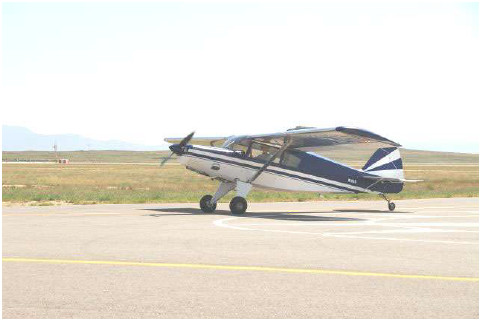
I’d like to have the 40 hours flow off in time to fly to Copperstate. Although everything looks good now, something may come up to prevent flying off the required 40 hours in couple of months. The dark area on the side of the cowl is a polished aluminum scoop (I like to pound aluminum) as the air intake for the oil filter. I’ve attached a photo. I used Van’s RV10 oil cooler mounted on the firewall which has a scat tube large enough that prevents taking air off the back of the baffling. So far, the engine is running cool, so it seems to be working fine. I flew again today, and it seems the airplane gets better every flight. It is rock solid and enjoyable to fly. After 3.8 hours, I can’t find anything I don’t like. I did some slow flight today with up to four notches of flaps and it feels totally solid even below 50 mph – I guess I’ve already heard that from other builders who have flown, and it is certainly true. What I found today that I really liked was the performance that Bob talks about with power set at 1900 rpm and 19 inches MP. It is very smooth, a lot quieter, and simply feels great. I think most of my flying will be full power for takeoff, and then loafing along at 1900 rpm. If Bob flies all the way to Alaska with this power setting, it should work fine for most of my flying.
Thanks for all of your kind comments.
David
Bearhawk Hot Spot
Source: 2008 Q1 Beartracks, Mike Creek
 February 2008 marks the 4th Bearhawk quick build kit order from Elko Nevada. What makes this so unusual is that Elko is a relatively small rural town. When combined with the population of Spring Creek, a nearby bedroom community, the total population reported in the 2000 census is 30,000. According to Mark Goldberg, this is probably the highest concentration of Bearhawk kits outside of the Phoenix area. Alan Wilson purchased the first kit in late 2004. The Bearhawk is Alan’s third project. The first was a VMax and the second an Airbike, both built from scratch. The Airbike was powered with a turbo charged direct drive Subaru engine. While both planes were fun to fly and were good for low and slow, they just didn’t make for good cross country flying. With Alan’s prior experience with an auto conversion, he decided to tackle one in the Bearhawk.

Elko Builders (from left) – Alan, Jim, Mike, and Kevin
Alan’s BH will be powered with a modified Range Rover engine producing over 275 horse power, a 1.7:1 reduction ratio Eagle Precision Machine (formerly Northwest Aero) belt drive and an Ivo in-flight adjustable propeller. It will also have a full-span skylight, 8.50 tires mounted on Matco triple-puck brakes, and be equipped for day/night VFR with dual Dynon EFIS displays. Installing an auto engine is the road less traveled, adding time and complexity to the building process. In addition, life throws us curves; Alan’s building progress was delayed about 2 years, during which time he sold his home, built a shop, and moved. Alan likes to joke that he is careful not to get AIDS – Airplane Induced Divorce. Alan is back to building and expects to have his plane flying late this year or in early 2009. He recently completed the right wing and is thankful for Mark Goldberg’s tip to use a flat bar to rivet the wing trailing edge, which keeps the sheets perfectly straight.

Alan’s Fuselage – Awaiting FWF

Range Rover – Pending Engine Mount

Mike’s Plane
Only a few deviations from plans were made; the interior will use removable panels instead of Poly-Fiber fabric, the brakes are dual-puck Cleveland’s with 8.50 sized tires, throttle/mixture/prop controls are lowered, landing/position/strobe lights were added, and a muffled Vetterman system was added. The wings were just closed up and Mike is optimistic his plane will fly by late this summer as the only major portions left to complete are painting the wings and cowling, windshield installation, and the hundreds of little details needed to give it a finished look. He is very appreciative of and has taken advantage of assistance offered by local EAA members in particular Alan Wilson and Roger Knight. Roger is a retired Navy jet mechanic who has built two planes; a Taylor Monoplane and BD-4. Mike is also fortunate to have a supportive spouse and 3 kids who jump in and help out regular basis. Mike built the majority of the kit in an attached two car garage. He believes having the plane close at hand and doing something on it every day are important factors in completing the project.
Jim Allen ordered his kit in January and is busy finishing the interior of his shop to accommodate his plane. He owns an ultra light and decided he wanted something to use for traveling. Jim was originally considering a Velocity. In talking with his neighbor, EAA member Hal Stockman, Hal told Jim about Alan’s and Mike’s Bearhawks and suggested he look into that instead because of the utility it offers and the ability to use unimproved strips common to the region. He is fortunate to have a work schedule that will allow a lot of time to work on the project. Jim recognized the value of having two other builders in the area to help. This will be Jim’s first airplane project.
Kevin and Cathy Cox ordered their kit in February. Kevin was thinking about building an RV, but after looking at Mike’s Bearhawk decided the extra cabin space, useful load, and unimproved field capability offered by the Bearhawk was what they needed to commute to their cabin in Idaho. They also recognized the value of having two examples previously completed and the advantage of having that expertise available. Not to mention a great source for borrowing tools. Jim and Kevin teamed up to save on shipping costs and both of their kits will arrive in April on the same trailer.
For those considering building or for those who just want to see what others builders are doing, Elko might just be worth a visit for the next few years, even though it is a little out of the way. For those of you within striking distance, Elko may host a fly-in Saturday September 20th, 2008. It has not been confirmed yet, but you might want to mark your calendars.
Tim Weaver First Flight
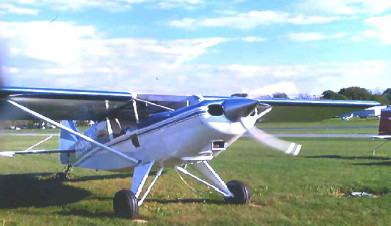
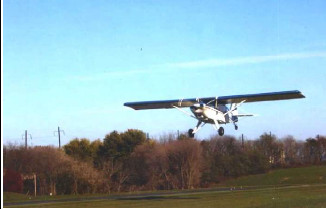
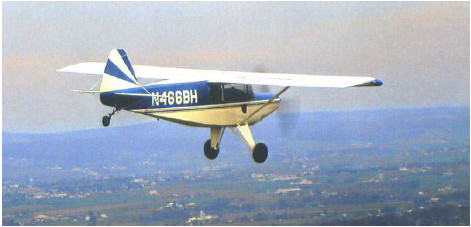
Shown here are photo’s and Wt. & Balance sheet for Tim Weaver’s scratch built Bearhawk N466BH. Tim says the plane flies great with impressive take off and landing performance. Empty Wt. was kept down to a nice low value.



Q3 2007 Builder Updates
Source: 2007 Q3 Beartracks
Continue reading