Summer 2024 Updates from Bob Barrows

Source: 2024 Q2 Beartracks
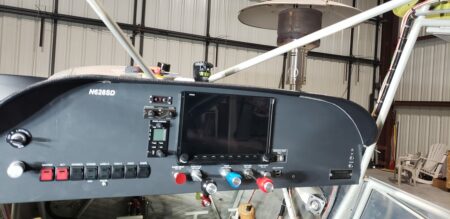
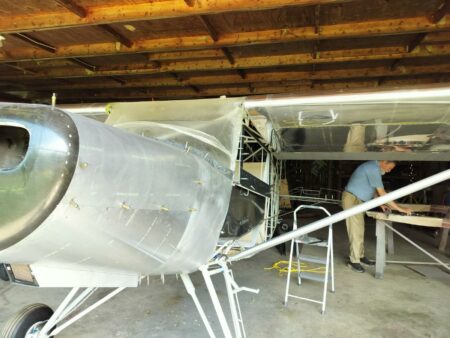
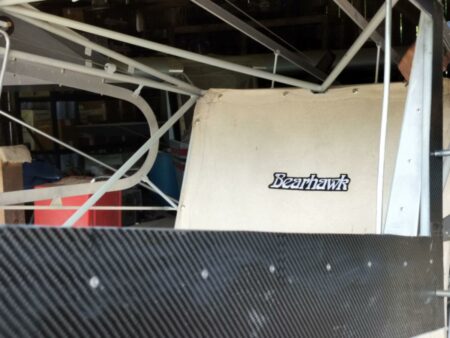
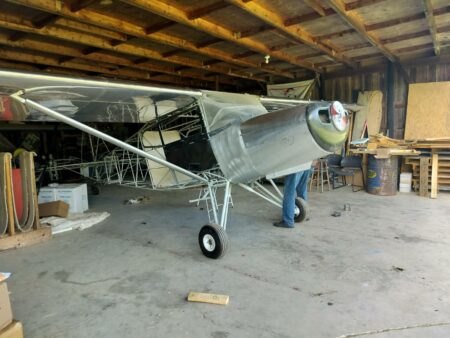
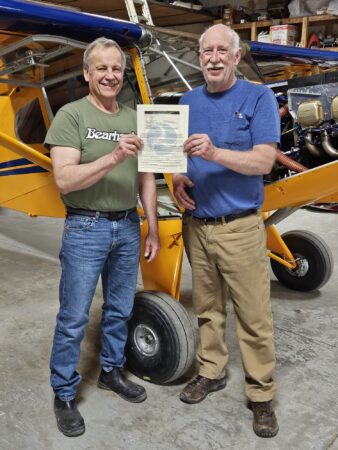
Work continues on Bob’s Companion project. As of press time he did a preliminary installation of the wings and has mostly completed the cowling. There is a mock-up engine that has no cylinders in place, and he has validated alignment and positioning of the engine, and is quite pleased with the kit’s conformation to the plans. The ailerons, flaps, rudder are covered, and the elevators and horizontal stabilizer are in progress. With the mock-up engine in place, the weight was 767 pounds. Bob feels like he is on track to meet the target empty weight of 1050 pounds. This build uses carbon fiber door panels instead of aluminum. Bob says it saves a little weight, and he’s pleased with how the carbon panels flex, drill, and otherwise behave much like aluminum would. To make them, he starts with a flat sheet of aluminum. He says you can also bend the aluminum if you want the part to also be bent. He applies lots of wax to the aluminum, draws out an outline of the rough shape of the panel, and paints resin onto the panel. Then he lays 2-3 layers of carbon onto the panel, and the next day, it’s ready for cutting to shape and installing. He made similar floor boards out of Kevlar, and figures those are 2/3 to 1/2 the weight of aluminum in the same application.
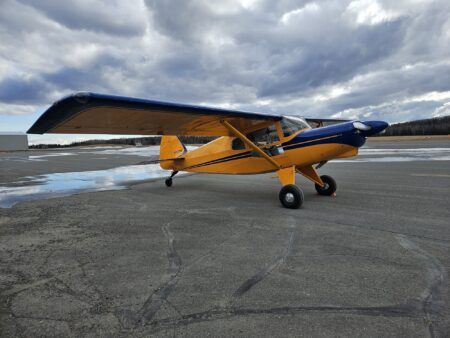
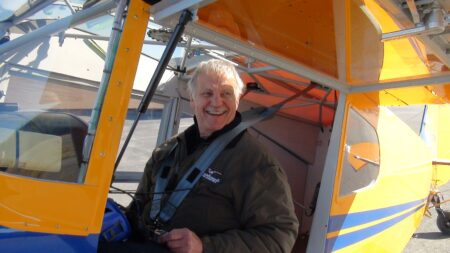
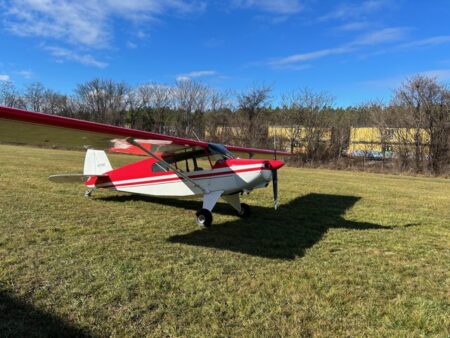
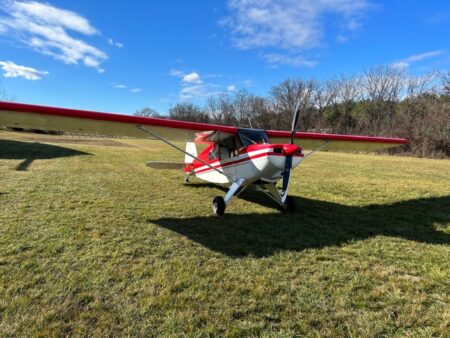
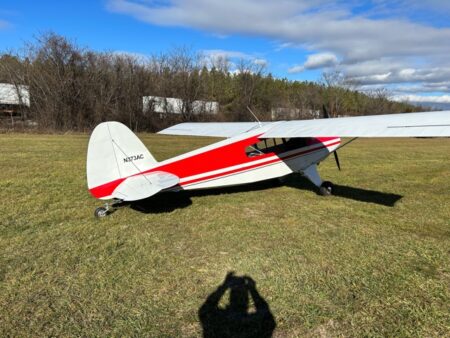
Bob and Diana recently flew the Patrol to Pence Springs, West Virginia for a get-together that included around 30 airplanes. They have a nice long grass strip there. Diana’s improved mobility and health are great news. She’s always eager to ride along whenever Bob flies. He says he alternates between flying his Patrol and LSA, just to keep both active, and enjoys both equally.
He has not been working much on his electric Ultralight project. It is still pending a new motor controller to up the motor output from 230 to 300 amps. Bob did design and build a new full-castering tailwheel for it, to improve taxi handling. The new tailwheel doesn’t attach to the rudder for steering but is easier to maneuver than the original skid. Bob says back when he flew his RV3 the tailwheel could either be swiveling or steerable, so he usually left the chains off and allowed it to swivel so that he could turn around more readily at the end of the runway.
Bob has been working on a solution for the Brake master cylinders that uses an EDM (electrical discharge machining) machine to make very precise fluid passageways inside of the bore. The EDM machine is well-suited for this kind of work and yields very smooth and precise shapes down inside the bore, based on the shape of a custom electrode.
Save the date for Bob’s Picnic on 10/19/2024 at VA04!

Cabin Organization with MOLLE

Source: 2024 Q2 Beartracks, Tyler Williams
I like clean organized spaces. Well, at least I do in my airplane and in my kitchen. My truck, on the other hand, is a complete mess…always. It looks like I live in it, which sometimes I do. But not a lot goes on inside the truck that forces me to be meticulous about it being clean and organized. I sit, hold the wheel, throw the snacks in the center console and turn on some good tunes. My kitchen is a different story. My chef’s knife is sharp, my spices are stocked and I am a stickler for “mis en place.” When everything is in its place, I can work efficiently and get into a flow to create, improvise and make great food.
Operating the airplane is a similar experience for me. I like everything in its place, the plane prepped and my mind sharp for the task at hand. Flying a plane, at least the way I do it, involves much more than road tripping in the truck. I don’t just get in, hold the wheel and follow the line on the map. From the preflight, to the engine management, to flying the terrain and improvising the route around weather and airspace, to chatting with ATC and jotting down instructions, there’s always something to do. An organized cockpit helps keep the mind free for the important things, and I don’t like anything flopping around loose. When flying far, I need water, a bag of snacks, sometimes a pen and paper, sometimes I need my flashlight, I’ve got my InReach on and I like to plug in my phone for music. I keep a lot of stuff in the back of the airplane too and it all needs a secure place to rest. From the basic things like a screwdriver, fuel tester and a small flashlight that get used every preflight, to the just-in-case tool kit, spare fasteners, tubes and patches, to control locks, tie downs, travel chocks and a first aid kit, I like to have what I need, when I need it. You can usually find help anywhere in the lower 48, but it sure is nice to have what you need to handle things, in flight and on the ground.
When I finished the Bearhawk and started venturing across state lines, I kept all the tool kits and spares in a duffel bag in the baggage area. But, digging through a bag of stuff to find what you can be annoying at best. For the cockpit items, I initially used the side pockets installed by my feet and the seat back pockets to stow checklists, small items, snacks and water bottles. But we travel as a family often and I like to keep those seat back pockets clear for my kids to stow their drawing paper, books, cards and such. My side pocket is best kept minimal so I can get my checklist or writing pad without fumbling around down there while trying to fly and my wife likes to have her side available for her magazine or book.
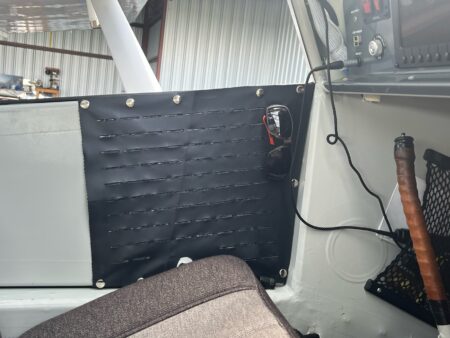
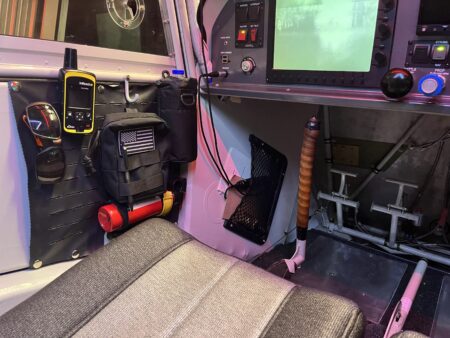
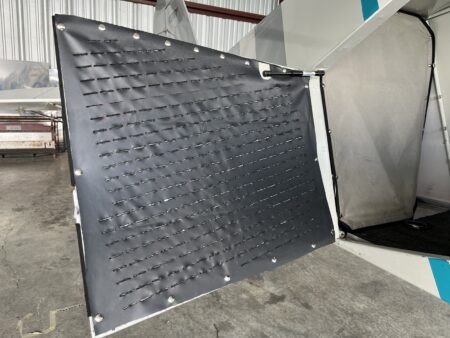
I got some inspiration from some nice overland camper trucks that used the MOLLE (Modular Lightweight Load-carrying Equipment) system to organize gear and tools. I saw seat-back MOLLE panels with small pouches and also some nice tailgate MOLLE panels for easy access to tools, even when the truck is loaded with gear. That seemed like the perfect solution for my plane. Our doors are all recessed slightly from the interior so there’s a little space there that can be used to hang a MOLLE panel and install some organizers.
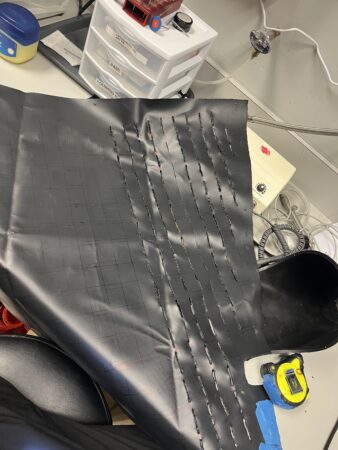
I made mine out of PVC coated Cordura nylon. I found some basic dimensions for the standard laser-cut Molle grid, drew it out on the fabric and simply melted the slits with a soldering iron. Mine are 1.12” wide slits, spaced ¼” apart horizontally and 1” apart vertically. I probably don’t have the exact military spec, but it was easy to lay out and fits all the attachments well. Someone more digital savvy could do the layout on a computer and have the fabric laser cut for a faster and more precise, factory looking result. I installed snaps in the door frames and fabric and snapped on the panels. They are lightweight and work great. Up front, I have my water bottle holder, sunglasses, pen, charge cord pouch, a place to keep my phone and snacks and my fire extinguisher secured on the door for easy access and still have all the elbow room I need. The passenger door has a panel as well with the same drink holder and stuff pouches and my wife loves it. The big panel on the aft baggage door stores my first aid kit, gust locks, travel chocks, extra quart of oil and funnel, preflight tools, hanging luggage scale, spare fuel cap, pitot cover, etc. etc. You can certainly stuff all these things under the back seat and that works just fine. But it sure is nice when the plane is fully loaded to be able to just pop the baggage door open and grab what you need.

Tribute to “Tinman” Kent White

Source: 2024 Q2 Beartracks, Mark Moyle
Sad News from California: “Tinman” Kent White Died on 5/19/2024
Kent was an early member of the Bearhawk community and was active in the Yahoo-based discussion groups that predate our present forum. Many of us purchased metal-shaping and welding tools, instructional videos, and supplies from Kent over the years. Bearhawk Builder Mark Moyle offers this tribute:
I hope I can even come close to relaying my reverence for Kent. From the second day I had met the man I started addressing him as Kent Master. Nearly 15 years ago I met Kent and 4 other Bearhawk builders at an aviation sheet metal class in Anchorage. Del Rawlins, Paul Minelga, Dan Schillings and Matthew Schumacher. There were other folks in this class, I don’t recall any of them. To me they were metal mashers, chimps I didn’t have any association with. I’m sure they were nice guys, but the Bearhawk guys. We were different. We obviously were not hammered mechanics like the other guys… my story relates to that.
Kent was there to teach us the basics. Taught us how to take a round disc of 5052H32 and turn it into a bowl by thickening the metal around the circumference of the circle. Now imagine 12 people all hammering on aluminum at the same time being taught by this huge man. Kent was like 7 foot if he was an inch! Here’s this huge guy using the same tool as the rest of us, but in his hands, that hammer, it looked tiny. That same hammer looked like a sledge hammer in the hands of a few of the small guys. Believe me when I say guys follow the example set for us by the teacher. Almost everyone was whaling on that sheet metal. Here’s this huge guy tapping on a thin piece of aluminum… he’s so damn big he must be putting allot of force into the metal. I’m like where are the ear plugs? I stood back and just watched for a bit before I started. Thing is I listened. Kent was one of these guys who gave you pearls of wisdom to make you think. He was an artist at it, and I think he enjoyed watching befuddlement. He enjoyed seeing the perplexing expressions on people’s faces. I could see it, it was like a twinkle in his eye. He wasn’t going to tell you how to do something one bean at a time. He’d tell a short story. Really short, maybe 5 words. You had to listen and think. I remember Paul catching on real quick. I think he was the first or second person to get the bowl done and done nicely. Turned out to make that bowl, this great big man was gentle on metal as he was as a person. I learned buckets from the guy. Even tooled up with the equipment he sold. English wheel, Planishing hammer and a bunch of his hand tools. Bought all of his videos. I have every one of his prototype planishing hammer dies.
Kent became a master European classic car restoration at Harrah’s auto museum. Kent was one of the few guys who could duplicate replacement parts with all the correct tool marks to make his part indistinguishable from OEM. He was considered royalty amongst the classic European classic car owners. It’s like Kent was many people: the teacher who didn’t lead you by the nose. The expert on European classic cars. The aviation expert on airframe repair and prototype work. To the guy who nobody really knew. Kent lived way off the beaten path. He moved to the Grass Valley, Nevada City area in the foothills of the Serria Nevada mountains in 1979. The year I moved away from Grass Valley. Kent lived in North San Juan. About as far out in the mountainous country and still be in Nevada county.
Kent was such a master craftsman. For years he build the prototype inlet nacelles for hawker beech jet engines. He was approved by Boeing to teach mechanics how to shape and replace skins on Boeing aircraft at facilities around the world. Kent was also the guy that Hollywood called upon when they wrecked damaging the tail on a Howard Hughes mono-wing replica aircraft in the movie Aviator. I have pictures he sent me of him repairing one of two aircraft in existence totaled by the insurance carrier, but had to be repaired because they performed a very specific task. A couple mechanics lifted this twin engine turbo prop with wing jacks and didn’t support the fuselage causing it to buckle badly in the middle.
About ten years ago, maybe longer. Kent began making a yearly trek to Platinum for a few weeks in late August for Silver salmon fishing. He liked that I took him on adventures and always brought him back alive. These adventures involved boats and four-wheelers to places and at speeds that would make a sissy cry out in fear. I didn’t put airplanes on that list. We did fly in some nasty conditions together, but always safely. Last summer Kent flew into Soldotna. We fished the Kenai and stayed with my daughter and her family waiting on a weather window to fly my airplane to Platinum. By the way, in Alaska, seaplane doors that are nothing but window, down low. Yeah.. do it.
We spoke on the phone often. Ask about each other lives, things real friends talk about. The emotional stuff. When it came to me tying to mine that brain of his for some nerdy odd ball thing, it was always on the phone. I avoided taking advantage of him on his vacation. Made me feel guilty. It’s like being a doctor and everyone around you is asking you things medical. Or a car mechanic whose friends want you to fix something for them. Maybe that’s why I have all of his prototype dies for the planishing hammer. We’d use them together in my shop.
Kent was a true independent thinker. He made his life his way and by his rules. I don’t think I ever heard him say or do anything that told me this guy was any thing but a genuinely nice caring person who was nice and respectful to absolutely everyone.
Kent was truly a great friend, loved that guy. We were going to a sandbar hopping fishing and camping adventure this summer. From Platinum, through the Dillingham area, up through lake Clark. I’m going to miss him. Now I’ll have to train up someone for my adventures. Didn’t have to train Kent. He was game for anything. Great great man!
Continue reading

Bearhawk Camping at Creighton Island, Georgia

Source: 2024 Q2 Beartracks, Tyler Williams
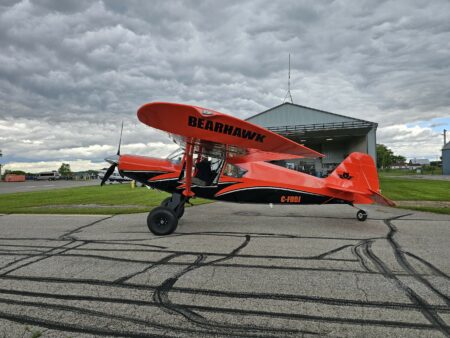
“So, is there anywhere to go around here where you need a plane like that with those big tires?” This is the most common question I get from the classic plane peepers at the fuel pumps. And I don’t even have real Bushwheels yet. The Bearhawk draws a lot of attention. It is a cool looking airplane compared to the flock of sheep on the ramp. Just looking at it conjures up thoughts of adventures far and wide and nights spent under the stars. So, my response is always, “No. Not around here. But I didn’t spend two and a half years building a big, family hauling, off airport capable airplane to stay around here.” Here in the east, the mountains and ocean are several hundred miles apart. I love being in both places and the Bearhawk gives us more access to it all. I live in Charleston, SC, near the ocean and love it. Once in a blue moon, we get some good waves and there’s great salt marsh fishing to be had just a short walk down the street from our home. Charleston is also FULL of people and is lacking in wide open space to get away from it all. But, I can fire up the old Lycoming, load up the family and in an hour or two, we can be saddling up the mountain bikes, or pitching a tent in the grass.
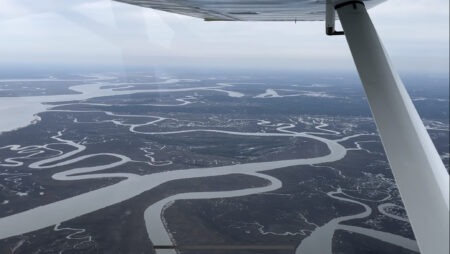
The closest place we can fly into where the people are few and the stars are many is a little barrier island on the Georgia coastline called Creighton Island. It is a short 115 nm flight and though it is close to the mainland, being there feels far away. It isn’t “around here,” but is accessible for us on any good-weather Saturday. Flying along the coast at low altitude is always a treat. We follow miles of waterways, marshland and tidal creeks curling around the barrier islands that dot the entire Carolina and Georgia coast. We dodge pelicans and seagulls, spot dolphins and the occasional shark cruising the beaches. No magenta line is needed for a trip like this.
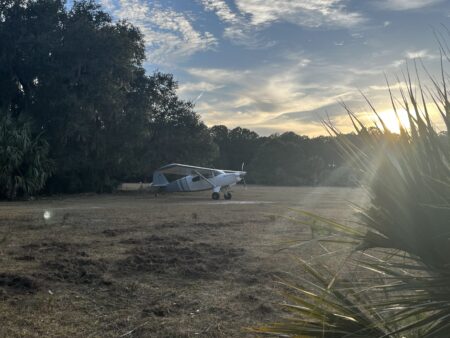
Creighton Island’s grass strip is supported by volunteers in the Recreational Aviation Foundation and all the info for visiting pilots is in the airfield guide on their website, www.theraf.org. The strip, lined with old growth oaks and palmetto trees, is a fun and fairly easy place to land, with a beautiful approach over the lowcountry marsh. Once in a while, a low pass or two is required to run the animals off the strip before landing. There are no roads out there and the island has been privately owned by one family for several generations. Over time they have made the place an easy place to camp. If you prefer a roof over your head, there are a few hunter’s cabins that have been built out there for the bow hunters who frequent the island for wild hogs. There is good well-water, a big cast-iron fire bowl, an outhouse, and even a weather station to check before you go. This isn’t the backcountry, but it is a beautiful quiet place to get the Bearhawk away from the pavement and spend some time outside with the family. Donkeys, pigs, cows, and armadillos roam free, making my 5 and 7 year old kids feel like they are on some kind of safari of the American South. Plus the fishing is great. Really great. The east side of the island has a little sand causeway out to a small sandy island on the waterway where bald eagles were nesting this past winter. On the other side, there are spartina grass flats that flood at high tide and offer access on foot to sight-fishing for spot tail bass. These fish are super tasty, fun to hunt and fight, and we are always hoping to score a few. If that’s not enough, there’s a boat dock where you can access some deeper water. It is hard to beat pitching a tent under the massive oak trees and Spanish moss, cooking dinner over the fire after a day of fishing, roaming the woods, and flying over a beautiful coastal landscape. It is almost close enough to home to consider it “around here” and we are thankful to have access to such a beautiful spot.
This would be a fun venue for a winter Bearhawk fly-in.

Bearhawk 4-Place N907PM First Flight

Source: 2024 Q2 Beartracks, Paul Minelga


Jared was nice enough to ask me to write an article about my first flight in the Bearhawk, and since then I have been thinking about what that actually meant for me…first flight in an aircraft that I had built. So, my take will be a bit different than what others have written.
I had a fascination with airplanes as long as I can remember, but my desire to build an airplane started in the early 70s while attending high school in Lacey, Washington. I was 17, worked at an Olympia airport FBO and was on the way to earning my Private Pilot Certificate. A friend took me to Tenino to meet the Sorrell family and I saw a Hyperbipe for the first time. Little did I know that it was the first one made and in my eyes it was really strange, almost scary-looking compared to the Cessna I had been flying. After watching a short demo flight, my friend took me over to meet another man on the same airstrip who was building a Stolp Starduster Too in his garage. All I remember was this guy in the middle of a really, really cool workshop with a tube fuselage under construction and surrounded by lots of aviation-related organized chaos. I was astonished that this guy was actually making an airplane…from plans…by himself! Then and there I decided that I wanted to, somehow, someday, do the same.
Fast forward to the mid 80s. I had left Army Aviation in Germany to start another career in the FAA as a center controller in Alaska. I had since married a wonderful German lady and had a son, and soon had another son. We were pretty poor at the time, and as a single income household on a trainee salary in Alaska, money was tight. I didn’t fly privately, but I dreamt of building a Van’s RV-6 and built R/C airplanes as time and budget permitted.
Jumping in time again to 2003, I was well-entrenched in the FAA. I had built my own home, my oldest son was in college having graduated high school in 2001 and son #2 was a junior. By that time I had realized an RV-6 wasn’t the right aircraft for Alaska and nothing else in the homebuilt world looked like what I was envisioning. A good friend of mine named Rob Taylor showed me a picture of a Bearhawk. I immediately said: “THAT’S IT!…ummm…what is it?” That Christmas 2003, Santa (with a little help from Rob) gifted me Bearhawk plans #708 and that’s when the journey started in earnest. Rob and I went to OSH 2005 and had a blast. That’s when I met Budd Davisson and Mark Goldberg for the first time at the Bearhawk booth. Also, I got my first ride in Mark’s (now Jared’s) N303AP and my first taste of what a Bearhawk was like. Not long after I ordered a set of “quickbuild” wings, all the tubing and flat stock to make the fuselage, and started building a shop to put it all in.

This is my first kitlog entry. Notice the OCD force was very strong:
Date: 3-14-2008
Number of Hours: 1.00
Brief Description: First Longeron
I started by laying out the bottom of the fuselage on the jig table. All went well except I found that Station C “pinched in” about 1/8th inch on either side when a line was drawn between Station B and D. Apparently, this should be a straight line. I triple-checked my measurements and found them to be correct. I polled the BH group about this and the answer I got was that it should be a straight line. It makes sense that way anyway. I’m trying to be too exact in my measurements it seems. I guess officially, this is the first day of construction although I never got the longeron bent the whole way. I’m sure when it’s all said and done that I’ll look back on this first log entry and just laugh!

This is my last kitlog entry after 16 years and 4269.2 hours, interspersed with weddings, memorial services, births, career changes, camping trips, and just living life:
Date: 4-26-2024
Number of Hours: 40.00
Brief Description: The end of my Kitlog
Well, this is it. The fairings and panels are all on and the project is complete. I put 40 hours of work on this entry because it spans the many days of the last two weeks that wasn’t logged, getting everything done in preparation for the DAR visit and reassembling everything afterwards. I taxied the airplane today and it’s ready for its first flight. That will happen when I get some refresher training. If you are reading this and building a project…keep at it. It’s not an easy thing to do. But if you do a little every day, it will eventually come together. Good luck!

I have to admit the first flight was a bit stressful. The tach had failed on runup, but it’s not required equipment. I had flown enough to judge RPM, but it did make me think twice and I almost taxied back. I lined up on the runway, but before I put the throttle in I paused a bit as per Ken Frahm’s (AKKen) suggestion. I went over everything in my mind again: I’m in an airplane that has never been in the air and I’ll be flying it at the waaaay upper end of its design speed envelope because the engine is brand new and needs to be run at 75% power or more to be broken in. Will the airplane fall apart? Probably not. I did the best I could and I know everything is right. Am I ready to land it if it make it that far? Yes. I can get it on the ground safely, it may not be elegant, but I’ll survive. A short prayer as the throttle went forward and the rest is, as we say, history. So it really wasn’t a first flight, but the culmination of a life ambition with the help and support of many good friends and family.
The Bearhawk performed very well and others before me have captured that in their first flight reports, so no need to rehash that. But here is a parting thought as I wrap this up. There are many nights I struggled in the shop making parts, remaking parts, correcting mistakes, making new mistakes, correcting those…on and on and on. There were times I just wanted to pack the whole thing up, drive it to a cliff overlooking Cook Inlet and dump it all in. Don’t give up. If you need to, take a short break, but don’t give up. Most times a good night’s sleep did the trick on helping solve a construction impasse.
If you want some inspiration, get this book and read it. It was gifted to me by my oldest son and it is a good read: The Propeller under the Bed: A Personal History of Homebuilt Aircraft by Eileen A. Bjorkman. On July 25, 2010, Arnold Ebneter flew across the country in a plane he designed and built himself, setting an aviation world record for aircraft of its class. He was eighty-two at the time and the flight represented the culmination of a dream he’d cultivated since his childhood in the 1930s.

A Corvair Engine for the Bearhawk LSA

Source: 2024 Q1 Beartracks, David Swartzendruber
I am building a Bearhawk LSA and one of the engine options for the LSA is a Corvair auto engine conversion. This is what I have chosen for my LSA and I completed my engine build at the end of 2023 during a 3-day supervised build in William Wynne’s shop in Florida. Bob Barrows and William Wynne worked together to design a motor mount for the Corvair engine in the Bearhawk LSA and this mount is available from William. But I’ll back up and start at the beginning of my story.
Like many of you, I decided I wanted to build an airplane many years ago, about 33 years ago for me. However, along the way I lost that dream when it didn’t seem like time or money would allow that to happen. About five years ago, that dream was rekindled when I picked up an unfinished non-Bearhawk project for a very affordable price that was designed to use a VW engine conversion. As I thought about what to do for an engine, I came across the Corvair and William Wynne’s website, Flycorvair.net, and began to consider using a Corvair engine in that project. Through the information on Flycorvair.net, I also discovered the Bearhawk LSA was a good candidate for the Corvair engine and I became less enthusiastic about the project I had acquired. I eventually decided to order a Bearhawk LSA kit and sell the other project.
Having already started down the path of building a Corvair flight engine, I thought I would go ahead and complete that while I waited for my LSA kit to arrive. The first step is to get a conversion manual from William Wynne. This manual includes information about which core engines can be used to build a flight engine. I picked up a 1965 Corvair parts car for $250 and the engine from that car became my core. Corvair flight engines always start with a 1964-1969 engine because engines earlier than that had a smaller stroke, lower displacement and lower strength crank and rods. My core engine was locked up, but I was still able to disassemble it and discovered that the piston rings on one piston had rusted to the cylinder wall. To my surprise, I found that my 1965 engine had a crankshaft and rods from a 1963 or earlier engine. This ended up not making any difference because I decided to go all out and build the bored and stroked version that bumps the displacement up from 164ci to 200ci, also referred to as the 3.3L. The 3.3L engine requires a new billet crank, billet rods, forged pistons and special cylinders so my old crank and rods weren’t needed anyway.
I shipped my engine case and heads off to Sport Performance Aviation (SPA) in Florida for machine work on the case and heads and complete rebuild of the heads. Larger holes are bored into the case to accommodate larger cylinders and some clearance machining is done inside to allow the rods on the stroked crank to clear the case. SPA developed the 3.3L stroker parts, so I bought the new crank, rods, pistons, rings and cylinders from SPA. In addition, SPA has developed a 5th bearing system for the front of the crankshaft to react the propellor loads not normal to an automotive application. All the other standard conversion parts from William Wynne are also used in the 3.3L stroker, so I ordered those from William, including:
-Prop hub, safety shaft and hybrid mounting studs
-Ring gear, starter and aluminum top cover
-Billet aluminum oil pan with oil pickup tube and screen
-Oil filter housing, oil cooler adapter and AERO-Classics oil cooler
-Rebuilt oil case with high volume oil pump
-Rebuilt distributor with Willam’s dual ignition conversion
-Reground camshaft developed by Crane cams for William Wynne
-Alternator mounting bracket
-Modified valve covers to add oil fill tube and vent ports
-Billet aluminum pushrod tubes
-Rotec throttle body injector
-Stainless steel intake and exhaust manifolds
-Engine mount for Bearhawk LSA
-Fiberglass nose bowl
-Engine baffles are coming later but are also offered by William
Once I had all the parts, I began to assemble the engine. The case came back from SPA already closed with the crankshaft, camshaft and 5th bearing installed. This would normally be done at home on the lower displacement engines, but on the stroker motor SPA wants to make sure everything goes together with adequate clearance and rotates freely. I installed the hybrid studs, safety shaft, prop hub and ring gear on the front of the crankshaft and then added the oil case to the rear of the engine.
At this point, I masked things off and painted the engine case and rear oil case. I also cleaned up the new cylinders and painted them. More assembly would have followed from here, but I had decided to take advantage of the supervised engine build opportunity that William Wynne offers. I traveled to Florida with my partially assembled engine and all the other parts and over the course of three days, completed the engine build and test ran it on Williams test stand with a club prop. I liked the idea of spending 3 dedicated days and completing the engine and I also valued the opportunity to run the engine on the test stand and learn from William while I was there.
The amount of calendar time that passed during this whole process was greater than I originally thought it would be so I already had my LSA kit for 11 months by the time my engine ran. Of course this meant that when I returned home from Florida, I couldn’t resist installing the engine on the front of the airplane even though there is still a lot of other work to do on the fuselage. I got ahead of myself and installed the nose bowl to the prop flange, but now I need to go back and install the boot cowl before I can complete the cowling. The typical engine cowling used with the Corvair engine is very similar to the standard Bearhawk cowling. William Wynne sells a fiberglass nose bowl sized for the Corvair engine and then a sheet metal cowling is fabricated to go between the nose bowl and firewall with doors that open for easy pre-flight inspection.
Besides providing parts for converting Corvair engines, William Wynne provides education about the engine. Not just how to build the engine, but also how to own, operate and maintain the engine. I referred to a conversion manual that William sells, but there is also a Maintenance, Operations and Procedures manual that helps you through the flight test period and developing a POH for your aircraft. The support that William provides and the Corvair community that exists are a big part of why I decided to use a Corvair flight engine. I think there are some similarities between the Corvair community and the Bearhawk community in that I believe both draw more of the old school type homebuilders than you find in some of the other homebuilder circles.
For those of you who are interested in more details about the Corvair flight engine in general, I’ve listed some information below that largely comes from William Wynne’s website, Flycorvair.net.

More about the Corvair:
The Corvair is a General Motors designed engine, manufactured by Chevrolet. 1.8 million engines were built in the Tonawanda, NY engine plant between 1960 and 1969. The Corvair has been flying on experimental aircraft since 1960, and William Wynne has been working with them as flight engines since 1989.
Configuration: The engine is a horizontally opposed, air-cooled, six cylinder configuration. William only promotes its use as a simple, direct drive power plant. The engine configuration is very similar to Lycomings and Continentals.
Displacement: The engine is effective without a gearbox or belt drive because it has a comparatively large displacement. William supports versions that are 2700, 2850, 3000 and 3300cc. The smallest of these is twice as big as a Rotax 912. The 2850cc is very popular because it sits in a sweet spot for performance and value.
Power: The power ratings for these four displacements of Corvair flight engines are 100hp, 112hp, 116hp and 125+hp at 3000 rpm.
Weight: The 2700cc engine weighs 225 lbs ready to run.
This is effectively the same as a Continental O-200. It’s installed weight is 35 lbs more than a 912 Rotax, 25 lbs more than a Jabiru 3300 and 40 lbs lighter than a Lycoming O-235. 2850cc and larger Corvairs are slightly lighter than 225 lbs because the cylinders weigh about 5
lbs less. 3300cc Corvairs also use a billet crank which saves another 4 lbs. Aluminum pushrod tubes can be used on any of the engines to save another 1 lb.
Reliability: From the factory, the Corvair made up to 180 hp in the car and turned more than 5500 rpm. The flight engine is reliable and long-lasting because it is only operating at 55% to 70% of these levels. Conversion engines that run at the car’s red line rpm historically have short lives and cooling issues.
Cooling: The Corvair has a factory cylinder head temp limit of 575F. This is the highest limit on any mass-produced air-cooled engine ever built. The engine is also the first mass-produced turbocharged car. GM engineered the engine to have excellent heat tolerance and heat dissipation. In aircraft the engine typically runs at 325 to 350 CHT.
Parts availability: Every wearing part in the engine has continuously been in production for 5 decades. A high end Corvair conversion only has an original pair of cases, and oil housing and cylinder head castings. All other parts in the engine, including the crankshaft, are brand new. Many of the parts in the engine, like the lifters and valve train, are common to Chevy V-8s. There is no part availability issue.
Ignition: The fleet of flying Corvairs is about 500 aircraft. More than 90% of them have a dual ignition system built by William Wynne. His system uses two mostly redundant systems, one points based, the other a digital electronic system. The design has two of every part potentially subject to failure, but it utilizes one plug per cylinder. Six cylinder engines can fly on one cold cylinder, most four cylinder engines cannot. Plug fouling is unknown in Corvairs because the ignition system is 40,000 volts and uses a plug gap twice as wide as a magneto system.
Fuel: The Corvair can use either 100LL or automotive fuel. It is not bothered by ethanol in the fuel. When Corvairs were designed, car gas was a lot like 100LL; for the last 35 years every mile driven by Corvair cars was done on unleaded car gas. Many engines like 912s and modern car engines do not have exhaust valves that can withstand the corrosive nature of 100LL. William uses stainless and Inconel valves in Corvair flight engines.
Maintenance: The Corvair is low maintenance. The heads never need re-torquing. The valves have hydraulic lifters and never need to be reset or adjusted. William dislikes the term “maintenance free” because it implies a “no user serviceable parts inside” disposable appliance mentality. The Corvair is a solid, robust machine which holds its adjustments, but his program is aimed at teaching builders to be self-reliant owners.

My donor car:
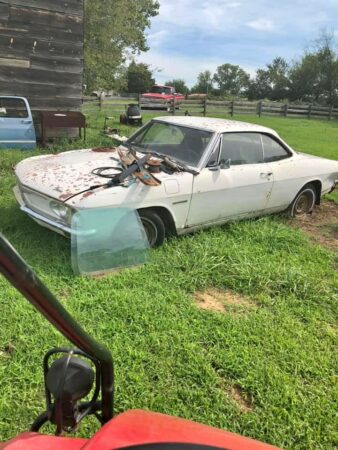

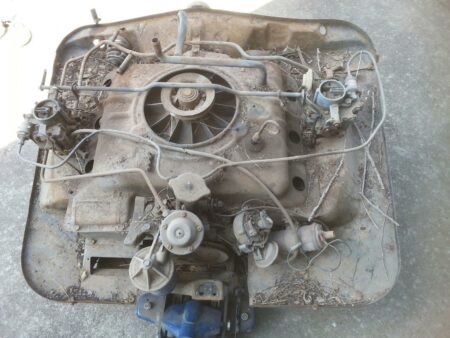
Engine removed from car
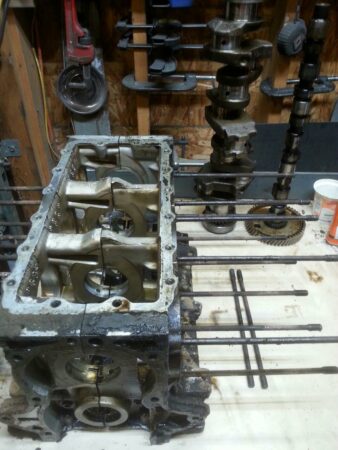

Engine after disassembly
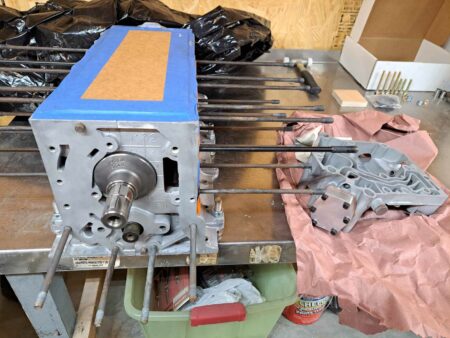

Bottom end as it returned from SPA
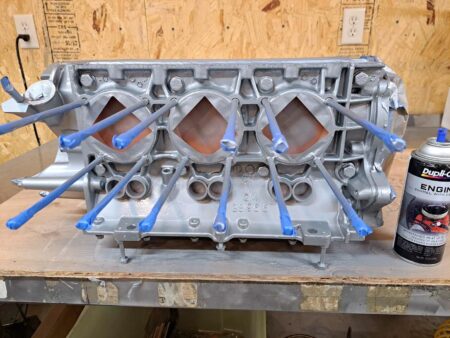

Bottom end after adding rear oil case, masking and painting
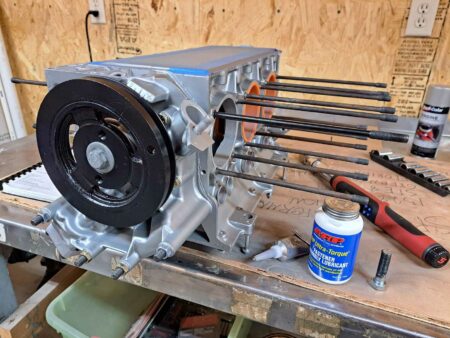

Masking removed and harmonic balancer added to rear of engine
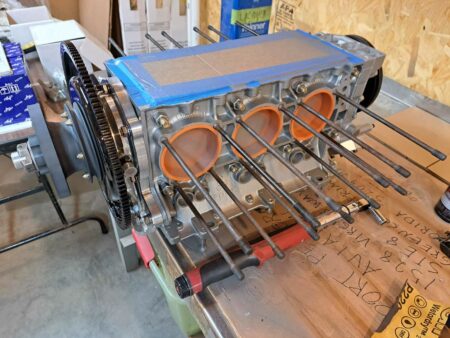

Prop hub and ring gear added to the front of engine
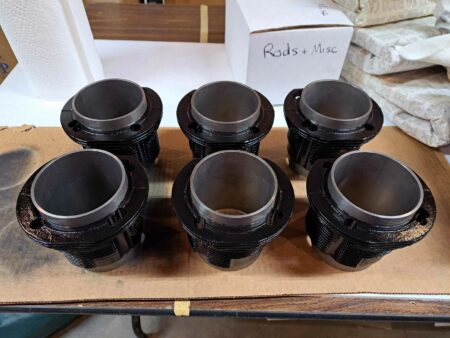

New cylinders painted
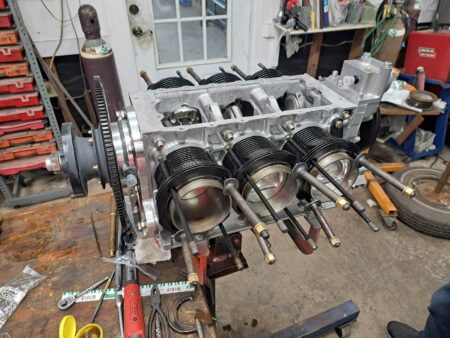

Now at William Wynne’s shop in FL. Rods, pistons and cylinders installed.
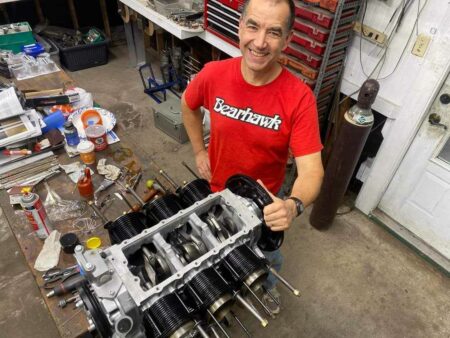

Showing off my Bearhawk gear
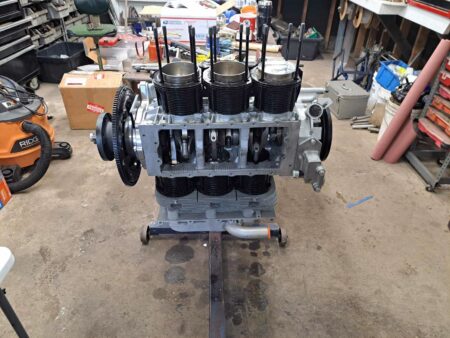

Engine is repositioned to install the head from the top and then rotated to install the second head from the top as well.
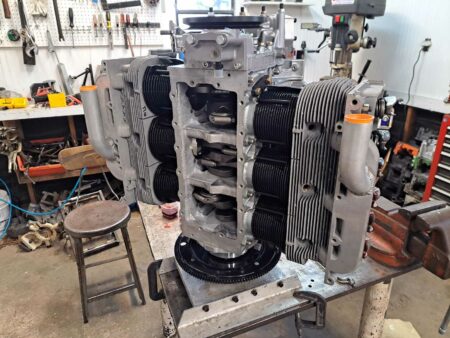

Second head now installed and engine moved to the vertical stand
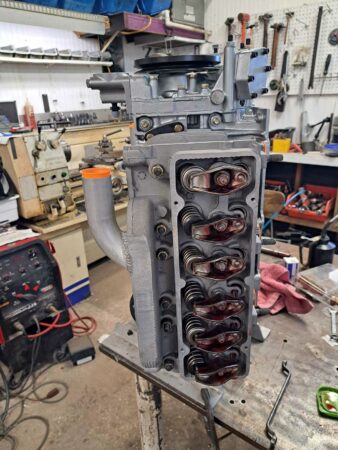

Valvetrain now installed
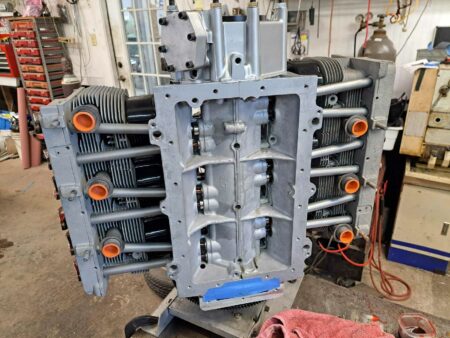

Ready to install oil pickup screen and oil pan
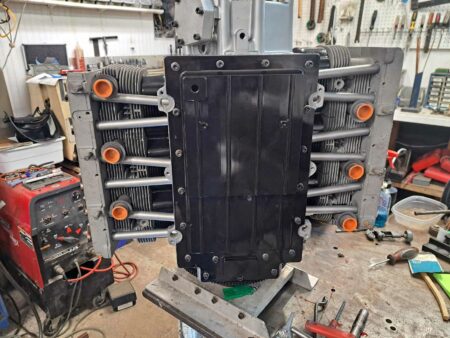

Oil pan now installed
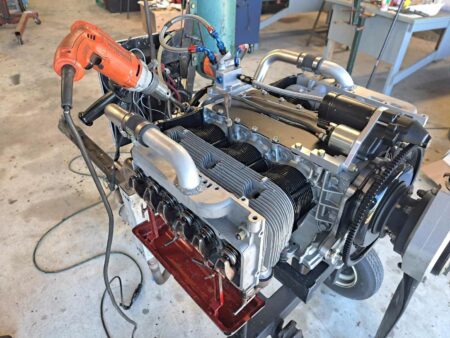

Engine has moved to the test stand. Top cover, starter and oil filter housing now installed. Drip trays mounted on heads to catch oil during pre-oiling process performed with drill motor spinning the oil pump.
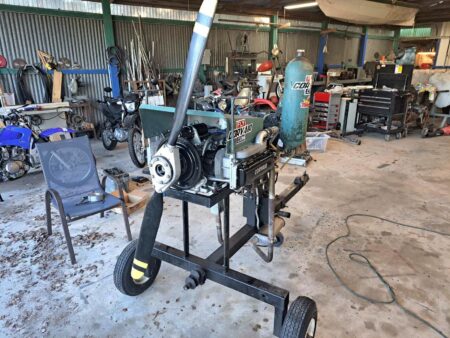

Pre-oil is complete, valve covers installed, and cooling shroud added in preparation for test run.
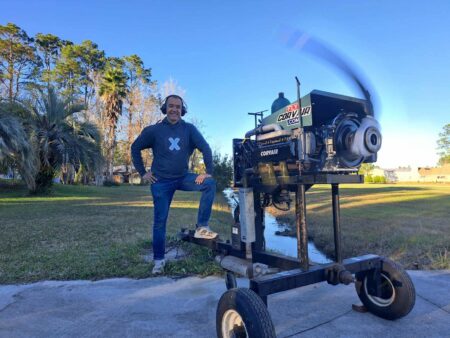

And it runs!
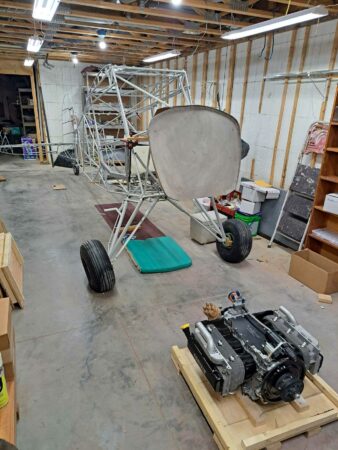

Back in Kansas, engine is waiting to be mounted on my LSA.
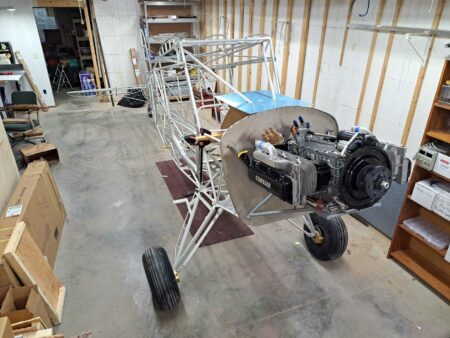

Engine mounted with William Wynne’s engine mount. The Corvair uses a bed mount.
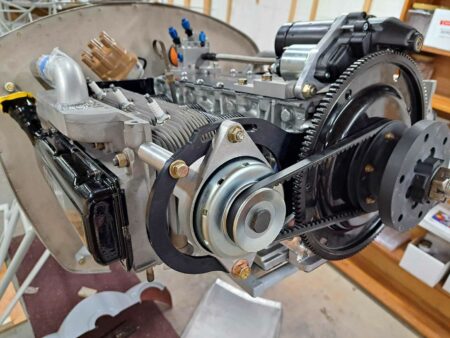

20A alternator now installed.
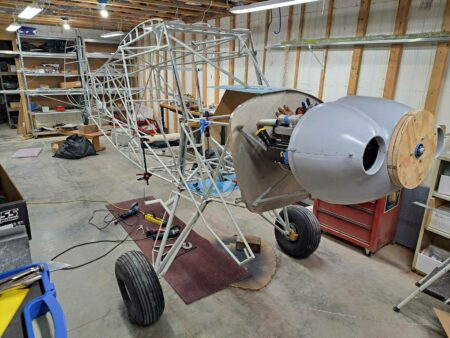

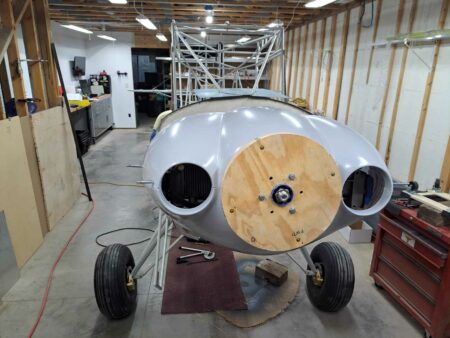
Nose bowl installed. This nose bowl is designed to use the 13″ spinner from Van’s Aircraft.
DIY Seat Upholstery

Source: 2024 Q1 Beartracks, Mark Richardson
Those of us who are building (or have built) an airplane know that there is a lot to learn over and above being a pilot. Leaving aside manual skills, we need to learn about the rules and regulations for building and licensing, avionics and electrical design, AC-43.13B contents and how to actually do … stuff … correctly, it’s the manual skills that are the bread and butter of aircraft building and the most fun.

With all models of the Bearhawk you need to learn how to rivet (both solid and pop), work metal (bending, forming, filing, etc), do fabric covering, run cables, install the engine, fit and prep fibreglass, cut, trim, and fit plexiglass, and a plethora of other detailed skills. If you are brave (stupid?) enough and decide to scratch build, you also need to learn to weld, operate metals shears and brakes, build and align jigs, and so on. There are lots and lots of jobs and skills you will learn by building an airplane.

A couple of the jobs that are often farmed out to the pros are aircraft painting and seat upholstery. I had already learned to paint an airplane when I built my RV-8 20 years ago (Google C-GURV) so although I am using a completely different paint process this time (Stewart vice Imron), it wasn’t totally new.

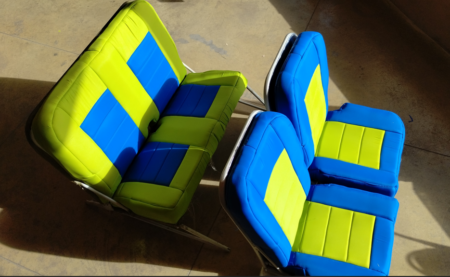
Which brings me to the purpose of this short article; how I upholstered my aircraft seats (your mileage may vary, batteries not included). I had considered (very seriously) just buying upholstered seats and carrying on. However, three things made me change my mind: 1) this would be a new skill that might be fun to learn, 2) I’m now retired so I have time, and 3) OMG it is expensive to have seats professionally done! I won’t lie, I found this the most challenging thing to learn yet. But it was actually fun and I am, well, not richer, but certainly not poorer by hundreds of dollars by doing it myself. I can’t give a step by step how-to with measurements and detailed instructions otherwise this article would be book length. However, I will show a bunch of pictures with descriptions of what is happening and notes on things to think about and avoid. Yes, even you can learn to do this.

The tools and materials:
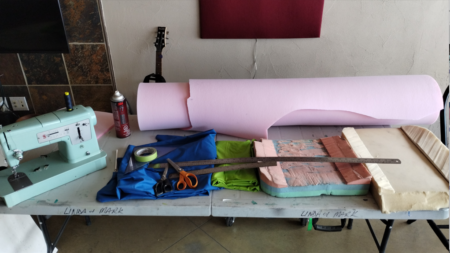
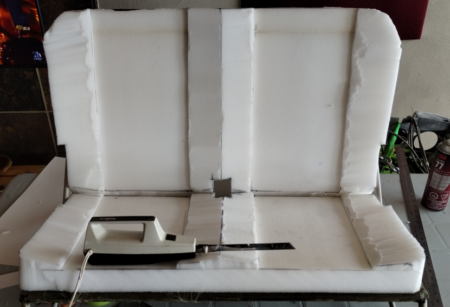
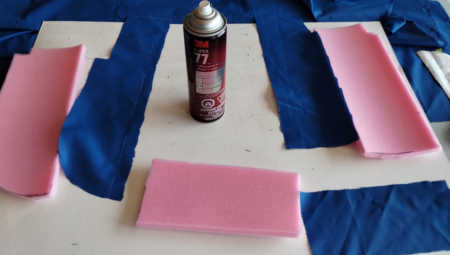
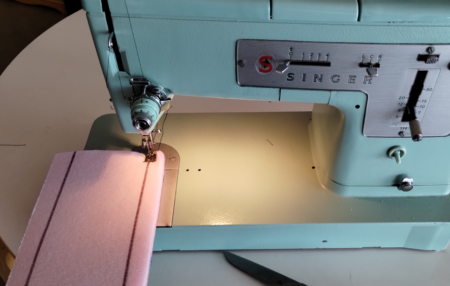
We have a 60 year old Singer sewing machine that we bought fully restored a couple of years ago. No fancy computer features but it is indestructible and works great. You’ll need pinking shears for the fabric, regular scissors for the foam, sewing clips, rulers, marking pens, paper/cardboard for templates, tape, spray contact cement and a work surface. I used an electric carving knife to carve up the foam for the seat parts.
For the fabric I used RipStop because it is quite inexpensive, is super tough, it won’t give me third degree burns on a sunny day like leather, and actually looks really good. You’ll need some backing foam (1/2” or 1cm) that has a backing material on it, and foam for the seat bases and back. I got the Confor Foam seat bases from Aircraft Spruce for the front seat bases and used 2” firm upholstery foam for the rest.

The Method:
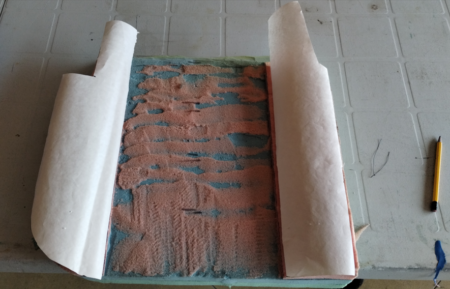
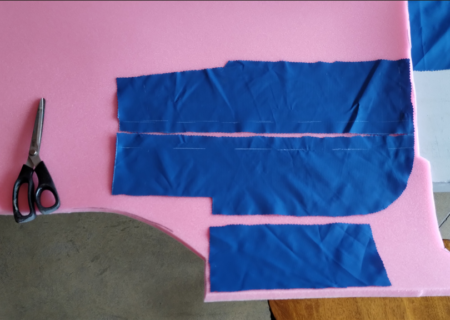
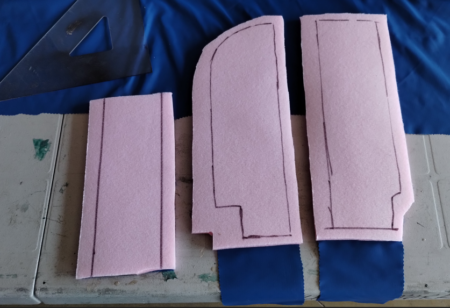
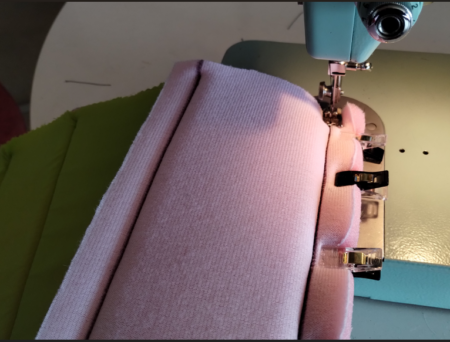
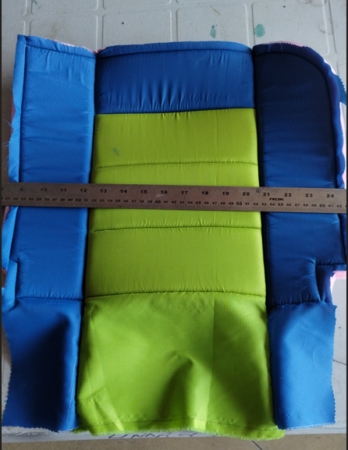
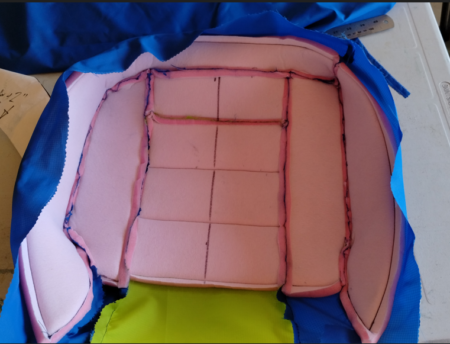
I made templates out of paper and cardboard for the various components of the seat cushions that were then used to cut out the fabric, backing foam, and to lay out the sewing lines. After a LOT of trial an error (mostly error), I added 3/4” on all sides to my fabric and backing foam patterns and just snipped off the excess at the end. Once the fabric pieces and backing foam were cut out, I used spray contact cement to apply the fabric to the foam (this is temporary to keep everything in place for initial sewing). I then used the paper template to mark on the back of the foam where I wanted to sew. Again, trial and error taught me to sew with the fabric side down as the feeder foot (or whatever it is called on the sewing machine) worked way better this way.

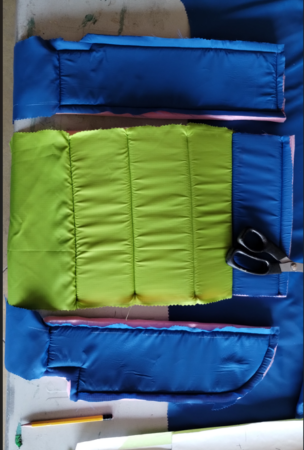
Once you get the various individual parts made you need to put them together. The trick is to overlay the existing sewn seams on the two sides such that when you sew the pieces together the seam disappears. Use LOTS of clamps. I put an extra 2” of material where the fabric would wrap around the back of the seat so there is material to pull on to tighten the fabric then staple. I used 1/4” birch ply with lightening holes as the backing material and stapled the fabric to the ply. The ply is quite light, and since the RipStop weighs almost nothing, the seats are not at all heavy. I will use Velcro to attach the seat components to the actual seat frames.

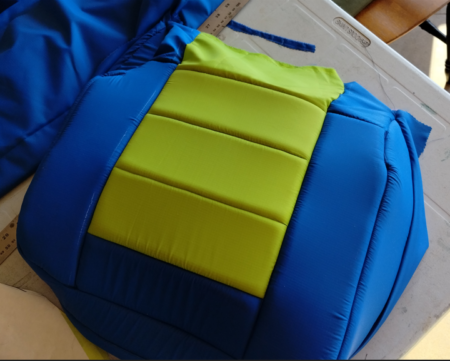
I realize this is hardly a “this is how to do it” article, but I hope it is an encouragement to try it yourself the next time you need seats for your airplane. The most expensive part of the whole thing were the Confor Foam seat bottoms ($200 CAN each!!). The rest was very inexpensive with the RipStop material < $5/running yard. Our own Michel Roy is the one who inspired me to do this with the seats he made for his Bearhawk using RipStop and between looking at his pictures and watching a BUNCH of YouTube videos, I was able to produce these: