Source: 2014 Q2 Beartracks, Jared Yates
On a recent visit to Alaska, I had the good fortune of meeting up with Dan Shilling at Merrill Field in Anchorage. Dan graciously spent a few hours showing me his airplane and talking about how he built it, and how he uses it in Alaska.
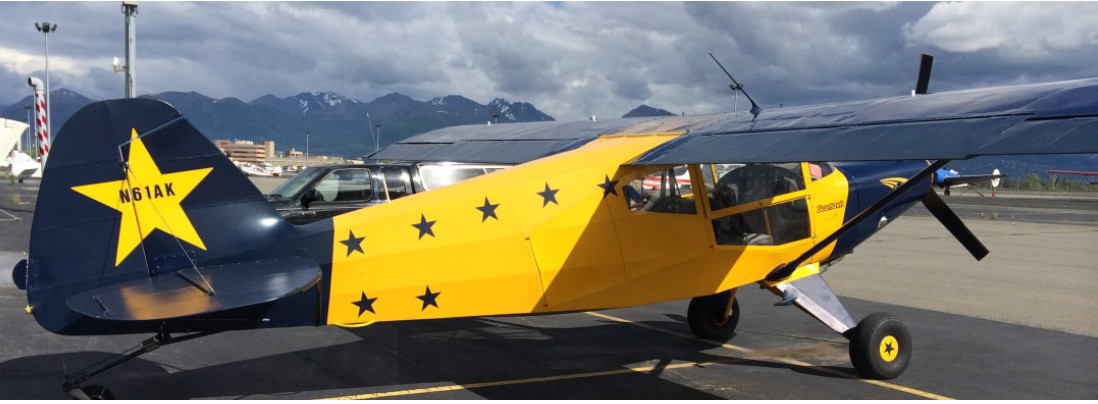
Dan built his Bearhawk from scratch, over 8 years and 3300 hours of build time. As of now it has around 260 hours of flight time spread over 6 years. Dan was born in Alaska and is a minister by trade, and has always been interested in flying. He took his first lessons while living in Colorado early in his career. When he built his Bearhawk, one of his first priorities was minimizing his out of pocket expense. This explains why he was able to have about half as much money invested in his project as I do, but also about twice as much build time. It seems as though the cost and time variables are often interchangeable, a relationship that conveniently allows a builder to chose his priorities and proceed accordingly.
Dan shares a trait that I have found in many Bearhawk builders that I have met: he’s an excellent scrounger and seems to get a thrill from bargain hunting. For example, here is the story of how he got his spinner. “I scrounged the spinner for free off of a wrecked Maule. The spinner is the only thing that remains from that Maule. It had wrecked on a beach landing, and it was being sling lifted out of the area by helicopter. It was a pretty heavy load for the helicopter being used, and a bad gust of wind got hold of the plane and was about to cause a second crash when the helo pilot punched it loose into the ocean. I don’t know why the spinner had been removed since it was also damaged, but it now is a modified BH spinner. I hammered and hammered on that bent up thing to straighten it out.” Anyone can call up Aircraft Spruce and order a spinner, but how many folks can tell a story like that?
From the firewall back, Dan’s Bearhawk is much like the others that I have seen. He used the Polyfiber covering process with Polytone on the fabric and Aerothane on the rest. In Alaska, hangar space is practically unobtainable, so his airplane sits outside all year. I couldn’t help but note the unfortunate irony that the majority of airplanes in Alaska are not hangared, even though the weather and exposure there are about as bad as they could be anywhere. He installs wing covers in the winter, though they are a little bit tricky to get over the vortex generators. The condition of his finish speaks to the durability of the Polyfiber system; while it is not perfect, I thought Dan’s was one of the better looking birds on the ramp.
Notable deviations from plans include straight-bottom front doors (no mouse doors) and a skylight. The front doors don’t open quite as wide as those with a mouse door, but as he points out, they open plenty wide enough for him to get in and out of the airplane. Dan also incorporated a lever-actuated elevator trim system that is similar to the Patrol, though the lever points forward instead of to the side. By choosing this arrangement, he was able to eliminate the hump in the center of the fuselage and use a single, flat piece of plastic for the skylight. He added a hoop of metal to the top of the flap handle that makes it much easier to reach when the flaps are fully retracted. Dan’s tailwheel assembly and spring are right off of a Cessna 180, or as Dan said, “Right off of that Cessna 180 parked right there.” Don’t be concerned, the owner of the 180 was involved in that decision. After all, Dan is a minister, remember? 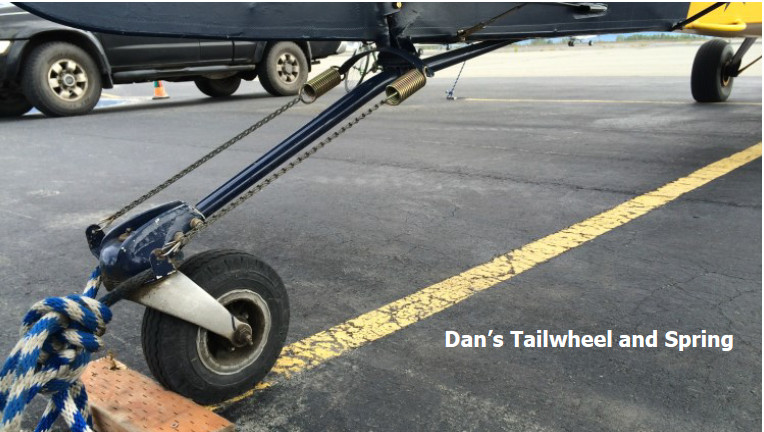
On the 180 the bolts that clamp the tailwheel to the stinger had worked loose and enlarged the holes (see the safety update in this issue for a similar concern on the Bearhawk). Dan drilled the holes to the next bolt size up and the setup works great, though he’d like to consider upgrading to a wider tire for soft ground operations. The smaller tire tends to plow in those conditions, and while a wider tire is available, it also requires a wider fork, which is an expensive upgrade.
On the day of our visit, Dan did not have the back seat installed. Since he usually flies solo or with one other passenger, he prefers to not carry around the extra weight of the seat. He keeps a survival kit and minimal camping gear in the back, and has had to stop for an impromptu overnight on at least one occasion. Dan uses his Bearhawk mostly for local flights around his part of Alaska, though he also uses it to visit is parents in a fairly remote area near Fairbanks. A trip that would require 10 hours of rough driving only takes a little more than two hours in his Bearhawk.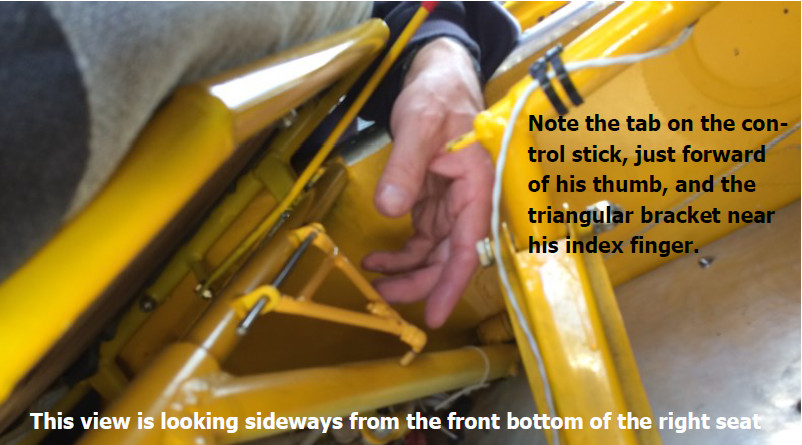
I was also impressed with Dan’s creative flight control lock. Control locks are certainly not something to take lightly– they should be designed well to mitigate the possibility of trying to fly with them installed. But for an airplane that sits outside all the time, they are a necessity. He uses large diameter (12 inches or so) externally-mounted padded disks to lock the flaps and rudder in place, but for the elevator and ailerons he devised a lock that clamps the control stick to the long carry-through tube that goes under the front seats. He said that if he were to do it again, he would change the design from its current pivoting arrangement. As it is now, he must remove the pivot pin for flight, since he’s concerned about interference in the full-aft stick position. He also realizes the very remote possibility that inflight turbulence could allow the lock to swing up into place and engage. His improved design would be to incorporate the same type of fitting on the rear two corners of the triangle that he used on the front of this one.
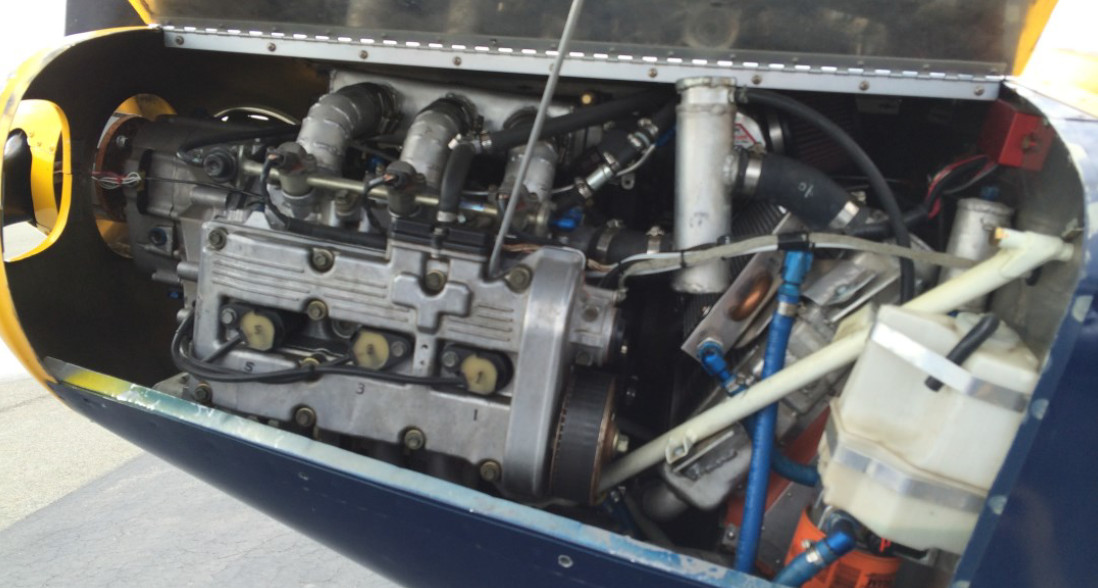 So what about the engine? Auto engine conversions are a polarizing topic in the homebuilding community. They often present an initially appealing price that can easily be overshadowed by a much longer build time and complicated research and development phase. Engines are the sort of thing that are designed for a specific use, and the designers of car engines certainly don’t have small airplanes in mind as they make design choices that balance power, weight, longevity, maintainability, fuel economy, and ease of mass production. It is not uncommon to hear about a builder who has started with an auto conversion and eventually replaced it with a Lycoming or Continental.
Someone must not have told Dan all of that, because his engine looks like it was supposed to be there, and it has been working great for the last 260 hours. When I asked him why he chose the Subaru over the Lycoming, he said that he was interested in minimizing cost, and that he was interested in the challenge of doing something different. He started with a junkyard engine, though he eventually replaced the junkyard engine with a newly-rebuilt engine of the same type. The cost of the rebuilt engine was on the order of $3500. It sits “backwards” compared to how it would sit in the car, with the belt-driven accessories on the back end. The new front end is connected to a New-Zealand made Autoflight PSRU that gears the prop down to about half of the engine RPM. The intake is on the top end, and he made a custom aluminum manifold that saved considerable weight and bulk over the original. The car exhaust manifolds were cast iron, so he removed those and fabricated a pair of muffled 3-into-1 pipes out of mild steel. The radiator sits parallel to the white engine mount tube in the right side of the picture, and he had it custom-made for this application. An oil cooler sits just in front of the radiator, with the small blue lines connected to it. The prop is a 3-blade 80-inch Ivo that has electrically-adjustable pitch. I looked at the prop hub and raised an eyebrow when he told me this, since the blades are clamped rigidly to the hub. It turns out that instead of rotating a rigid blade assembly like the Hartzell does, the Ivo contains a spanwise rod that warps the prop blade to change the pitch.

Dan doesn’t have any way to know exactly how much horsepower he is getting out of the Subaru. He knows that his static thrust is around the same as a Lycoming O360 Bearhawk, but that’s at full throttle and around 4400 of the 5400 static RPM that the engine could safely produce. This is an issue that he’s still tinkering with, and his next step will be to try trimming the prop blades to lighten the load on the engine and allow it to turn up to a higher RPM. Static thrust only tells part of the story anyway, so short of comparing climb rates, cruise speeds, and takeoff rolls, it’s hard to say exactly how the Subaru is performing. It is getting the airplane around Alaska just fine, which is certainly worth something. From my discussion with Dan, it sounds like his flight performance is on par with what I see in my 360-powered Bearhawk, though he notes that his firewall-forward weight is probably more comparable to a 540.
From the pilot’s perspective, operating the Subaru is a little bit different. For example, when Dan checks his oil level before each flight, he also checks his coolant level. In the cockpit, there is only one lever, which controls the throttle. The prop control is a three position switch just under the VSI. The left bank of switches includes an electrical master and two electric fuel pumps. This is certainly an electrically-dependent airplane, and Dan has designed the electrical architecture accordingly. He has two PC680 batteries under the front pilot seats. If his alternator quits working, he immediately gets active notification in the cockpit by means of a loud buzzer and flashing light. At that point he has around 45 minutes to find a place to land. The two electric fuel pumps deliver about 60 PSI for the injection system, which is controlled electronically by a system used in other aviation and racing applications. That system also controls ignition and ignition timing. The panel includes an extra gauge or two, such as coolant temperature and fuel mixture. The rheostat to the right of the prop switch is a mixture control that provides sort of a “trim” function to the computer.
Just to the right of the rheostat you can see the horizontal LED bar that shows the mixture condition. We prepared the airplane to fly, and I was impressed with Dan’s passenger briefing. He pointed out the location of his survival gear, a reminder of his prudent preparation for the remote areas that he flies over. So by now you must be thinking, how does it fly? I can’t tell you that, because we didn’t have a chance to fly it. Dan did start it up on the ground and ran it for a few minutes. It started readily, and ran very smoothly. The coolant flow is thermostatically controlled, so it comes up to temperature quickly.
Throttle response was very fast with the lightweight prop. We didn’t get to fly because the winds were very gusty and variable. Dan seemed very motivated to take me for a ride, but I was impressed to see that in spite of that motivation, he decided to stay on the ground when he realized how strong the winds were on the ATIS broadcast. I strive to live by the old adage “the superior pilot uses his superior judgment to avoid situations that demonstrate his superior skill.” In this regard Dan is certainly a superior pilot, and I suppose that one doesn’t fly for very long in a place like Alaska without having good judgment and respect for environmental conditions beyond his control.
I asked Dan about the reliability of his engine, since that has been one of the talking points in the argument against auto conversions. He recalled two situations where he had to land prematurely, but in both cases he was able to get the airplane safely on the ground at an airport. In one case he had a coolant line break soon after takeoff. His more-experienced pilot friend Mark (owner of the aforementioned Cessna 180) was at the controls during the early test hours and as the line broke he could smell the leaking coolant. He stayed in the traffic pattern and landed without incident. After finding the broken radiator hose, Dan recalled that he had probably scored the hose during fabrication. The second premature landing was a case of bad fuel. This manifested itself as a partial loss of power and a rough running engine, but Dan still had enough engine power to make it back to land. Honestly it seems to me like these sorts of problems can just as readily happen to any airplane, and I don’t think it would be fair to say that Dan’s powerplant has been any less reliable than a Lycoming or Continental.
In closing I would say that Dan has an excellent machine that fits his mission. While the auto engine added a year to his build, it also yielded a firewall-forward cost around $9,000, not counting the subsequent replacement engine. His airplane shows the flexibility of the Bearhawk, and how it allows builders to prioritize cost and effort to find just the right balance for each individual case. Auto engines are certainly not for everyone, but neither is scratch building! If you find yourself in Alaska, I’d suggest contacting Dan to try to get together for a visit. He’s an interesting fellow and loves to talk about the airplane that he has every reason to be proud of.
LSA Builder Update from Rolly Clark
Source: 2014 Q1 Beartracks, Rolly Clark
Mr. Barrows flew down to 52A back in October to make up an engine mount for production at AviPro’s factory. He would be using my fuselage as a jig. I was very eager to see Barrows in person and look his LSA prototype over. I could hear him coming for about 3 minutes before I could see him. I was curious as to what he would bring with him. He brought an O-200 case, three sticks of 4130 tubing about 30 inches long (guessing), four steel disks about an inch in diameter, and some aluminum disks to simulate the Lord mounts. He also brought an electric grinder and a hack saw! I had tried to set my fuselage up according to the LSA Book, with everything plumbed and square and the string that represents the thrust line pulled from the tail to the spot where the engine case would set. After greeting, he went to work setting up my fuselage for the job. He said, “you’ve the right idea but we need to change a few things.”
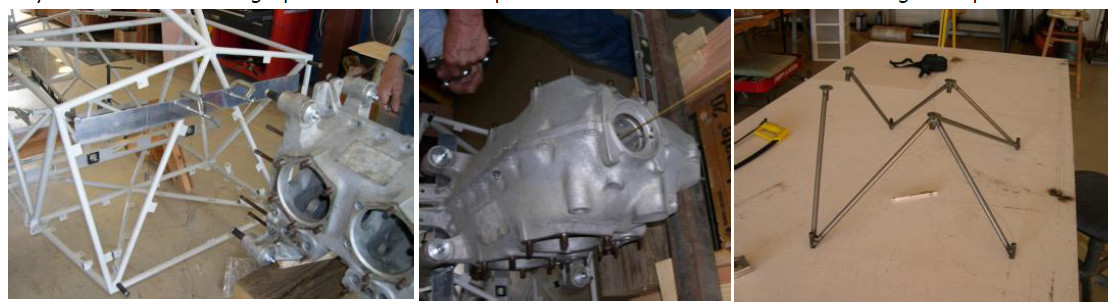
He then took measurements from plumb bobs (he let me help) and made marks on the floor of my hangar, and generally got things organized. He admired the C-170 that was also in my hangar and told me how he used to fly one picking up and delivering engines to customers. After an uncomfortable experience with it, he decided he need an airplane that was better suited to his purpose. I took that to mean it had more power and room and easier to load and un-load. The result of course was the 4-place Bearhawk.
It was interesting to watch him work – not much wasted motion. He said a fellow named William Wynne would be driving up from Florida to help and this fellow was a Corvair aero engine expert. Well, that really got my interest up as there is a very active EAA group in Carrolton, Georgia, where they have built a bunch of Peitenpols and put Corvair engines in them. I had flown over there about a year ago. I watched them fly and looked them over carefully. That Corvair engine is very impressive and it does a good job in the Piets! Incidentally, these Pietenpols were modified a little and were called “Big Petes”. The main change was to make the small cockpits big enough for the big Georgia boys to fit. About the time Mr. Barrows got everything all set and ready, Mr. Wynne drove up pulling a covered trailer that housed his Air Corvair equipment.

After greeting all around, he pulled out a ramp and unloaded what he needed. It consisted of his MIG welding rig (gasp!) and his Corvair case, and his Corvair complete engine. Six cylinders and 110 HP!
What a beauty! Those gentlemen worked that afternoon and the next day and had two prototype engine mounts for production purposes to show for their work. I tried to stay out of the way while watching what they were doing. I would also go out to the LSA, which was tied down on the ramp, and look at what I thought I might find interesting. When all the welding, etc., was finished, Mr. Barrows offered me a ride. I am a very experienced pilot and it does not take me long to evaluate an airplane. It is a good flying airplane with good control harmony.
Control response is just right all the way down to the bottom of the envelope. It slips well, which is good if you are high on final. Mr. Barrows airplane is very basic with only the minimum required instruments – no electrics, no nothing. When I was getting in the plane, he handed me some earplugs! They were needed! The airplane is loud. There are no mufflers and exhaust pipes are right under your feet.
I plan on mufflers, and an electrical system on my plane. I am next to the ATL Class B and feel the need. Mr. Wynne went next and I watched the take-off. Not much runway needed! Rapid climb. Looked good. When they got back, I helped them load their equipment. Mr. Barrows asked me to give him a prop, which I did and then off he went back to Virginia. Mr. Wynne and I visited some more while he was finishing preparing to leave. He gave me some interesting advice about electrical needs on my airplane.
I hope to get this airplane done and in the air in the next several years, but in the meantime I look forward to the learning experience of building this unique airplane.
LSA Builder Update from Fletcher Burns
Source: 2013 Q1 Beartracks, Fletcher Burns
 I’ve never been one of the fast, high powered types. I like a simple airplane without all the bells and whistles. 95% of my flying ends up at the same airport I took off from. When I was a kid I read everything I could find about aviation pioneers, the Wright Brothers, Lindberg, etc. Back then it was all out of the library, no internet. In High School I started learning about homebuilts and the EAA. After High School I got a job and took flying lessons. At that time I bought plans to the KR-2 and the Sonerai 2. I realized I didn’t have the knowledge to undertake either of them because I read numbers like 2024-T3 and 4130N, and had no idea what they meant.
So I got my Private Pilot certificate and soon after joined the Air Force. I picked aircraft sheet metal as a career. I served in that field for almost 22 years, got my A&P certificate and a 2 year degree in aircraft metals technology while on active duty. I enjoyed learning how airplanes were built and have always been happy with my career choice. My first assignment was to Germany working on F-4 Phantoms. So I basically had 3 years to study the plans I had and settled on building the Sonerai. I built it in just over a year when I got back to the states and flew it for 15 years. I also built a Teenie Two, rebuilt a Pietenpol, a Cessna 150, and built several ultralights. So as I said, I’ve always preferred the low-powered end of aviation.
In the past few years I have entertained the idea of building a Zenith 701, and actually bought a bunch of aluminum for it, but never started it. I began work on a Wagabond, but lost interest in it. I also considered the Buttercup, but it seemed a little too complicated to fly both fast and slow. I was already familiar with Ribblet airfoils, so I built a second set of wing for my Sonerai that used a 15% thick Ribblet airfoil and I loved the difference. I couple of months ago I read about the Bearhawk LSA and I knew this was it. I liked the aluminum wings (I already had the aluminum), Ribblet airfoil, steel tube fuselage and decent performance on low horse power. I have a 90 hp Franklin to power it with. My Pietenpol had a 90 hp Franklin and it was the smoothest engine I’ve ever flown behind (or in front of). I also have all sorts of aircraft parts I’ve picked up over the years, so I should be able to do this fairly inexpensively. I’m 55 now, so I think I’ll just stick to Sport Pilot flying, and the LSA is perfect for this. The Wagabond could have done it, but the Bearhawk has a much more modern appeal to me. Don’t get me wrong, I love the old classics, I just think the LSA looks like an airplane should. Everyone has their own taste, and this one fits mine. It reminds me of a Citabria in a way. My taildragger checkout was in a Citabria, and I remember thinking it flew like a truck, I’m hoping the stick forces are lighter in the Bearhawk LSA. 
I ordered the plans about of month after I read about it in Kitplanes, joined the Yahoo user group and began building a few weeks ago. I like the plans, they are way better than what I managed to build a Sonerai, or Teenie Two from. The LSA plans are working out well. I have the right main spar completed and I’m working on the left. I have all the parts formed for the rear spars and once they are done I will start making ribs. I’ve made one rib to get my spar heights where I want them. And that’s another thing I like about Bob’s plans. There’s enough info there to build from without overwhelming you with critical dimensions and tolerances. It’s not as if I’m mass producing this airplane so that my parts will bolt on perfectly with someone else’s. It’s a one of a kind creation of my own made the way Bob drew it. I started by just making each part by the plans, then putting them together, everything has fit well. I have no idea how long it will take me to finish this project but it doesn’t matter, I’m enjoying it.
Swapping the O-470 for IO-390
Source: 2013 Q1 Beartracks, Merv Hargraves
After having some trouble with the old Continental O-470 APU engine, I decided to bite the bullet and replace it with a new Lycoming IO-390 and Constant speed Hartzell propeller. Continue reading
Ernie Green Flying Update
Source: 2009 Q2 Beartracks, Ernie Green – N844EE
Ernie Green bought his Bearhawk plans in 1995 after reading about it. He pretty much sat on the plans and didn’t begin work until 1998. What finally prompted Ernie to get going was a call he received from Michael Harris, a fellow Florida resident who heard that Ernie was building a Bearhawk also. Michael contacted Ernie and came to see him. They made an agreement. If Michael made the commitment to show up and help Ernie work, together they would build the two Bearhawks. Ernie promised to weld up the frame of Michael’s plane in return.
Ernie has been a professional welder for over 20 years. His last years welding professionally were for the US Navy on aircraft carriers. Ernie is certified to weld titanium, magnesium, stainless, and all the other exotic metals that most welders never see.
Progress was slow but steady until Ernie retired in 2006. Then Ernie has been at it hot and heavy to get his BH finished. Ernie and his building partner Michael bought a Cessna 310 for the exorbitant price of $15,000. It was complete with engines and props but no radios. The engines (Continental 470’s) had 168 hours and 224 hours since chrome major overhauls. Ernie’s Hartzell 82” prop cost him $500 to comply with all AD’s by a certified prop shop in Florida. Then they sold the C310 airframe for $8000 on Ebay. Quite a nice deal for the Bearhawk builders.
When asked how many hours he has worked on this scratch built project, Ernie answers “a bunch”. The ‘N’ number Ernie has, N844EE, signifies Ernie’s birth date of August(8) 1944. The EE is for Ernie’s first and middle names. He hopes to fly before his birthday this August. Ernie fought a little with the Stewart covering system due to the extreme temperatures and humidity in Florida. But the results are beautiful and unique as you can see in the pictures. Ernie gives special thanks to Warren Simpson, a neighbor and experienced builder who has been a tremendous help.
Dan Shilling Builder Update
Source: 2008 Q4 Beartracks, Dan Shilling
 I am getting pretty close to the final inspection and first flight of my Bearhawk with 3.3 Boxer Subaru. It has a 1.97:1 Autoflight gear box & three blade Ivo Magnum Paddle Prop. I think I am within 6 months of flying if all goes well, and maybe less. I will keep you posted. I started work on plans #460 in October 2001. To date, I have almost 3,000 hours invested. I nicknamed my Bearhawk “Ursa” because of the Alaska flag “Big Dipper” paint scheme I designed. A few detours from the plans include a Cessna 180 tail wheel and stinger, Patrol style trim lever, skylight, cargo tube and rifle rack.
From the very beginning, I had planned to use an automotive power plant, considering rotary power first, but finally settling on a normally aspirated Subaru EG33, H-6, 230 HP from their SVX model car. Coming up with a motor mount design that would fit under the Bearhawk cowling was one of the biggest challenges, but with input from friends and the Bob, I finally got it sorted out. Figuring out an adequate cooling system is usually the hardest obstacle in any auto conversion.  I have a custom aluminum radiator that fits just in front of the firewall. A plenum isolates the air discharge from the front of the radiator, thus forcing all the air entering the cowling to flow through the radiator before exiting the bottom of the cowl. Time will tell if this design is sufficient.
My PSRU comes from Autoflight, in New Zealand, with a 1.9:1 reduction ratio. I am using an Ivoprop Magnum Paddle in-flight adjustable propeller, as well as a Simple Digital Systems ignition, both of which are proven in Ken Wardstrom’s Roverhawk. I hope to be flying by Spring 2009. The only things left on the “to do” list are some electrical changes and painting firewall forward. When I began this project seven years ago, I did not have the funds to complete it, or know where they might come from. Living in airplane Mecca and scrounging everything I could, having great friends and helpers, a supporting wife and above all, the Lord’s providence and generosity, I am at the cusp of completion. I haven’t added up all the receipts yet, but I think the total cost will be around $30,000.
Dan Shilling – Anchorage, AK
Bearhawk Hot Spot
Source: 2008 Q1 Beartracks, Mike Creek
 February 2008 marks the 4th Bearhawk quick build kit order from Elko Nevada. What makes this so unusual is that Elko is a relatively small rural town. When combined with the population of Spring Creek, a nearby bedroom community, the total population reported in the 2000 census is 30,000. According to Mark Goldberg, this is probably the highest concentration of Bearhawk kits outside of the Phoenix area. Alan Wilson purchased the first kit in late 2004. The Bearhawk is Alan’s third project. The first was a VMax and the second an Airbike, both built from scratch. The Airbike was powered with a turbo charged direct drive Subaru engine. While both planes were fun to fly and were good for low and slow, they just didn’t make for good cross country flying. With Alan’s prior experience with an auto conversion, he decided to tackle one in the Bearhawk.

Elko Builders (from left) – Alan, Jim, Mike, and Kevin
Alan’s BH will be powered with a modified Range Rover engine producing over 275 horse power, a 1.7:1 reduction ratio Eagle Precision Machine (formerly Northwest Aero) belt drive and an Ivo in-flight adjustable propeller. It will also have a full-span skylight, 8.50 tires mounted on Matco triple-puck brakes, and be equipped for day/night VFR with dual Dynon EFIS displays. Installing an auto engine is the road less traveled, adding time and complexity to the building process. In addition, life throws us curves; Alan’s building progress was delayed about 2 years, during which time he sold his home, built a shop, and moved. Alan likes to joke that he is careful not to get AIDS – Airplane Induced Divorce. Alan is back to building and expects to have his plane flying late this year or in early 2009. He recently completed the right wing and is thankful for Mark Goldberg’s tip to use a flat bar to rivet the wing trailing edge, which keeps the sheets perfectly straight.

Alan’s Fuselage – Awaiting FWF

Range Rover – Pending Engine Mount

Mike’s Plane
Only a few deviations from plans were made; the interior will use removable panels instead of Poly-Fiber fabric, the brakes are dual-puck Cleveland’s with 8.50 sized tires, throttle/mixture/prop controls are lowered, landing/position/strobe lights were added, and a muffled Vetterman system was added. The wings were just closed up and Mike is optimistic his plane will fly by late this summer as the only major portions left to complete are painting the wings and cowling, windshield installation, and the hundreds of little details needed to give it a finished look. He is very appreciative of and has taken advantage of assistance offered by local EAA members in particular Alan Wilson and Roger Knight. Roger is a retired Navy jet mechanic who has built two planes; a Taylor Monoplane and BD-4. Mike is also fortunate to have a supportive spouse and 3 kids who jump in and help out regular basis. Mike built the majority of the kit in an attached two car garage. He believes having the plane close at hand and doing something on it every day are important factors in completing the project.
Jim Allen ordered his kit in January and is busy finishing the interior of his shop to accommodate his plane. He owns an ultra light and decided he wanted something to use for traveling. Jim was originally considering a Velocity. In talking with his neighbor, EAA member Hal Stockman, Hal told Jim about Alan’s and Mike’s Bearhawks and suggested he look into that instead because of the utility it offers and the ability to use unimproved strips common to the region. He is fortunate to have a work schedule that will allow a lot of time to work on the project. Jim recognized the value of having two other builders in the area to help. This will be Jim’s first airplane project.
Kevin and Cathy Cox ordered their kit in February. Kevin was thinking about building an RV, but after looking at Mike’s Bearhawk decided the extra cabin space, useful load, and unimproved field capability offered by the Bearhawk was what they needed to commute to their cabin in Idaho. They also recognized the value of having two examples previously completed and the advantage of having that expertise available. Not to mention a great source for borrowing tools. Jim and Kevin teamed up to save on shipping costs and both of their kits will arrive in April on the same trailer.
For those considering building or for those who just want to see what others builders are doing, Elko might just be worth a visit for the next few years, even though it is a little out of the way. For those of you within striking distance, Elko may host a fly-in Saturday September 20th, 2008. It has not been confirmed yet, but you might want to mark your calendars.
Corvette LS1 Engine Updates from Ed Schweitzer, Late 2006
Source: 2006 Q4 Beartracks, Ed Schweitzer

Hello:
READER BEWARE. THIS GOT TOO LONG AND DULL. The transmission weighs 64 pounds complete for bolting on to an engine. I designed it so it can be used on any engine. The engine is a Corvette LS1. Aluminum block and heads. Its weight is 370 pounds. The prop will be in the same position as the prop of a Lyc O540. It has 350 hp at 5600 rpm. It has 350# of torque at 4200 rpm. (approx numbers).
The transmission swings the prop at 2700 when it is in low and the engine is running at 5600. The prop also turns at 2700 when the transmission is in high and the engine is at 4200 rpm. The concept I followed was to load the engine with the pitch to avoid over revving in high gear. The concept worked as predicted on my Q-200 and a Subaru engine before I learned that the fuselage was destroyed by invading gas. I did several taxi tests WITH A FIXED PITCH PROP.
The concept I followed is to allow an auto engine to work like it is intended and to avoid any modification. Auto engines have advanced so much while the A/C engine has the basic 1940’s design with a few “changes of an unsubstantial nature”. This must be so to avoid developing a new engine and keeping the old Certificates from FAA. If I am wrong about this correct me. They still use nitrite Hardening and magnetos as well as updraft carbs. I cannot see any difference between my fathers 1935 Case tractor carb and the carb on my previous O-200 Continential. I took both apart and reassembled them. The Marbel Schebler trade make label is even the same.
The reason I choose to use an auto engine without any mods is my belief that the auto makers want the greatest reliability in there engines. Too many dead cars on the shoulder will cause a question in the minds of new car buyers. The aircraft engine has some of the same features of a diesel, like low rpm for peak torque. This is necessary when swinging a direct drive big prop and not having mach tip excesses. With the 84 inch prop my Bearhawk prop will be at mach .94 when the plane is traveling at 170 mph and 2700 rpm. RED LINE rpms. I have worked on this transmission for 15 years , the last 4 years full time. Now I must finish the Bearhawk and test it in flight. I have a lot riding on this. I invite luck and constructive remarks. You are the unfortunate ones to see the first public pictures.
Ed Schweitzer

A Fresh Engine from Bob, Delivering an Engine with the Bearhawk
Source: 2006 Beartracks, Tim Weaver
 On Saturday, July 12, Bob Barrows flew his prototype Bearhawk to a fly-in at Smoketown, Pa. On this day I experienced one more ‘little’ confirmation that the Lord of all creation was working with me to complete this great project of building the amazing Bearhawk. The day was beautiful in Pennsylvania, however, a large low pressure system hung over the South. When I talked with Bob on Friday, he was just signing the log book to the 0-360 I ordered and was hoping to bring it to the fly-in. By 10 o’clock AM Saturday the weather lifted over southern Virginia and Bob took off from the home field.
He arrived at Smoketown to be greeted by many onlookers and a very excited Bearhawk builder. And Bob, it was great to know that you enjoyed the day as well.

Bearhawk #466 was a dream of mine, to build a utility airplane and to embark on a building project that would require a lot of learning and refreshing of my skills. Today, I am happy to report that I have completed the major airframe components and have primed them.
As you can see from the pictures, an airplane is about to be born – just as my first grandchild is being born! Yes, I am now a grandpa and I am thrilled. My daughter and her husband live just a few hours from Bob Barrows home and we live in Pa. I am a very happy camper! My wife is encouraging me to hurry and finish the Bearhawk so we have air transportation to see our granddaughter!

Continental O-470 Engine Mounts
Source: 2005 Q2 Beartracks, Mark Goldberg
In early March, Justin Brown and I went to Monterrey Mexico to observe the trial fit of the Continental O-470 engine mount designed for the Bearhawk Quick Build kit. Continue reading