Bob’s Method for Installing the Windshield

Source: 1998 Beartracks, Bob Barrows

The windshield is fitted in place after the boot cowl is made and installed.


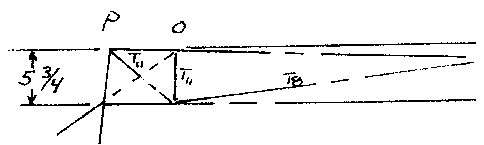
The windshield is held in place at the top by sliding into the windshield mounting (section T-T dwg. 16), by tabs which are welded to vertical T14 tubes at section B-P, and by a fairing and backup strip at the intersection of the windshield and the boot cowling.


NOTE: Do not remove the protective film from the windshield. Cut the windshield to fit the boot cowl using a 1/32″ thick 3″ diameter high speed cut off wheel mounted on an air die grinder. Do not attempt to cut the windshield to fit all at once. You should take off no more than 1/2″ inch at each pass.

After the proper fit is obtained hand sand smooth all edges of the windshield.

Windshield Fairing

The Fiberglass fairing is made up of about 8-10 layers of 4″ fiberglass tape, then trimmed to size and sanded smooth.

To make the fiberglass fairing at the bottom of the windshield, tape the windshield in its proper location and cover it and the boot cowl with black electrical tape. Cover the bottom 4″ of the windshield and the front 4″ of the boot cowl where it intersects the windshield. Add a good coat of wax to the taped area and lay up the cloth.

Some of you may be able to make this fairing out of 5052 aluminum. I hope that someone does.

As shown in the photo the fairing goes from the T14 tube around the front of the windshield and back to the T14 tube on the other side of the fuselage.


The back up strip of .032 5052 H32 aluminum is first bent about 110° on a brake, then stretched and shrunk as needed to match up with the windshield and boot cowl. Both the back up strip and the fairing are attached to the boot cowl using #6 screws about 3″ apart with nut plates on the boot cowl.

Bob’s Method for Boot Cowl Fabrication

You are not yet authorized to view this page. Learn more here.

1998 Wing Strut Material Update

Source: 1998 Beartracks, Bob Barrows

As mentioned in past issues of the newsletter, we have been involved in obtaining new strut material for use on your BEARHAWK project. This endeavor was initiated due to many builders request.

We have designed and purchased an extrusion die so as to produce the strut shown.

The struts are made from aluminum alloy 6061-T6 and heat treated per. spec. Our supplier has provided us with chemical and mechanical certifications for each lot ordered.

We have also designed new aluminum strut end fittings that can be bolted to the strut material. We can supply this NEW strut material and the drawings for the end fittings for shipment inside and outside the U.S.A. Contact R&B Aircraft for details.

You are not yet authorized to view this page. Learn more here.

1998 Inboard Flap Lever Engineering Notice (280 and below)

Source: 1998 Beartracks, Bob Barrows

Reference drawings #12 and #14 for plans serial numbers 280 or below.

Inboard Flap Lever

The inboard flap lever arm was shortened from 4-1/8" to 4" for clearance with the aileron cable. If you have completed this assembly you may remove up to 1/16" from the tip of the flap lever arm for clearance.

You are not yet authorized to view this page. Learn more here.

1998 Firewall Positioning Engineering Notice (326 and below)

Refer to Drawing # 18 firewall detail.

During the assembly of the Bearhawk I am now building I found that the 7 1/2" dimension was about 1" too high. This dimension should be reduced to about 6 1/2". See corrected drawing below.

This change is needed to keep a good line from the top of the nosebowl to the top of the instrument panel and increase the tunnel area at the bottom of the firewall for better engine cooling.

Please note the size of the firewall has not been changed, it has just been positioned lower on the airframe.

Also note that depending on the type of engine you use, the shape of your nosebowl and the height you make the instrument panel may affect the vertical location of the firewall.

The minimum clearance of the engine and related components to the cowl is 1/2".

You are not yet authorized to view this page. Learn more here.